Els: MBN360 Asia
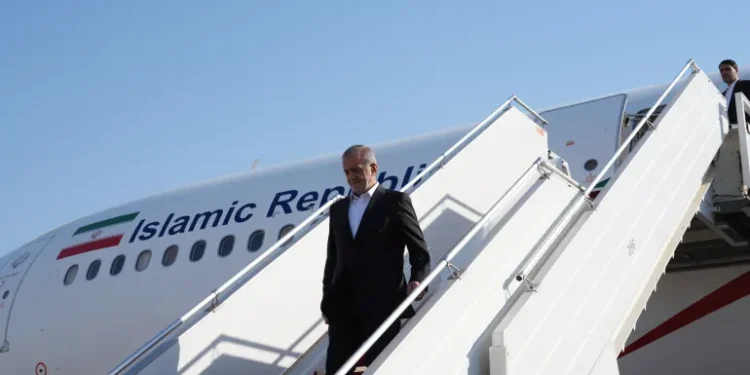
Iranian President Masoud Pezeshkian has visited Pakistan, arriving in Islamabad earlier in the afternoon.
His Pakistani counterpart Asif Ali Zardari, Prime Minister Shehbaz Sharif, and Deputy Prime Minister and Foreign Minister Ishaq Dar received the Iranian leader at a military base near Islamabad.
Pezeshkian was accompanied by a high-level delegation that includes Ministers and senior officials. He arrived aboard a special aircraft named Minab 168, a tribute to the 168 people killed in an attack on an Iranian girls’ school by US and Israeli forces in the Iranian city of Minab on the first day of the war in February.
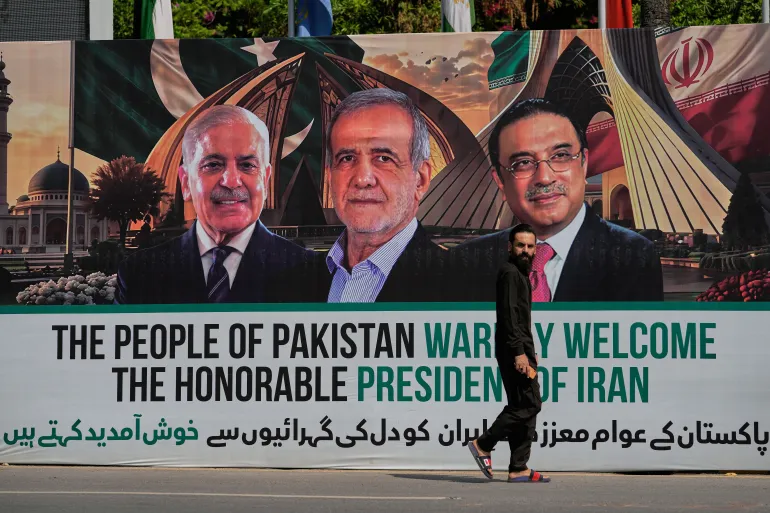
Iranian Foreign Minister Abbas Araghchi, who had arrived separately earlier in the day from Oman, was also part of the delegation.
The visit, Pezeshkian’s first foreign trip since the United States and Israel launched strikes on Iran on February 28, comes a day after Pakistan and Qatar announced that the opening round of US-Iran talks in Burgenstock, Switzerland, had yielded a 60-day roadmap towards a final agreement.
As part of the agreement, the US will release $12bn in frozen Iranian funds. The US has also announced a temporary easing of international sanctions on Iran, allowing it to sell its oil and petrochemicals until August 21.
It is also Pezeshkian’s second visit to Pakistan as President. His first, in August 2025, came days after the 12-day Iran-Israel war, and was also his first overseas trip following that conflict.
Today’s visit is widely viewed as an expression of gratitude for Pakistan’s role in brokering the Islamabad Memorandum of Understanding, signed on June 18 by US President Donald Trump and Pezeshkian, with Prime Minister Sharif signing the document as a mediator.
Pezeshkian met the Pakistani leadership, military chiefs and thanked Pakistan for its role in de-escalation and in trying to find a peaceful settlement.
According to a statement from the military’s media wing, ISPR, during his meeting with Pakistani Army Chief and Chief of Defence Forces Field Marshal Asim Munir, Pezeshkian praised Pakistan’s role in promoting dialogue and de-escalation, acknowledging Islamabad’s efforts to encourage a peaceful resolution “at a time of heightened geopolitical challenges.”
Read also:
- Fair Trial Must Prevail in Wontumi Case — Atta Akyea
- Herald editor Larry Dogbey granted bail after contempt conviction
- KNUST, Promotes Mineral Waste for Sustainable National Economic Development
- Gov’t rules out major public sector salary renegotiations in 2026.
- Ghana Economy to Experience positive impact Under New Oil Initiative
According to a statement from the presidency in Islamabad, Pezeshkian and Pakistani President Asif Ali Zardari discussed a range of issues, including regional peace and economic cooperation.
At a joint press conference with Pezeshkian, Pakistan’s Prime Minister Shehbaz Sharif noted that there is no mention of ballistic missiles in the MoU “because it was never on the table.” Sharif warned against what he described as double standards, saying that Tehran should not face restrictions while others are free to possess ballistic missiles.
Also, Sharif praised Iran’s role in securing a ceasefire and the MoU with the US.
“Please convey my warmest regards to His Eminence, the Supreme Leader Ayatollah Mojtaba Khamenei. Thanks to his leadership, Iran has been able to achieve this MoU and, as a result, a ceasefire with dignity and honour.”Shehbaz Sharif
Sharif added that “we would like to continue our role until a lasting peace is achieved.”
Also, the Pakistani Prime Minister warned that efforts are underway to derail the agreement and progress made by the US and Iran. “There are spoilers all over the world who want to scuttle this peace deal,” Sharif said, without mentioning specific countries or parties. He added, “They don’t want the Iranian nation, a great nation, to come out of the ashes of war and touch the zenith of glory.”
Meanwhile, the US and Iran were in dispute today over whether Tehran had agreed to allow U.N. inspectors to view bombed Iranian nuclear sites, as officials mediated talks on a permanent end to their war and violence broke out again in Lebanon.
The differing accounts came as Iran’s President met with Pakistani officials mediating negotiations and while technical teams were working on details following talks in Switzerland between the U.S. and Iran.
Earlier in the day, Iran’s Foreign Ministry spokesperson Esmail Baghaei told reporters in Tehran that UN inspectors were not scheduled to examine the nuclear sites bombed by the U.S. last year, refuting comments made a day before by U.S. Vice President JD Vance.
In response, President Donald Trump posted on social media that Iran had agreed to nuclear inspections long into the future, saying that without this concession “there would be no further negotiations!”