ELS: MBN360 BUSINESS
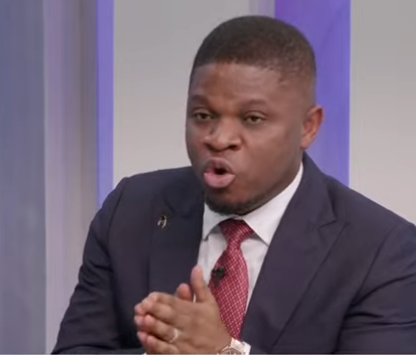
The Chief Executive Officer of the Ghana Gold Board (GoldBod), Sammy Gyamfi, has rejected claims that the International Monetary Fund (IMF) attributed some $1.7 billion losses directly to GoldBod.
Mr Gyamfi said the IMF’s reports clearly identified the Domestic Gold Purchase Programme (DGPP) as the source of the losses, rather than GoldBod, which was established later to take over key activities of the programme.
The CEO said this at the Government Accountability Series on Wednesday, August 19.
He challenged commentators and fact-checkers to examine the relevant IMF documents instead of attributing statements to the Fund that, he said, were not contained in its reports.
Mr Gyamfi said Ghana recorded losses of about $400 million from the sale of gold under the DGPP in 2024, with the figure rising to more than $1.7 billion in 2025 following a significant expansion of the programme.
He said the IMF had specifically linked the 2025 losses to the scaling-up of the programme and had also identified service fees, discounts and foreign-exchange valuation effects as factors behind the losses.
According to Mr Gyamfi, public discussions surrounding the $1.7 billion figure had frequently suggested that the IMF had directly blamed GoldBod for the losses.
He said that interpretation was inaccurate and urged those making the claim to identify the specific passages in the IMF reports that support it.
“I want to read the relevant portions of the IMF report because, most of the time, you hear claims in the media that the IMF has said GoldBod made a loss of $1.7 billion. Yet nobody questions which part of the IMF report actually says that,” he said.
“They say the IMF has stated that GoldBod is responsible for the loss, but nobody asks them to provide the evidence. We are all talking about IMF reports. Fact-checkers must get to work.”
Mr Gyamfi said the first relevant document was the IMF’s recent review under Ghana’s Extended Credit Facility (ECF) programme.
He directed attention to paragraph 15 on page 27 of the report, which discusses the effect of the Domestic Gold Purchase Programme on the financial position of the Bank of Ghana (BoG).
According to Mr Gyamfi, the IMF report states that the Domestic Gold Purchase Programme “weighed on the financial sustainability of the BOG”.
He said the report further stated that the programme, which the central bank had used to accumulate reserves and intermediate funds to the private sector, generated losses of $2.2 billion, equivalent to 1.5 per cent of Ghana’s gross domestic product (GDP), in 2025.
He stressed that the report did not attribute those losses to GoldBod.
The IMF, he noted, also referred to a government cost-sharing arrangement at the end of 2025 involving the transfer of bonds with a par value of $5 billion in March 2026.
That transaction resulted in a breach of the ceiling on the Bank of Ghana’s claims on the central government and public entities at the end of December 2025 and again at the end of March 2026, according to the report.
Mr Gyamfi also pointed to the IMF’s reference to a July 2026 memorandum of understanding between the Bank of Ghana, GoldBod and the government.
The agreement formalised the transfer of Domestic Gold Purchase Programme activities from the central bank to GoldBod, with the stated objective of eliminating the related quasi-fiscal risks for the Bank of Ghana.
He said this was significant because it demonstrated that GoldBod was taking over activities that had previously been undertaken by the central bank.
Mr Gyamfi further highlighted the IMF’s disclosure that an external auditing firm was conducting a special audit of the Domestic Gold Purchase Programme from its inception in 2021.
The findings of that audit are expected to be available in 2026.
He said the audit would provide an independent assessment of the programme’s operations and financial implications from the beginning of the initiative.
The IMF also indicated that losses related to the Domestic Gold Purchase Programme, together with the high cost of open market operations and exchange-rate valuation losses resulting from the appreciation of the cedi, had worsened the Bank of Ghana’s negative equity position to 6.7 per cent of GDP.
Mr Gyamfi said these details were important in understanding the distinction between the programme, the Bank of Ghana and GoldBod.
Read also:
- ‘You can’t improve players on pitches like this’ – Kotoko coach Tinkler
- Show where IMF blamed GoldBod for BoG losses – Sammy Gyamfi challenges Afenyo-Markin
- President Hichilema re-elected for second term in Zambia
- Doctors remove 3.1kg stone from man’s bladder
- Eight years on, Kofi Annan’s legacy of peace and goodness endures
The GoldBod CEO said the second important document was the IMF’s Selected Issues report, published on August 4.
He cited paragraph 13 of the report, which examines the Domestic Gold Purchase Programme and its financial impact on the Bank of Ghana.
According to Mr Gyamfi, the report stated that the programme’s operations generated significant losses for the central bank.
He said the IMF put the losses in 2024 at almost $400 million, equivalent to 0.5 per cent of GDP, with about one-third of that amount linked to gold-for-oil purchases.
The situation worsened considerably in 2025, he said, when the significant scaling-up of the Domestic Gold Purchase Programme resulted in losses of more than $1.7 billion.
“The IMF therefore identifies what led to the loss: the significant scaling-up of the programme. It is stated clearly in the report,” Mr Gyamfi said.
He argued that the wording was important because the IMF had identified the expansion of the programme as the factor that led to the sharp increase in losses, rather than stating that GoldBod itself was responsible for the losses.
Mr Gyamfi also drew attention to the IMF’s explanation of how the losses accumulated.
He said the Fund reported that the losses were almost entirely related to gold purchases and amounted to about 17 per cent of the value of the gold sold by the Bank of Ghana.
According to him, the IMF attributed the losses associated with gold purchases to a combination of service fees and discounts paid in connection with the purchases, as well as exchange-rate losses.
He described the exchange-rate effect as the most significant factor.
The losses, he explained, arose from the difference between the foreign-exchange bureau rates used to purchase the gold and the cedi reference rate used by the Bank of Ghana for accounting purposes.
The IMF also indicated that survey data suggested prices paid for Ghanaian artisanal and small-scale gold were among the highest in the region.
Mr Gyamfi said this was another important aspect of the IMF’s assessment because it demonstrated that the reported losses were not simply a matter of GoldBod selling gold below its purchase price.
Another point highlighted by Mr Gyamfi was the IMF’s qualification that the reported losses partly reflected valuation effects rather than actual economic costs.
He said that distinction should be taken into account when interpreting the headline $1.7 billion figure.
“The IMF also noted that these accounting losses partly reflected valuation effects rather than economic costs,” he said.
Mr Gyamfi argued that presenting the entire amount simply as a loss caused by GoldBod risked giving the public an incomplete picture of the financial mechanics of the programme.
He said the IMF’s own reports made clear that the losses under discussion related to operations of the Domestic Gold Purchase Programme, particularly its substantial expansion in 2025.
Mr Gyamfi ended his presentation with a call for greater scrutiny of claims attributed to international institutions, particularly where such claims are being used to support political or public arguments.
He said the debate should be based on what the IMF actually wrote rather than interpretations presented in the media.
“Ladies and gentlemen, these are the words of the IMF. It is important that we do not attribute statements to the IMF that it has not made,” he said.
“The IMF has not said that GoldBod is responsible for causing the Bank of Ghana to lose $1.7 billion.”
He maintained that the relevant passages from the IMF reports attributed the losses to the scaling-up of the Domestic Gold Purchase Programme, while identifying service fees, discounts and exchange-rate valuation effects among the factors that contributed to the financial losses.