Els: MBN360 Economy
Ghana has emerged as one of Africa’s most closely watched economic recovery stories after recording the sharpest decline in policy rates on the continent in 2025.
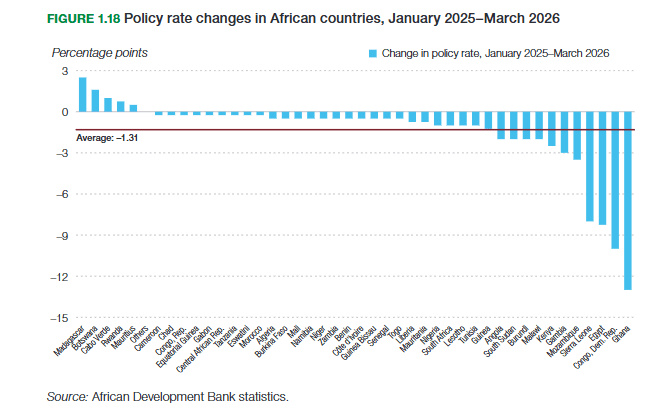
According to the latest African Economic Outlook report by the African Development Bank (AfDB), the country reduced its policy rate more aggressively than any other African nation as inflationary pressures eased and macroeconomic conditions improved.
The achievement comes after a period of intense monetary tightening that saw borrowing costs soar in response to elevated inflation and economic instability. While many African countries cautiously adjusted their monetary policy stance, Ghana moved decisively, cutting rates by a remarkable nine percentage points between December 2024 and December 2025.
The development signals growing confidence in the country’s economic recovery path and highlights the Bank of Ghana’s determination to support growth while maintaining price stability.
A Dramatic Turnaround in Monetary Policy
The numbers reveal a remarkable shift. Ghana’s Monetary Policy Rate stood at 28 percent in early 2025. By May 2026, it had fallen to 14 percent, reflecting one of the most aggressive monetary easing cycles in recent African history.
The AfDB report noted that cooling inflation across the continent encouraged central banks to lower rates. However, Ghana stood out among its peers. Alongside Sierra Leone, Egypt, and the Democratic Republic of Congo, it was among only four countries that reduced policy rates by eight percentage points or more.
This dramatic policy reversal was driven largely by declining inflation, improving fiscal conditions, and growing investor confidence in the economy.
For businesses and consumers who had endured months of high financing costs, the rate reductions were welcomed as a sign that economic conditions were gradually stabilizing.
Ghana Still Among Africa’s Highest Policy Rate Economies
Despite the significant cuts, Ghana remains among the African countries with the highest policy rates.
The AfDB ranked Ghana eighth among 44 African economies with a policy rate of 14 percent. The country shares the position with The Gambia.
Only Zimbabwe, Nigeria, Malawi, Egypt, Angola, Sierra Leone, and Liberia recorded higher policy rates.
The ranking illustrates the difficult balancing act facing policymakers. Although inflation has moderated considerably, authorities remain cautious about removing monetary restrictions too quickly.
The lingering effects of previous inflationary shocks, exchange rate pressures, and global uncertainties continue to influence policy decisions.
Borrowers Still Feeling the Pressure
Perhaps the biggest surprise is that lower policy rates have not yet translated into substantially cheaper borrowing costs across the economy.
Read also:
- Fix Kasoa–Winneba Road or face 20% fare hike from June 29 – Transport operators warn gov’t
- French Football Mourns Young Guingamp Player Kenzo Kies After River Tragedy
- Meet Kevin Akoto and friend being paid $50,000 to watch every single World Cup match
- Drug Peddling In Schools Rising — NACOC Deputy Director
- Teyana Taylor Invited to Join Prestigious Academy Voters Roster
According to the Bank of Ghana’s May 2026 Summary of Economic and Financial Data, the average lending rate remained elevated at 16.33 percent in April 2026.
While this represented a notable improvement from 20.58 percent recorded in January 2026, many businesses continue to face expensive credit conditions.
Commercial banks often take time to pass policy rate reductions fully to customers. In addition, risk assessments, operational costs, and broader economic uncertainties continue to influence lending decisions.
For many small and medium-sized enterprises, access to affordable credit remains a major challenge despite the improving interest rate environment.
Encouraging Signs for Businesses and Investors
There are, however, growing signs that monetary easing is beginning to influence financial conditions.
The Ghana Reference Rate declined sharply from 15.68 percent in January 2026 to 10.06 percent in April 2026. This reduction provides a strong signal that borrowing costs could continue trending downward in the months ahead.
Lower financing costs have the potential to stimulate business expansion, encourage investment, and support job creation. Companies seeking capital for expansion projects may gradually benefit from improved credit conditions as banks adjust to the new policy environment.
Investors are also monitoring developments closely. Continued macroeconomic stability and declining inflation could strengthen confidence in Ghana’s financial markets and improve the country’s attractiveness to both domestic and foreign investors.
Risks Still Loom on the Horizon
Despite the positive momentum, the Bank of Ghana remains cautious.
At its May 2026 meeting, the Monetary Policy Committee decided to maintain the policy rate at 14 percent rather than proceed with further cuts. Officials cited ongoing risks to inflation and economic growth.
Particular attention is being paid to geopolitical tensions, especially developments in the Middle East, which could trigger volatility in global commodity and energy markets. Such shocks could spill over into domestic inflation and complicate Ghana’s disinflation efforts.
The central bank has also introduced a uniform Cash Reserve Ratio of 20 percent, effective June 4, 2026, as part of broader measures aimed at strengthening monetary policy transmission and safeguarding financial stability.
A Landmark Achievement with More Work Ahead
Ghana’s distinction as the African country with the sharpest policy rate reduction underscores the significant progress made in restoring macroeconomic stability. The aggressive easing cycle reflects growing confidence in the country’s economic fundamentals and its ability to sustain declining inflation.
Yet the journey is far from complete. Businesses and households are still waiting for lower policy rates to translate into meaningfully cheaper credit. Until borrowing costs fall more substantially, many sectors of the economy will continue to face financing challenges.
In the intervening time, Ghana’s monetary success story stands as one of the continent’s most notable economic developments, offering hope that sustained stability could unlock stronger growth, increased investment, and broader prosperity in the years ahead.