
ELS; MBN360 UK
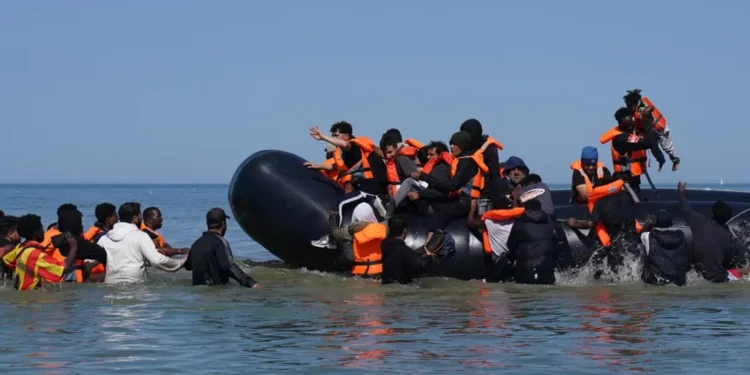
France has strongly rejected Reform UK’s proposal to use Royal Navy vessels to intercept migrant boats crossing the English Channel and return them to French shores, warning that such an approach would violate French sovereignty and breach international law.
The proposal was first presented by Reform UK as part of a larger plan to address irregular migration across the English Channel, claiming that military-backed operations will prevent risky crossings and save lives at sea.
According to the idea, inflatable boats transporting migrants would be intercepted by Royal Navy patrol boats assisted by Royal Marines, Border Force personnel, and police, who would then accompany the passengers back to ports in Belgium or France.
However, political rivals, experts in marine law, and the French government all questioned the proposal’s viability and legitimacy right away.
In a statement issued after Reform announced the policy, France’s Interior Ministry dismissed the proposal in unequivocal terms.
“This would constitute a violation of French sovereignty, as well as a violation of the law of the sea and international law.”France’s Interior Ministry
French officials also argued that existing cooperation between London and Paris was already delivering measurable results, pointing to a decline in Channel crossings compared with the same period last year.
According to the Ministry, bilateral agreements and coordinated operations between both countries have contributed to a reduction in irregular migration across the Channel during 2026.
The sharp response illustrates the diplomatic tensions surrounding migration management, an issue that has repeatedly tested relations between Britain and France in recent years as thousands of migrants have attempted the dangerous journey in small boats.
Despite the criticism, Reform UK leader Nigel Farage defended the proposal, insisting it was compatible with international maritime obligations.
Speaking alongside the party’s home affairs spokesman, Zia Yusuf, Farage stated he was “entirely confident” the plan could be justified under international law, arguing that returning migrants safely to France would fulfil humanitarian obligations while discouraging further crossings.
The party’s proposal envisages ten Royal Navy patrol vessels deploying military-crewed inflatable boats to intercept migrants at sea. Border Force officers and police would board the vessels, arrest those travelling illegally and oversee their transfer back across the Channel.
Reform also proposes using a Bay Class landing ship capable of holding up to 700 people as temporary detention capacity at sea if necessary.
According to Zia Yusug, Reform UK would first seek agreement with France to allow migrants to disembark at French ports.
Read also:
- Eco-Conscious Coordinator Calls for Stronger Oversight of Mining Activities
- 9,000 Miners Registered for Responsible Mining Scheme, Ministry’s Spokesperson Discloses
- Ghana’s Inflation Fight Scores Major Victory As July Inflation Drops to 4.6%
- Inusah Fuseini opposes proposal to extend presidential term.
- Haruna Iddrisu critiques Parliament’s approach to oversight role
However, he added that, “if the Elysee Palace refuses, make no mistake – His Majesty’s Royal Marines will disembark them safely on the very shore they left that morning.”
The issue comes at a politically sensitive time for the new Labour government. More than 2,000 migrants have crossed the Channel since Prime Minister Andy Burnham took office two weeks ago, while official figures recorded 326 arrivals on Saturday alone.
Although the overall number of crossings this year has fallen by around 43% compared with the same period in 2025, irregular migration remains one of the most politically contentious issues facing the government.
Legal Experts Challenge Reform’s Interpretation of Maritime Law
Reform UK’s proposal is based on its interpretation of the United Nations Convention on the Law of the Sea (UNCLOS), which requires states to provide aid to those who are discovered in distress at sea.
The party contends that in addition to fulfilling those humanitarian obligations, capturing migrants and returning them to France will deter criminal smuggling networks from planning risky Channel crossings.
Farage maintained that “securely picking people up and safely taking them back to France” could be justified under international conventions governing maritime rescue operations.
Yusuf acknowledged that implementing the proposal could trigger “a diplomatic argument” with France but argued the French authorities have legal responsibilities to receive migrants who departed from their territory.
Legal specialists, however, questioned that interpretation.
Andrew Serdy, an expert in the public international law of the sea at the University of Southampton, argued that any such operation would require France’s explicit consent.
He indicated that Reform’s proposals “would require the agreement of France, which is a bold assumption to make, as there is no reason to expect it to agree.”
Moreover, James Turner KC, a maritime law specialist at Quadrant Chambers, also disputed Reform’s legal argument.
He noted that although UNCLOS permits coastal states to execute immigration rules within a contiguous zone up to 24 nautical miles from their coastline, those provisions do not permit governments to send asylum seekers back to the territory of another nation without consent.
Turner claims that states are not allowed to “collect asylum seekers in its contiguous zone or anywhere else and take them back to the state they set off from” under the agreement.
The Labour government also rejected the proposal, arguing that closer operational cooperation with France has already begun reducing the number of dangerous Channel crossings.