
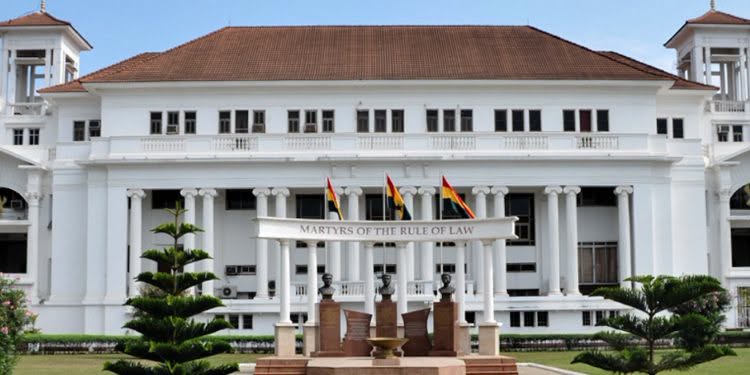
ELS: MBN360 NEWS
The Supreme Court says expanding political party primaries to include all members in good standing may not completely eliminate vote buying, but will reduce the vulnerability of internal elections to targeted financial inducements.
According to Chief Justice Paul Baffoe-Bonnie, concentrating the power to select presidential and parliamentary candidates in a relatively small group of delegates creates an electoral market that can be more easily influenced by money.
The Supreme Court, by a 5–2 majority decision, declared the delegate system used by political parties to elect presidential and parliamentary candidates unconstitutional.
It consequently ordered political parties to introduce arrangements that allow every member in good standing to vote directly in the selection of their candidates.
Addressing concerns that expanding the electorate may not necessarily end vote buying, Chief Justice Baffoe-Bonnie acknowledged that money politics could adapt to the new system.
“True, opening party primaries to every party member is no guarantee that money politics will disappear. Corruption is remarkably adaptable. It often changes its form rather than vanish altogether. Yet constitutional adjudication rarely offers perfect solutions.”
He explained that courts are sometimes required to choose the option that best advances constitutional principles, even where no available solution is perfect.
According to the Chief Justice, the delegate system increases the value of each vote because only a limited number of people ultimately determine who becomes a party’s presidential or parliamentary candidate.
“Concentrating decisive electoral power in a relatively small body of delegates inevitably increases the value of each delegate’s vote. It creates a smaller market, a more identifiable electorate and, therefore, a more attractive environment for targeted inducements.”
The Court recognised that organising primaries involving thousands of party members could increase the cost of campaigning and create logistical challenges.
It, however, concluded that a broader electorate would distribute political power among ordinary party members and make it more difficult for candidates to influence an election through a limited number of financial transactions.
Read also:
- Eco-Conscious Coordinator Calls for Stronger Oversight of Mining Activities
- 9,000 Miners Registered for Responsible Mining Scheme, Ministry’s Spokesperson Discloses
- Ghana’s Inflation Fight Scores Major Victory As July Inflation Drops to 4.6%
- Inusah Fuseini opposes proposal to extend presidential term.
- Haruna Iddrisu critiques Parliament’s approach to oversight role
“A broader electorate may increase campaign costs, but it also disperses political power among thousands of ordinary members, making it considerably more difficult for electoral outcomes to be shaped by a relatively small number of transactions.”
The Chief Justice said the decision was consistent with the democratic model preferred by the 1992 Constitution, particularly its emphasis on broad political participation and the involvement of citizens in the formation of political authority.
“For that reason, this Court may legitimately conclude that, at this stage of Ghana’s democratic development, fidelity to the Constitution requires political parties to embrace the model of democracy that the Constitution itself consistently prefers for the purpose of constituting political authority.”
The case was initiated by Prof. Kwabena Frimpong-Boateng, Dr Nyaho Nyaho-Tamakloe and Dr Christine Amoako-Nuamah.
They argued that delegate-based primaries disenfranchised ordinary members of political parties and violated the democratic principles contained in the Constitution.
The Court granted the reliefs sought by the plaintiffs and restrained political parties from continuing to select presidential and parliamentary candidates through the delegate system.
Political parties have been given one year from the date of the judgment to establish systems that will allow all qualified members to participate directly in their internal primaries.
The Court also held that the Electoral Commission has a responsibility to ensure that political parties organise themselves and conduct their activities in accordance with the Constitution.
However, decisions, appointments and actions lawfully undertaken under the delegate system before the judgment will remain valid and cannot be overturned solely on the basis of the ruling.
The seven-member panel was made up of Chief Justice Paul Baffoe-Bonnie, Justice Gabriel Scott Pwamang, Justice Issifu Omoro Tanko Amadu, Justice Samuel Kwame Adibu-Asiedu, Justice Senyo Dzamefe, Justice Ernest Yao Gaewu and Justice George Kingsley Koomson.
Justices Samuel Kwame Adibu-Asiedu and Ernest Yao Gaewu dissented from the majority decision.