Els: MBN360 News
HE President John Dramani Mahama
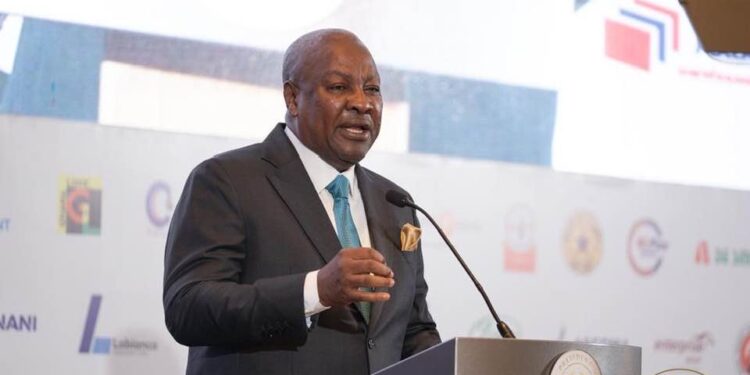
President John Dramani Mahama has called for a broad international partnership to advance reparatory justice, stressing that the work ahead must extend beyond Africa and the Caribbean to include governments, international organisations, academic institutions, civil society groups, faith communities and cultural institutions.
Speaking at the Next Step High-Level Consultative Conference on Reparatory Justice in Accra, he said the scale of the historical injustice under discussion requires “inclusive coalitions capable of sustaining progress and fostering trust.”
He emphasised that reparatory justice must be forward looking, not limited to remembrance alone, but focused on expanding opportunity, advancing development and building a more equitable global future.
According to him, the next phase of engagement must produce a practical international roadmap that covers truth telling, education, memorialisation, restitution of cultural heritage, legal pathways and strengthened cross regional partnerships.
President Mahama stressed that the African diaspora remains central to the process as rights holders whose voices must shape the outcome of all deliberations.
The President’s remarks framed the Accra conference as a critical transition point in global discussions on reparatory justice, shifting emphasis from symbolic recognition to structured implementation.
From Recognition to Implementation
President Mahama stated that the global conversation has now reached a decisive stage, noting that the focus must move from recognition of historical injustices to concrete implementation mechanisms.
He explained that sustaining momentum requires structured institutions that can guide, coordinate and support international action. In that regard, he announced the establishment of three global panels that will serve as the backbone of the next phase of work.
The first is a Global Advisory Panel on Reparatory Justice, composed of heads of state, eminent leaders and public figures. This panel will provide strategic guidance to strengthen international dialogue and cooperation on reparatory justice.
The second is an Expert Panel on the Restitution of Cultural Artefacts. This body will focus on facilitating the return of cultural property, archives and sacred objects to their rightful communities and countries of origin, an issue that has remained central to reparatory justice advocacy.
The third is a Global Legal Panel on Reparatory Justice. This panel will bring together jurists and legal scholars to explore legal pathways that align with international law, justice and human dignity.
Read also:
- Minority Demands Disclosure of Prison Location for Convicted Former MASLOC CEO
- Wande Coal Teams With Wizkid For Highly-Anticipated Oshey Single
- Ghana Launches 2026 Mass Drug Campaign Against Neglected Tropical Diseases
- VP Opoku-Agyemang Engages Ghanaian Diaspora in Canada, Outlines Government Achievements
- Civil Society Backs Proposals Entrenching Vital Public Trust Doctrines
President Mahama clarified that these panels are not intended to replace existing government or institutional structures. Instead, they will complement ongoing efforts by providing technical, intellectual and policy support to help translate recognition into action.
He stated that “these panels will provide technical and intellectual support for the global transition from recognition to action,” underscoring the need for practical mechanisms to sustain progress beyond declarations.
Strengthening Global Collaboration
Looking ahead, the President indicated that discussions over the coming days will further refine a post adoption framework that builds on regional and international initiatives already underway.
He said the aim is to strengthen collaboration among states and institutions while improving alignment among existing efforts. This, he noted, is necessary to ensure that the momentum generated by the adoption of international resolutions is not lost but instead transformed into measurable outcomes.
A key highlight of the conference programme will take place in Accra at Christiansborg Castle in Osu, where participants will gather for a commemorative event marking the first joint observance of Juneteenth between Africa and the United States.
President Mahama described the occasion as an opportunity to honour memory, celebrate resilience and reinforce the deep historical and cultural bonds between Africa and its diaspora communities.
He noted that while the experiences of people of African descent unfolded across different societies and historical contexts, they remain connected by a shared history whose consequences continue to resonate across generations.
A Moral and Historical Responsibility
In his concluding remarks, President Mahama reflected on the broader moral questions underpinning the reparatory justice movement. He stated that the central issue is not whether history can be changed, since it cannot, but whether present generations have the courage to learn from it and act responsibly.
“The question before us is whether we have the courage to learn from it, the wisdom to confront it, and the determination to transform remembrance into responsibility and responsibility into action”.HE President John Dramani Mahama
He further emphasised that future generations will not judge the present era by the resolutions adopted, but by the tangible progress achieved in addressing historical injustice and its continuing effects.
He urged participants and the international community to ensure that their actions reflect a commitment to justice, truth and partnership rather than indifference or delay.
“Let them say that in Accra we chose truth over denial. Let them say that in Accra we chose partnership over indifference. Let them say that in Accra we chose justice over delay. And let it be said that when history called, we answered with courage”.HE President John Dramani Mahama
The conference continues in Accra as stakeholders work toward developing a structured international roadmap that will guide the next phase of the global reparatory justice agenda.