ELS: MBN360 BUSINESS
The Deputy Minister for Finance, Thomas Nyarko Ampem, has defended the Ghana Cocoa Board (COCOBOD) Bill, 2026, saying the proposed legislation is designed to introduce a sustainable financing model for cocoa purchases, expand local cocoa processing, protect cocoa farms from illegal mining and guarantee a greater share of cocoa earnings for farmers.
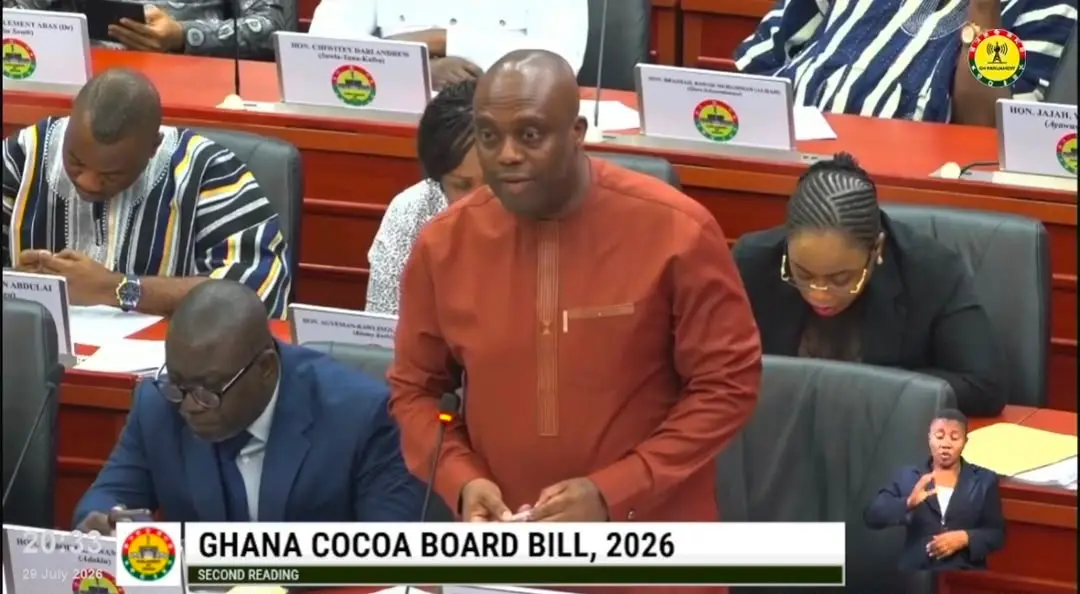
Speaking on the floor of Parliament during the consideration of the Finance Committee’s report on the Ghana Cocoa Board Bill, 2026, on Wednesday July 29, 2026, Mr. Ampem said the legislation seeks to address longstanding financing challenges confronting the cocoa sector while positioning it to create more jobs and add value to Ghana’s cocoa production.
According to him, the Ghana Cocoa Board (COCOBOD) relied on syndicated loans for more than three decades to finance cocoa purchases until Ghana’s debt restructuring limited access to that source of funding.
“Mr. Speaker, for 32 years, COCOBOD relied on the syndicated loan structure to finance cocoa purchases in this country, but following the mismanagement of the economy that led to our debt restructuring, COCOBOD could not access syndicated loans again. That forced COCOBOD to resort to the buyer-led funding model. That funding model too has actually proven to be unsustainable,” he stated.
Mr. Ampem explained that the Bill introduces a new financing arrangement that will enable COCOBOD to mobilize funding locally to purchase cocoa from farmers, reducing reliance on external borrowing.
He noted that the existing financing model, which depended heavily on forward sales contracts using cocoa beans as collateral, had also limited the availability of cocoa beans for domestic processing industries.
“This new Bill is bringing out a new arrangement where the beans will be available for our local processing companies, and the Bill is saying that at least 50 per cent of our cocoa produced here should be processed locally to add value and to create jobs for our people,” he told Parliament.
The Deputy Finance Minister said the proposed legislation also seeks to give legal backing to government’s policy of ensuring cocoa farmers receive a minimum of 70 per cent of the Free on Board (FOB) price of cocoa.
Read also:
- Minority accuses government of undermining Ghana’s democratic institutions
- Reform UK’s Deputy Leader Under Investigation Over Alleged Interests Declaration Failure
- France Rejects Reform UK’s Proposal to Deploy Royal Navy in English Channel
- Ghana Reaffirms $12bn First Phase of Petroleum Hub Project
- King Promise Features on CKay’s New Album Banger Boy
He argued that embedding the policy in law would protect farmers from future policy reversals.
“Apart from the policy announcement that government has made that we want a minimum of 70 per cent of the FOB price of cocoa to go to the hardworking farmers, we should go further to legislate this so that it becomes very binding for nobody to get up tomorrow and say, ‘We said 70 per cent, but today we are doing 60 per cent,’” he said.
Mr. Ampem further disclosed that the Bill designates cocoa farms as protected lands to safeguard them from illegal mining activities, popularly known as galamsey, which continue to threaten cocoa production across the country.
“The Bill is seeking to protect our cocoa farms and environment. We all know the debilitating effect of galamsey on our cocoa farms today. So, the Bill is designating every cocoa farm as protected land so that we can protect our cocoa farms,” he added.
The Deputy Minister also highlighted reforms to the COCOBOD scholarship scheme, explaining that while children of cocoa farmers would continue to benefit, greater emphasis would be placed on programmes that contribute directly to the growth of the cocoa sector.
He cited disciplines such as agronomy, soil science and related agricultural fields as priority areas, stressing that students pursuing other programmes, including law and engineering, would not be excluded from support.
According to Mr. Ampem, the Ghana Cocoa Board Bill, 2026, also seeks to consolidate existing laws governing the cocoa sector into a single legal framework to strengthen regulation and improve the administration of Ghana’s cocoa industry.
He appealed to Members of Parliament to support the Bill, describing it as a major reform that will strengthen the cocoa sector, improve farmers’ livelihoods and promote value addition for sustainable economic growth.