ELS: MBN360 Extractives/Energy
Ghana’s petroleum revenue framework recorded a stronger first half of 2026, with crude oil liftings, corporate income taxes and investment returns pushing total petroleum receipts above US$561 million and lifting the combined value of the country’s sovereign petroleum savings to US$1.64 billion.
Yet beneath the encouraging figures lies a familiar policy dilemma: how much of Ghana’s oil wealth should be spent to address immediate fiscal pressures, and how much should be preserved for future generations and periods of economic uncertainty.
New figures released by the Bank of Ghana show that while petroleum savings continued to expand during the first six months of the year, government also withdrew US$132.94 million from the Ghana Stabilisation Fund, highlighting the increasingly delicate balance between fiscal support and long-term resource management.
The report, published in accordance with Section 28 of the Petroleum Revenue Management Act (PRMA), presents a mixed picture of Ghana’s petroleum economy, one where improving upstream performance is strengthening revenues, but where persistent demands on public finances continue to test the country’s savings architecture.
The figures demonstrate the resilience of Ghana’s petroleum savings framework, with new allocations and investment income offsetting withdrawals from the Stabilisation Fund.The Bank of Ghana noted in its semi-annual report.
Oil Liftings and Corporate Taxes Drive Revenue Growth
Ghana generated US$561.69 million in petroleum-related receipts between January and June 2026.
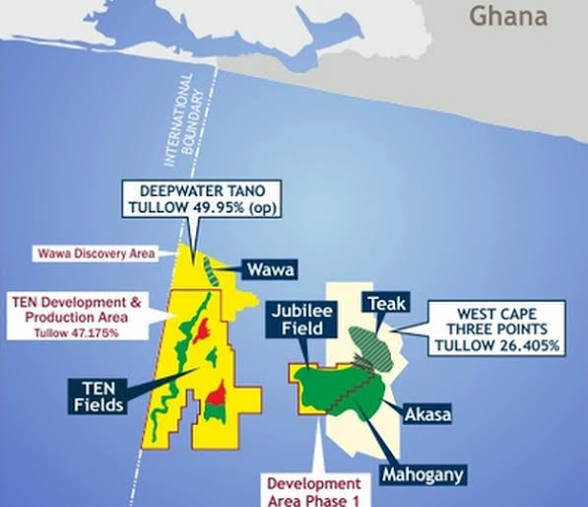
Crude oil liftings remained the largest contributor, accounting for US$355.50 million, or more than 63 per cent of total receipts during the period. Revenue came from five cargoes lifted from the Jubilee, Sankofa-Gye Nyame and Tweneboa-Enyenra-Ntomme (TEN) fields.
The Jubilee Field continued to dominate crude export earnings.
Its 87th lifting alone generated US$110.49 million, making it the largest single cargo exported during the reporting period. Earlier Jubilee liftings brought in US$58.63 million and US$66.99 million respectively.
Meanwhile, the Sankofa-Gye Nyame field contributed US$58.60 million from its nineteenth lifting, while the TEN field generated US$60.79 million from its twenty-fifth cargo.
Equally significant was the contribution of upstream petroleum companies through corporate income tax payments.
Taxes paid by operators reached US$203.98 million, representing more than one-third of total petroleum revenue received during the six-month period.
Italian energy major ENI Ghana Exploration and Production emerged as the largest taxpayer, followed by Vitol Upstream Ghana, while Kosmos Energy-related entities and PetroSA Ghana also made substantial contributions.
The strong tax performance reflects improved upstream production and profitability at a time government continues implementing reforms intended to reverse Ghana’s declining crude output.
Heritage Fund Continues to Outpace Stabilisation Fund
The latest figures further illustrate how Ghana’s petroleum savings have become increasingly concentrated in the Ghana Heritage Fund.
Designed to preserve petroleum wealth for future generations, the Heritage Fund ended June 2026 with assets valued at US$1.46 billion, representing almost 89 per cent of the country’s combined petroleum savings.

Its value increased by more than six per cent during the reporting period, supported by fresh allocations and investment income exceeding US$25 million.
Notably, no withdrawals were made from the Heritage Fund during the first half of the year, preserving its role as Ghana’s long-term sovereign savings vehicle.
The Ghana Stabilisation Fund, however, followed a different trajectory.
Although it received fresh allocations and generated investment returns, government withdrew US$132.94 million during the reporting period.
Fresh inflows nevertheless allowed the Fund to close the half-year with US$182.68 million, slightly above its opening balance.
The continuing growth of the Heritage Fund reinforces the portion of petroleum revenue preserved beyond immediate budgetary demands.The report indicated.
A Framework Under Increasing Fiscal Pressure
While the Bank of Ghana report presents encouraging savings growth, it also revives an important debate surrounding Ghana’s petroleum revenue management framework.
The Stabilisation Fund was created specifically to cushion government finances during periods when petroleum revenues fall below projected levels.
Read also:
- VALCO not being sold to Ibrahim Mahama – GIADEC
- AMA announces August National Sanitation Day exercise, orders temporary closure of businesses
- No court sittings in Greater Accra on July 28 and 31 as Judiciary marks Supreme Court’s 150th anniversary
- Mahama assures transfer of UGMC to University of Ghana.
- Fuel prices could go up again this week — COPEC
Its purpose is therefore not simply to accumulate savings, but to provide fiscal support during economic shocks.
However, repeated withdrawals inevitably raise broader questions about the sustainability of the mechanism.
Unlike the Heritage Fund, which is largely protected from expenditure pressures, the Stabilisation Fund remains vulnerable whenever government experiences revenue shortfalls or financing gaps.
The latest report did not specify the precise application of the US$132.94 million withdrawn during the first half of the year.
That absence of detail is unlikely to go unnoticed.
As petroleum revenues increasingly become intertwined with Ghana’s broader fiscal management strategy, transparency surrounding withdrawals becomes almost as important as the revenues themselves.
Although the PRMA permits such withdrawals under defined circumstances, public confidence in the framework depends on clear disclosure regarding how those resources are ultimately deployed.
Improving Upstream Performance Is Strengthening the Revenue Base
The stronger petroleum inflows also reflect broader improvements occurring across Ghana’s upstream sector.
Government has repeatedly indicated that reforms introduced earlier this year have begun reversing declining crude production through increased investment commitments and higher output from existing fields.
Those developments appear to be translating into stronger petroleum receipts.
Corporate taxes, in particular, often provide an important indication of improved profitability among upstream operators.
Higher tax contributions from companies including ENI and Vitol suggest increased operational activity within Ghana’s petroleum industry, a positive signal for government revenues beyond crude exports alone.
Surface rental payments and investment income added comparatively modest amounts, but together reinforce the diversified nature of petroleum-related receipts under Ghana’s revenue framework.
The Bigger Policy Question Is No Longer Revenue, but Discipline
The first-half figures suggest Ghana’s petroleum revenue system remains fundamentally sound.

Oil exports continue generating substantial foreign exchange, upstream companies are paying significant corporate taxes, and sovereign petroleum savings continue expanding despite withdrawals.
Yet the more important policy conversation may no longer concern how much revenue Ghana earns from petroleum.
Instead, it concerns how prudently those revenues are managed.
The Heritage Fund’s continued expansion demonstrates commendable discipline in preserving resources for future generations.
The Stabilisation Fund, meanwhile, illustrates the unavoidable tension between saving and spending.
That tension is likely to become more pronounced if government increasingly relies on petroleum revenues to support fiscal consolidation, infrastructure development and energy sector financing.
According to a report by norvan reports, the first-half performance underscores both the resilience of Ghana’s petroleum savings framework and the competing demands placed on oil revenues as government seeks to balance present expenditure with long-term national wealth preservation.

Ultimately, Ghana’s petroleum funds were established not merely to collect oil revenues but to transform finite natural resources into lasting economic resilience.
The latest figures show that objective remains achievable.
However, sustaining that balance will require continued transparency, prudent withdrawals and a fiscal strategy that treats petroleum wealth not as a convenient budgetary reserve, but as a strategic national asset whose greatest value may lie in what is saved as much as what is spent.