Els: MBN360 Extractives/Energy
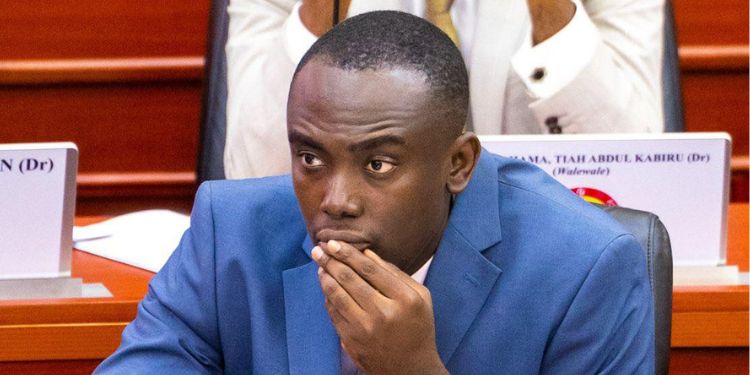
ember of Parliament for Manhyia North and Deputy Ranking Member on the Lands and Natural Resources Committee, Hon. Akwasi Konadu, has launched a scathing critique against the President’s inability to fulfil his high-profile pledge to eradicate illegal small-scale mining.
The lawmaker asserted that the “uncompromising war” once promised by the executive has devolved into a cycle of “poetic renditions” and renamed policies that fail to address the systemic destruction of Ghana’s ecological heritage.
He highlighted that despite the initial rhetoric of a “swift and ruthless” crackdown, the reality on the ground reflects a stark abandonment of environmental stewardship in favor of short-term economic gains.
“The president promised an uncompromising war to ensure our river bodies were cleared of debris and our forests restored. Instead, we see a culture of impunity where illegal mining has become a state-protected institution. Leadership is not about press conferences or renaming operations; it is about feasible enforcement.”Hon. Akwasi Konadu
While on these concerns, Hon. Konadu detailed how the current administration’s approach has shifted from active enforcement to what he describes as “state-protected” impunity.
He noted that instead of the promised reclamation of river bodies and restoration of forest reserves, the nation is witnessing the “last breath of survival” for its most vital water sources.
The MP argued that the government has substituted “feasible enforcement” with a revolving door of taskforces that “appear and disappear” without leaving any lasting deterrence.
This failure, he suggested, is not merely an administrative oversight but a calculated use of mining proceeds to “sustain an economy” at the expense of finite natural resources that future generations will desperately need.
The Choking Arteries of a Nation

The ecological fallout of this policy failure is most visible in the literal suffocation of Ghana’s major river systems. Hon. Konadu pointed out that the River Pra is heavily polluted, while the Ankobra is “distressed” and the Offin River remains “under siege.”
These water bodies, once the lifeblood of agricultural and domestic life in rural communities, have become sludge-filled channels of toxic chemicals and silt.
Research indicates that the turbidity levels in these rivers have reached unprecedented highs, making water treatment nearly impossible for the Ghana Water Company Limited. The “debris” the President vowed to clear has instead multiplied, creating an environmental crisis that threatens the very “survival” of the citizenry.
The MP’s assessment of the “state of the nation” focused heavily on the visual and tangible decay of the hinterlands. He remarked that “excavators are appearing at night like ghosts” within protected forest reserves, operating with a level of boldness that suggests high-level complicity.
The transition from active combat against galamsey to a state of “rampant” illegality has led to a collapse in public trust.
By “digging the riverbeds” to support the national economy, the government is accused of trading long-term environmental security for immediate fiscal liquidity, ignoring the “finite” nature of gold as warned by the Governor of the Bank of Ghana.
Read also:
- Government Flags GH¢160m ‘Non-Existent’ Teacher Trainee Allowance Arrears
- German Court Jails Lebanese National over Hezbollah Membership
- Audit Uncovers GH¢4.4bn Recycled, GH¢1.4bn Inflated Claims
- MoFA Under Forensic Scrutiny for 2024 Procurement Scandal.
Institutional Complicity and Global Decline

Beyond the environmental damage, Hon. Konadu raised serious allegations regarding the politicization of the galamsey fight, specifically citing internal friction within the security apparatus in the Ashanti region.
He referenced open accusations involving the National Security Coordinator and other liaison officers, suggesting that the “protection of these individuals is so glaring.”
This internal discord, where officials “openly accused” one another of using national security reports for personal or political leverage, highlights a breakdown in the chain of command. The MP argued that “you cannot be declaring a war in a car while small-scale mining activities happen in the forest,” emphasizing the disconnect between official statements and the reality of field operations.
This domestic failure has not gone unnoticed by the international community. Ghana’s reputation as a stable and regulated mining destination is currently under threat.
Hon. Konadu cited the Fraser Institute Survey of Mining Companies, noting that Ghana has dropped seven points down in its global ranking.
This decline is a mathematical reflection of the “calamities” and policy inconsistencies the country has endured over the last year.
The reduction in the number of assessing countries further underscores a shrinking confidence in Ghana’s ability to manage its extractive sector transparently and sustainably.
A Call for Feasible Enforcement

The path forward requires moving beyond “renaming of policies and relaunching of operations.” To end the menace of illegal mining, there must be a shift toward “feasible enforcement” that holds even the most “protected” individuals accountable.
The current trajectory, characterized by “the protection of campaigns” and the “culture of impunity,” offers no path to restoration.
As the MP for Manhyia North suggested, running an economy requires “steam and brains” rather than the exploitation of irreplaceable forest reserves.
Ending the galamsey crisis is no longer just an environmental goal; it is a test of national sovereignty and leadership.
The destruction of the Offin, Pra, and Ankobra rivers represents a permanent loss of natural capital. Without a “fearless” and “ruthless” re-engagement that transcends political affiliations, the “last breath of survival” for Ghana’s environment may soon be extinguished.
The legislative body and the executive must now align to ensure that “state-protected” illegality is replaced by a genuine, transparent, and enforceable framework for the mining sector.