Els: MBN360 News
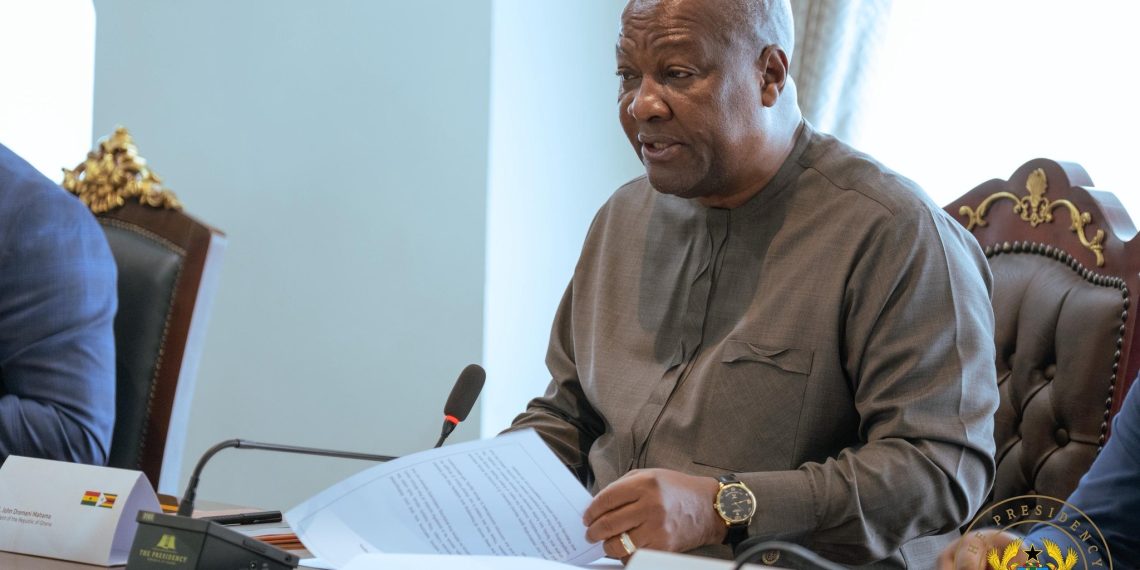
President John Dramani Mahama has said ongoing power interruptions across parts of the country should not be described as “dumsor,” arguing instead that they are linked to a planned nationwide upgrade of electricity infrastructure.
He made the remarks on Sunday (19 April) during a visit to the Northern Electricity Distribution Company as part of his “Resetting Ghana” tour, where he inspected transformer installations under a national replacement programme.
Large-scale replacement
He said ageing infrastructure, including transformers installed decades ago, had become insufficient for current demand, contributing to instability in supply.
“In 1980s when we started the national electrification programme, at that time the population of Ghana was smaller than it is…Today we are 33 million and it means that all our communities are expanding,” he said.
“And so if we take the example of a transformer in Nungua which was 22 years old and since then the community has expanded beyond the capacity of a transformer that’s how the lights have been very unstable,” he said.
Mahama said government had approved a large-scale replacement programme involving about 2,500 transformers, backed by the Ministry of Energy and the Ministry of Finance.
“The minister made a request and cabinet approved this and the ministry of finance came in to assist the ministry of energy and have acquired a lot of transformers for installation nationwide, currently 2500 transformers,” he said.
Phased rollout
He said the rollout would continue in phases, with old equipment gradually replaced to improve stability of the national grid.
“We are going to see stable power after this first phase and after that constantly we will keep taking out the old transformers so that Ghana can have stable power,” he said.
Addressing public concerns over electricity interruptions, Mahama pushed back on characterisations of a return to prolonged outages locally known as “dumsor.”
“I will appeal to the people that the outages we are facing are not dumsor, it is to enable you to get better quality and stable power,” he said.
Read also:
- OSP is confusing contructive criticism with calls for him to be scrapped – Dafeamekpor
- Passion, not survival, should drive career choice – Dr Kofi Annan
- Ocloo Announces Planned Demolition Of Unauthorised Sakumo Ramsar Structures
- Former CSA boss calls for a review of cybersecurity education to close skills gap
- Rosenior sacked by Chelsea after three months in charge
He added that communities would be informed ahead of scheduled outages during installation works.
“Anytime we are going to replace transformers we will inform the people so they will be aware their lights are going to be put off when their transformers are installed,” he said.
NDC not convinced
Ghana has in the past experienced periods of prolonged power shortages, widely referred to as “dumsor,” prompting successive governments to invest in generation and distribution upgrades to stabilise supply.
A member of the ruling National Democratic Congress (NDC) has publicly criticised the government’s handling of power supply in the Ashanti Region, accusing Energy Minister John Jinapor of failing to address persistent outages.
In a Facebook post addressed to President John Mahama, Isaac Asante Jnr. said ongoing electricity disruptions were affecting communication and daily activities in the region.
“The lights are not on… John Jinapor is sleeping on the job, which makes communication difficult for us in Ashanti Region,” he wrote.
Asante also directed a warning to officials of the Electricity Company of Ghana (ECG) in Kumasi, urging them to “exercise extreme caution” and take immediate steps to resolve the outages.
Assurance
Meanwhile, the Electricity Company of Ghana (ECG) has reassured residents and businesses in Kumasi that ongoing system upgrades are underway to improve power supply reliability as the city’s rapid growth drives higher electricity demand.
ECG clarified that the intermittent outages experienced in parts of the Ashanti Region are not load shedding. Instead, they stem mainly from technical faults, upstream transmission challenges, and planned maintenance work.
Speaking on the situation, a Communications Officer at ECG noted that Kumasi’s population now exceeds 4 million and is growing by more than 3 percent each year.
“Kumasi is expanding rapidly, and with that growth comes increased demand for electricity. What we are seeing is not load shedding, but pressure on infrastructure that we are actively upgrading to meet both current and future needs,” he said.
Localised faults
He explained that most outages are linked to localised faults such as damaged underground cables, transformer failures, and fallen conductors, which ECG’s technical teams typically resolve within short timeframes.
Some disruptions also originate from upstream transmission issues, reflecting the interconnected nature of the national grid. ECG emphasized that planned maintenance, while sometimes inconvenient, is essential to strengthen the network and prevent larger, longer outages.
“Our engineers are working around the clock, not only to restore supply quickly when faults occur, but also to reinforce the system to make it more resilient,” the Communications Officer added.
The company apologized for the inconvenience and reaffirmed its commitment to improving real-time communication, speeding up response times, and investing in infrastructure upgrades to serve Kumasi’s growing needs.