

Els: MBN360 Business
Ghana’s strategic pivot toward industrialization reached a record-breaking threshold in 2025, propelled by the dominant performance of cocoa paste and high-value derivatives. This transition from raw material exports to value-added processing has fundamentally reshaped the nation’s trade profile. By capturing greater value within domestic supply chains and expanding its footprint in regional African markets, Ghana is successfully insulating its economy from global commodity volatility while positioning itself as a competitive manufacturing powerhouse.
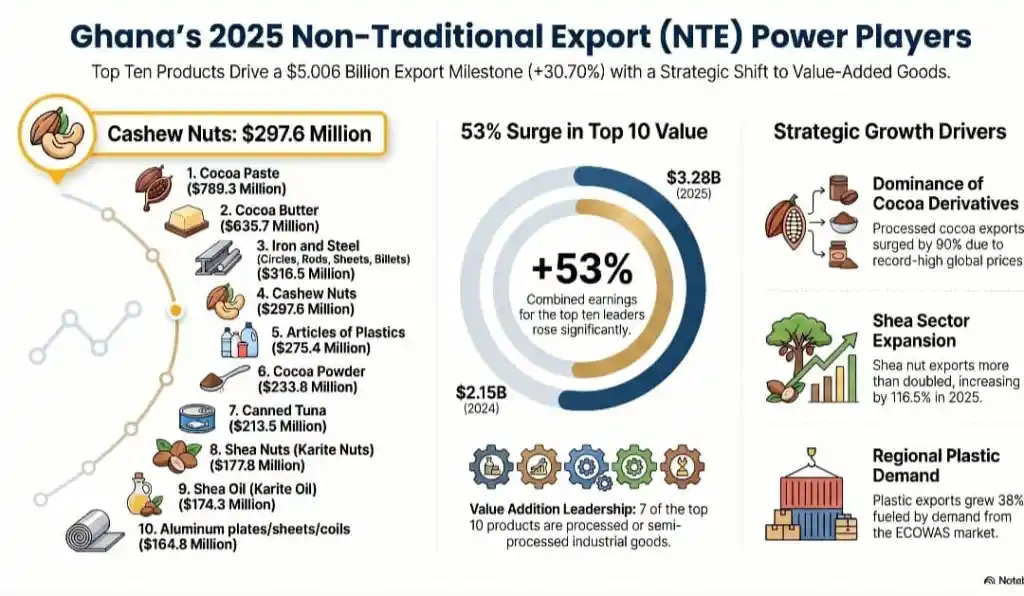
Building on this momentum, Ghanaian trade reached a historic milestone as the nation’s top ten non-traditional export (NTE) products generated $3.28 billion (GH₵36.31 billion) in earnings. This figure represents a 53% increase from the $2.15 billion (GH₵23.80 billion) recorded in 2024. Data from the Ghana Export Promotion Authority (GEPA) indicates that these leading products now account for 65.48% of total NTE revenue, with the average export value per product in this elite category reaching $327.86 million (GH₵3.63 billion).
Cocoa Processing Leads Structural Economic Shift
The primary driver of this growth is a successful transition from raw commodity dependence to high-value processed goods. Cocoa paste emerged as the top export product by generating $789.3 million (GH₵8.74 billion), reflecting a 70.97% increase compared to the previous year. According to GEPA, this trend reflects a “broader structural shift in Ghana’s export strategy, from raw commodity dependence to processed and semi-processed goods.”
Surge in Cocoa Derivatives and Global Demand
Complementing the dominance of cocoa paste, secondary cocoa products experienced even more dramatic growth rates due to industrial demand in Europe and other major markets. Cocoa butter exports rose by 120.18% to reach $635.7 million (GH₵7.04 billion), while cocoa powder surged by 112.97% to hit $233.8 million (GH₵2.59 billion). These derivatives are essential for global chocolate manufacturing, beverages, and cosmetics. GEPA notes that the sector recorded a “30.7% surge in earnings to $5.006 billion (GH₵55.42 billion), marking a historic milestone.”
Agricultural Diversification and Shea Nut Expansion
While cocoa anchored the rankings, other agricultural commodities also demonstrated significant resilience. Cashew nuts contributed $297.6 million (GH₵3.29 billion) to the economy, marking a 10.15% increase. Simultaneously, the shea sector saw a massive spike in performance; shea nuts recorded a growth of 116.51% to reach $177.8 million (GH₵1.97 billion), while shea oil exports rose 15.43% to $174.3 million (GH₵1.93 billion). This growth is sustained by the pharmaceutical and cosmetic industries’ increasing preference for natural ingredients.
Manufacturing and Fisheries Performance
Read also:
- PCSRC, Police MTTD Begin Crackdown on Unregistered Delivery Riders After Deadline Expiry
- High Court grants GH₵30m bail to Abu Trica amid ongoing extradition battle
- Davido confirms joint project with Chris Brown
- Black Queens rise from 62nd to 59th in latest FIFA Women’s World Rankings
- Free Primary Healthcare has reduced the burden on National Health Insurance Scheme – Dr. Djokoto
The success of value addition extended into the industrial and fisheries sectors, which maintained upward trajectories throughout 2025. Articles of plastics increased by 37.85% to reach $275.4 million (GH₵3.05 billion). Aluminium plates, sheets, and coils rose by 50.48% to $164.8 million (GH₵1.82 billion), supported by international construction activity. In the fisheries sector, canned tuna exports grew by 37.34% to $213.5 million (GH₵2.36 billion). These figures suggest that “manufactured and semi-processed goods accounted for over 83% of total export earnings.”
Challenges in the Steel Sector
Despite the overall positive trend, the iron and steel sector faced global headwinds that moderated the year’s gains. Exports of iron and steel products, including rods and billets, declined by 1.59% to $316.5 million (GH₵3.50 billion). The Ghana Export Promotion Authority attributed this specific decline to “fluctuating global prices and rising competition in the international market.” This sector remains the only outlier in an otherwise robust year for non-traditional exports.
Strategic Outlook and Market Destinations
The Netherlands remains the primary destination for Ghanaian exports, followed closely by the United Kingdom and France. Beyond Europe, intra-African trade within the ECOWAS region continues to expand. The 2025 data confirms that Ghana is successfully capturing more value along its internal supply chains. As GEPA concludes, the current performance “points to a growing shift toward processed and higher-value export products, particularly within the cocoa and shea value chains.”
Regional Integration and AfCFTA Momentum
The official launch of the 2025 NTE Statistics Report on April 17, 2026, highlights Ghana’s deepening footprint within the African Continental Free Trade Area (AfCFTA). Regional trade now accounts for 30.36% of total NTE earnings, a trend largely driven by demand within the ECOWAS sub-region. GEPA CEO Francis Kojo Kwarteng Arthur recently emphasized that this growth signals “Ghana’s growing competitiveness in regional markets.” Initiatives like the Accelerated Export Development Programme (AEDP) are specifically designed to bolster this momentum by improving production capacity and quality standards for regional buyers.
Economic Resilience Through Industrialization
The record-breaking performance of 2025 underscores a maturing economy that is effectively insulating itself against the historical volatility of raw commodity pricing. While the decline in the steel sector serves as a reminder of the pressures of global market competition, the triple-digit growth in processed cocoa and shea derivatives suggests that Ghana’s policy of aggressive value addition is yielding sustainable results. By maintaining this trajectory of industrialization and diversifying its trade partners across both European and regional African markets, Ghana is positioning itself as a robust manufacturing hub in the West African sub-region.
Source: Nana Karikari, Senior Global Affairs Correspondent