ELS: MBN360 BUSINESS
President John Dramani Mahama has called for a new chapter in Ghana-United States economic relations, with greater emphasis on trade, investment, technology transfer and productive enterprise.
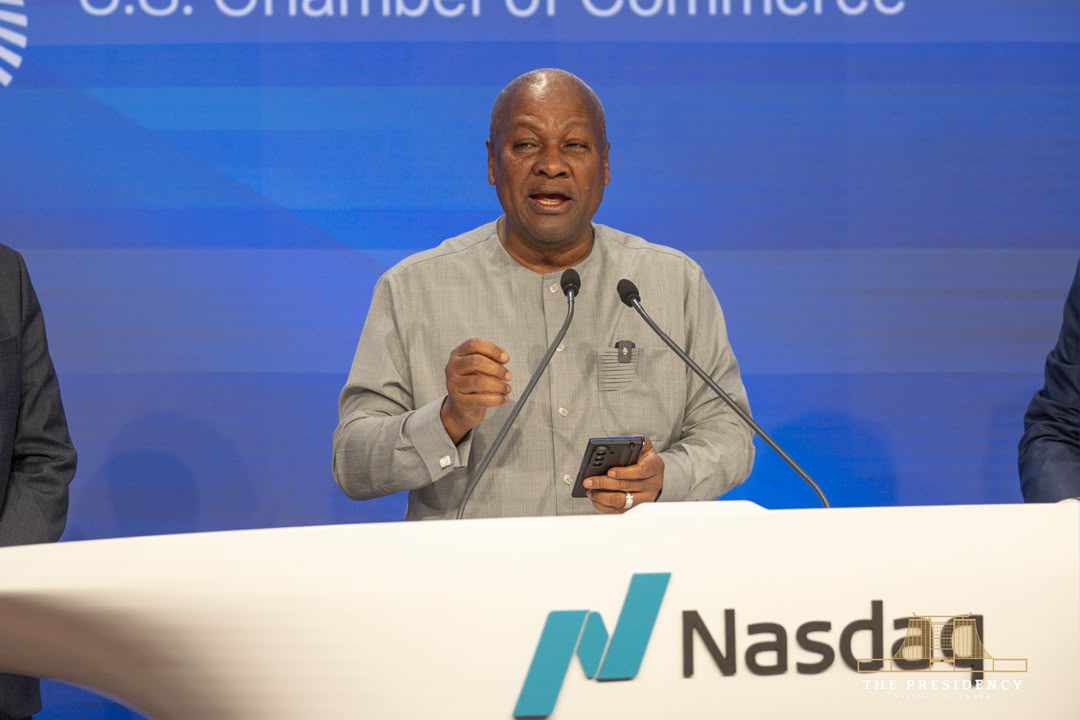
He made the call at the US-Ghana Presidential Roundtable organised by the US Chamber of Commerce and the US-Africa Business Center at NASDAQ in New York.

President Mahama said Ghana’s economic partnership with the United States must now go beyond development cooperation to focus more strongly on investment, expanded production, technology and job creation.
GHANA REFORMS INVESTMENT FRAMEWORK
President Mahama cited the newly enacted Ghana Investment Promotion Authority Act, 2026, as evidence of government’s commitment to removing barriers to investment.
He said the legislation, which he has signed into law as Act 1173, removes the blanket minimum capital requirements that previously applied to most foreign investors and establishes what he described as a more responsive investment framework.
He said the reform followed a commitment he made at the same roundtable a year earlier.
“When we identify an obstacle to investment, we must remove it, and when we commit, you should expect us to return and account for what we’ve done,” President Mahama said.
FDI RISES
President Mahama said investor interest in Ghana was improving, with foreign direct investment reaching approximately 2.6 billion dollars in 2025, about four times the level recorded in 2024.
He, however, said the volume of investment was only one measure of its impact.
“What does that investment produce after it arrives? Does it build a factory? Does it expand the farm? Does it introduce new technology? Does it increase our exports and create decent jobs? These are outcomes that matter to us,” he said.

The President said Ghana’s economic gains must now translate into lower business costs, greater access to long-term financing, increased production and more jobs.
24-HOUR ECONOMY
President Mahama said the 24-hour economy was central to government’s strategy to convert macroeconomic stability into production, exports and employment.
He clarified that the initiative was not a directive requiring every business to operate around the clock, but a framework to enable businesses with a commercial basis to introduce additional shifts and increase output.
He said government was implementing measures to support qualifying businesses, including duty-free importation of plant and equipment and faster clearance procedures at the ports.
President Mahama said the expansion of production would create opportunities in transport, logistics, warehousing, cold-chain facilities, digital services and other supporting sectors.
Read also:
- Dr. Bawumia Jabs BoG over Gold Reserves Losses
- Lekzy Decomic unites comedy veterans and new stars for November 7 show
- Kim Kardashian brushes off critics and returns for season two of ‘All’s Fair’
- Tamba Akin Boamah breaks Ghana swimming national record at Dakar 2026 Youth Olympics
- Japan Football Association president to challenge Infantino for FIFA presidency
FOCUS ON VALUE ADDITION
The President also called for greater investment in agriculture, manufacturing, energy, infrastructure, technology, mining, health and pharmaceuticals.
He said Ghana must reduce the export of raw commodities and increase domestic processing to create jobs and strengthen local enterprises.
Citing cocoa, cashew, horticulture, grains, poultry, livestock and food manufacturing, President Mahama said processing more of what Ghanaian farmers produce would create opportunities across the value chain.
He urged American investors to look beyond Ghana’s domestic market and use the country as a production base for the wider African market.
“Do not look at Ghana’s 34 million population only for what you can sell there. Look at Ghana for what you can produce and sell across Africa and to the world,” he said.
GHANA-US TRADE
President Mahama said trade in goods and services between Ghana and the United States reached approximately 4.6 billion dollars in 2025.
He said Ghana valued its longstanding relationship with the United States, including development cooperation, but argued that the next phase should place greater emphasis on trade, investment, technology and productive enterprise.
“American capital, American technology and experience can work with Ghanaian businesses and skills to produce goods and services for Ghana, Africa, and the world market,” he said.
President Mahama called for more American companies to establish production in Ghana, work with Ghanaian suppliers and share technology and expertise.
He said Ghana’s strategic location in West Africa, political stability, natural resources, improving macroeconomic conditions and access to the wider African market make it a platform for investment and production.
He also pointed to Ghana’s role in the African Continental Free Trade Area, whose secretariat is headquartered in Accra, as an opportunity for investors seeking access to the wider continental market.
A NEW ECONOMIC PARTNERSHIP
President Mahama said Ghana and the United States could build a partnership that combines American capital, technology and business experience with Ghanaian skills, resources and market opportunities.
He said such a partnership should deliver commercial value while contributing to production, exports, technology transfer and employment.
The President also said Ghana’s forthcoming role in the leadership of the African Union would provide an opportunity to advance the continent’s agenda on infrastructure, industrialisation, regional integration and implementation of the African Continental Free Trade Area.
The US-Ghana Presidential Roundtable formed part of President Mahama’s engagements with global business leaders on the sidelines of the 81st United Nations General Assembly in New York. He also rang the NASDAQ Closing Bell during his visit.