ELS: MBN360 NEWS
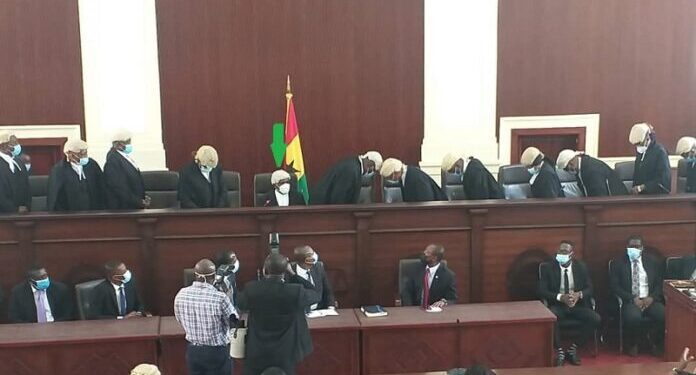
The Supreme Court of Ghana has ruled that political parties must allow all registered members in good standing to vote in their internal elections, declaring the long-standing delegate based electoral college system unconstitutional.
In a landmark 5 to 2 majority decision delivered by a seven-member panel presided over by Chief Justice Paul Baffoe-Bonnie, the court held that limiting voting rights to selected delegates violates Article 55(5) of the 1992 Constitution, which requires the internal organization of political parties to conform to democratic principles.
The ruling gives all political parties one year to amend their constitutions and electoral structures to comply with the new constitutional standard.
While the decision fundamentally reshapes how parties will elect their presidential and parliamentary candidates, the court also protected legal certainty by affirming that all elections, appointments and decisions made in good faith before the judgment remain valid.
Supreme Court Declares Delegate System Unconstitutional
The decision marks one of the most significant constitutional interventions in Ghana’s political party system since the Fourth Republic.
According to the majority ruling, political parties can no longer restrict participation in internal elections to a limited group of delegates. Instead, every registered member in good standing must be given the opportunity to vote in the selection of presidential and parliamentary candidates.

The court found that the delegate based electoral college system fails to satisfy the democratic requirements set out in Article 55(5) of the 1992 Constitution, which provides that the internal organization of political parties must conform to democratic principles.
The judgment was delivered by a seven-member panel chaired by Chief Justice Paul Baffoe-Bonnie. However, the ruling was not unanimous. Justices Samuel Kwame Adibu-Asiedu and Ernest Yao Gaewu dissented from the majority decision. The Supreme Court announced that its full written reasons for the judgment will be filed by August 5, 2026.
Political Parties Given One Year to Comply
Recognizing the far reaching implications of the judgment, the Supreme Court granted all political parties a one year transition period to implement the required reforms.
Within that period, parties are expected to amend their constitutions, revise their electoral regulations and establish voting structures that permit the full participation of all registered members in good standing.
The ruling effectively requires political parties to dismantle the delegate based electoral college systems that have traditionally determined the selection of presidential and parliamentary candidates.
The transition period is intended to allow parties to undertake the necessary constitutional, administrative and logistical adjustments before future internal elections are conducted under the new rules.
Court Protects Previous Party Decisions
While introducing sweeping reforms for future internal elections, the Supreme Court also sought to preserve legal certainty and political stability. The court clarified that every vote, appointment and decision made in good faith before the ruling remains legally valid.

By validating previous internal elections and decisions, the judgment avoids uncertainty that could have arisen if earlier party processes had been declared invalid. The court’s approach ensures that the constitutional changes will apply prospectively without disrupting existing political mandates or decisions already taken under previous party constitutions.
Read also:
- Minority demands full disclosure of gov’t’s VALCO equity plan
- Europe Heatwave Intensifies Wildfire Battle
- Parliament Passes Excise Bill, Scraps 20% Tax on Local Fruit Juices.
- Rising material costs push building inflation to 3.1% – GSS
- ‘At 65 I feel like I’m living an extra time’ – Veteran actor, RMD
Landmark Case Challenges Internal Party Democracy
The constitutional challenge was initiated by prominent public figures, including Kwabena Frimpong-Boateng, Dr. Nyaho Nyaho-Tamakloe, and Dr. Christine Amoako-Nuamah.
The applicants argued that the delegate system had become inherently exclusionary by concentrating voting power in the hands of a relatively small number of delegates rather than the broader party membership.
According to the case presented before the court, the long-standing electoral college model failed to reflect the democratic values guaranteed under Ghana’s Constitution. The majority ruling accepted that internal party democracy requires wider participation by registered members instead of restricting decision-making to selected delegates.
The judgment also places a significant responsibility on the Electoral Commission of Ghana. Under the ruling, the Commission has an explicit statutory duty to ensure that political parties comply with the new constitutional requirements governing their internal elections.

This means the Electoral Commission will be expected to supervise and enforce compliance as political parties amend their constitutions and electoral procedures during the one year implementation period.
The ruling establishes a new benchmark for internal political party governance that parties must satisfy before conducting future presidential and parliamentary primaries.
Ruling Expected to Reshape Party Primaries
Political analysts believe the judgment could significantly alter the nature of internal party contests across Ghana. Expanding voting rights to all registered members may reduce the influence of delegate based politics, which critics have argued created opportunities for monetization and manipulation during party primaries.
By broadening participation, the ruling has the potential to strengthen internal democracy and encourage greater involvement by ordinary party members in leadership selection. At the same time, analysts note that organizing nationwide membership based primaries will substantially increase the logistical demands placed on political parties.
Campaign strategies, voter education, registration verification and election administration are all expected to become more extensive as parties prepare to comply with the new constitutional framework.
The wider electorate within each political party could also increase campaign costs for aspiring presidential and parliamentary candidates, who would now be required to engage with the entire registered membership instead of a comparatively small delegate base.
Landmark Judgment Redefines Internal Party Elections
The Supreme Court’s ruling represents a major constitutional milestone in Ghana’s democratic development by redefining how political parties must organize their internal elections.

By declaring the delegate based electoral college system unconstitutional, the court has established that internal party democracy must reflect the broader democratic principles enshrined in Article 55(5) of the 1992 Constitution.
With political parties now required to expand voting rights to all registered members in good standing within one year, Ghana’s internal political landscape is set for significant institutional change.
Although the judgment preserves all previous party decisions made in good faith, it introduces a new constitutional standard that is expected to reshape presidential and parliamentary primaries, strengthen member participation and redefine internal political competition for years to come.