ELS: MBN360 WORLD
A Russian drone struck a train in western Ukraine just moments after former British Prime Minister Boris Johnson and prominent European security officials departed the area.

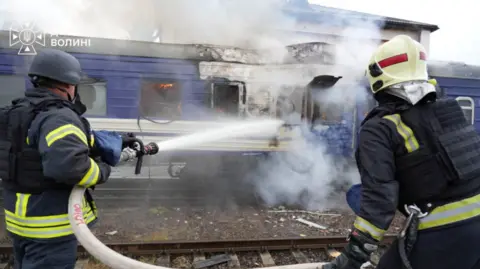
The attack occurred at Yahodyn near the Ukraine-Poland border following a high-profile gathering in Kyiv. Ukrainian state railway operator Ukrzaliznytsia reported that the train engine sustained damage, though all passengers had evacuated safely prior to the impact.
The timing of the strike has prompted serious security questions among regional leaders regarding the precise intent of the operation.
Ukrzaliznytsia noted that the targeted train had left the station earlier than expected because of a timetable change due to constant threats of Russian strikes, adding that an evacuation order had been given just fifteen minutes before the impact by a jet-propelled drone.
Russia stated it had struck railway infrastructure in western Ukraine, while the railway company suggested that quite possibly, the target of this drone could have been the diplomatic train.
Diplomatic Delegation Narrowly Misses Blast Zone
The targeted route was utilized earlier by international figures returning from the Yalta European Strategy conference.
Travelers included the United Kingdom’s national security adviser Jonathan Powell and former Central Intelligence Agency director David Petraeus, who rode on a separate train. Former Swedish Prime Minister Carl Bildt described receiving evacuation orders while onboard before authorities cleared his transport to proceed toward the Polish border station in Dorohusk.
Bildt recounted that on the train he was on they received an order to prepare for evacuation after it had stopped, but after a number of minutes they were informed that it was clear and they could proceed.
Polish Prime Minister Donald Tusk convened an emergency government session in Warsaw to evaluate the mounting security challenges near European Union territory.
Western Leaders Condemn Escalating Tactics
Ukrainian and Polish authorities confirmed the impact took place roughly two kilometers from the border, prompting temporary closures of regional crossing points. Ukrainian Foreign Minister Andrii Sybiha characterized the offensive as Putin’s terror knocking directly on the doors of the EU and NATO, while calling for increased sanctions and decisive action that increases the cost of war for Moscow to an unacceptable level. Former British
Read also:
- When things go wrong, that’s when you challenge yourself – Asamoah Gyan
- Argentina reject $1m offer from Morocco for October friendly in Rabat
- Sustained national action to reduce maternal deaths in Ghana require sustained political attention
- Mahama convenes high-level meeting to strengthen border security and narcotics control
- 469 farmers paid compensation as Accra-Kumasi Expressway clearance progresses
Prime Minister Boris Johnson stated on social media that he did not know what warped logic drove Putin to blow up a stationary Ukrainian locomotive on the Polish border this morning.
Johnson described the incident as the kind of random and senseless attack Ukrainians are enduring every day, even on civilian railways, and urged allies to urgently provide Ukrainians the air defences they need.
Polish Prime Minister Donald Tusk warned that the escalation of the actions from the Russian side is becoming a reality, and they are getting closer and closer to our border.
Broader Campaign Targets Transport Infrastructure
Moscow has increasingly focused its military capacity on Ukraine’s extensive railway grid, which serves as a vital transit network amid closed airspace.
Recent weeks have witnessed strikes against depots, fueling stations, and border terminals. Ukrainian officials note that similar actions have caused fatalities among railway personnel and civilians across multiple regions, including recent border attacks near Moldova and passenger train casualties in southern Ukraine.
European security agencies meanwhile investigate suspected sabotage operations spanning from Germany to Estonia, linking the incidents to a wider pattern of continental friction.
Trump Urges Halt to Energy Strikes Amid Global Supply Pressures

US President Donald Trump publicly urged Ukrainian counterpart Volodymyr Zelensky to suspend long-range aerial attacks targeting Russian diesel fuel processing plants, asserting that the campaign is hurting the world by triggering acute fuel shortages.
Speaking during an official visit to Ireland, Trump maintained that the resulting squeeze on refined products stems directly from the ongoing conflict rather than Middle Eastern disruptions.
Global oil benchmarks climbed to $108 per barrel while American retail prices crossed six dollars a gallon, elevating political and economic pressures.
In parallel developments, Ukrainian military forces targeted the TANECO oil refinery in Russia’s Tatarstan republic, an operation regional Russian officials claimed resulted in two civilian fatalities.
As diplomatic channels strain and regional defense postures shift, the intersection of infrastructure vulnerability and high-stakes international transit underscores a precarious new threshold in European security.