ELS: MBN360 NEWS
One year after a devastating military helicopter crash shook the political and social fabric of Ghana, the nation pauses on Thursday to honour the eight lives lost in a disaster that claimed two senior cabinet ministers and plunged the country into profound mourning.
The crash, which occurred on August 6, 2025, involved a Ghana Air Force Harbin Z-9EH utility helicopter traveling from the capital, Accra, toward the gold-mining hub of Obuasi in the Ashanti Region. The aircraft went down in the forested mountainous terrain of the Dampia Range near Antoakrom, killing all eight occupants on board.
A Nation Remembered in Grief
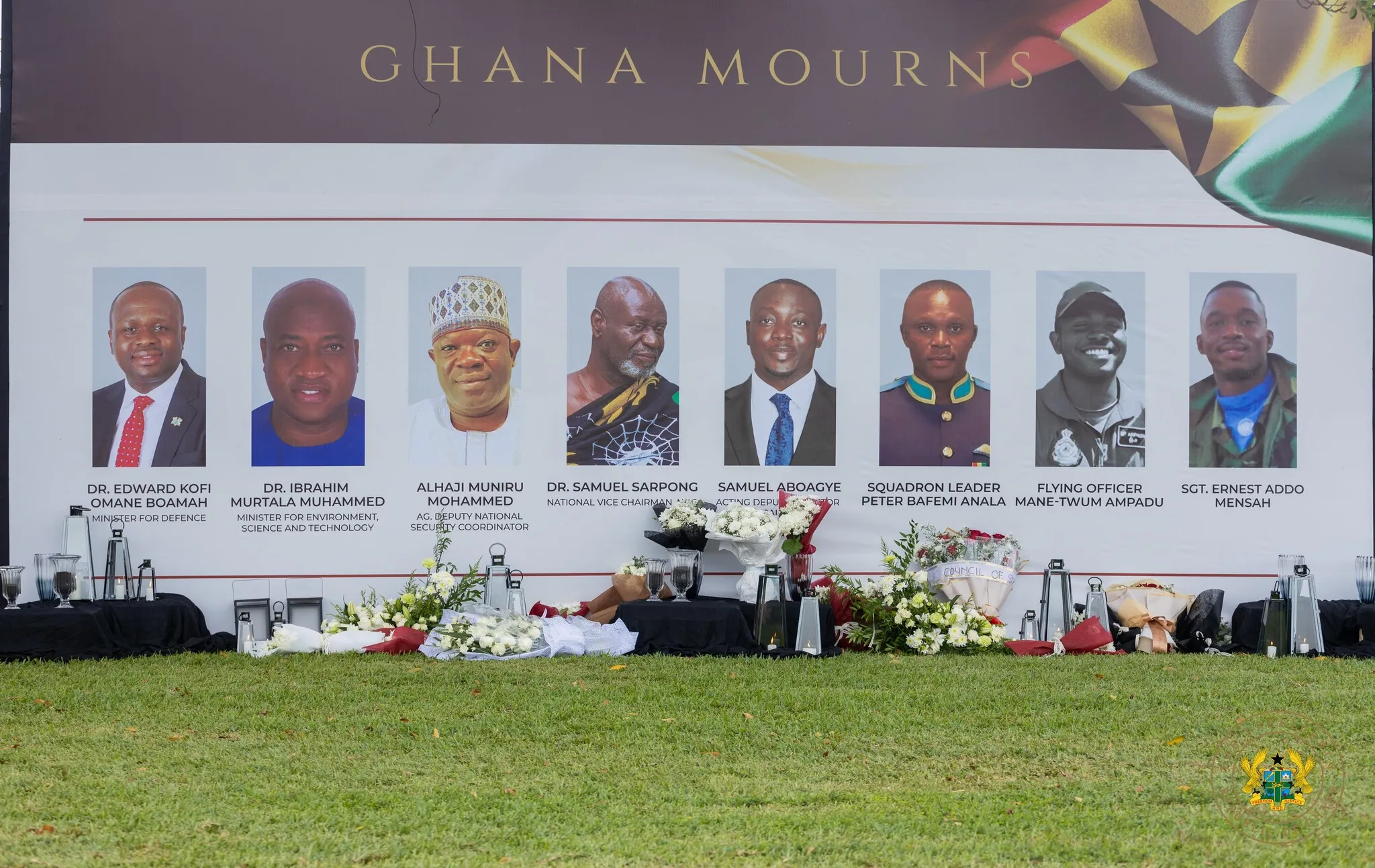
Among the victims were Minister for Defence Dr. Edward Omane Boamah and Minister for Environment, Science, Technology and Innovation Dr. Ibrahim Murtala Muhammed.
The high-profile delegation was en route to an official event centered on national efforts to combat illegal mining—a critical policy portfolio for the administration. Also killed in the crash were Acting Deputy National Security Coordinator Alhaji Muniru Mohammed, National Democratic Congress (NDC) Vice Chairman Dr. Samuel Sarpong, and disaster management official Samuel Aboagye, alongside three Ghana Air Force flight crew members: Flying Officer Manin Twum-Ampadu, Sergeant Leader Peter Bafemi Anala, and Sergeant Ernest Addo Mensah.
The tragedy stunned the West African nation, prompting three days of national mourning and a solemn state funeral at Independence Square in Accra, where thousands gathered to pay their final respects.
Findings Point to Weather and Terrain
Months after the accident, the official investigation report—compiled by an inter-agency board with technical support from international advisers—shed light on the final moments of Flight GHF 631.
Released late last year, the investigation concluded that the aircraft was fully airworthy and that the pilots were fully qualified and professional. However, the report cited a combination of sudden downdrafts, low-lying cloud cover, and marginal weather conditions over the hilly Ashanti terrain.
Read also:
- Laboma: The land of beautiful Katanomics
- TOR, Upper East Minister Tackle Paga Fuel Bottlenecks
- Coach Ofori Asare’s boxing kits allegation is false – Charles Osei Assibey
- Lionel Messi’s father Jorge Messi dies at 68
- We’ll proceed with oath-taking for UK scholarship beneficiaries – Zita Benson
Investigators noted that the helicopter lacked advanced situational awareness systems—such as an automated terrain warning system—which analysts say highlight systemic safety questions regarding military transport fleets operating in challenging weather conditions.
A Week-Long National Tribute and Memorial Schedule
Marking the solemn milestone, the government of Ghana announced a week-long series of national activities beginning July 30, 2026, to honor the memory, service, and sacrifice of the “Departed 8.” Organized in collaboration with the Ministry of Defence, key stakeholders, and alumni groups, the schedule included state support presentations to the bereaved families.
The commemorative programming featured the Dr. Edward Omane Boamah Memorial Lecture on August 4 at Burma Hall in Burma Camp, hosted by the Ministry of Defence alongside the Pope John Senior High School Old Boys Association (POJOBA).
The main national commemoration culminates on Thursday, August 6, with an interfaith memorial service at the UPSA Auditorium in Madina, Accra, led by President John Dramani Mahama—Commander-in-Chief of the Ghana Armed Forces—and Vice President Professor Jane Naana Opoku-Agyemang, Chair of the Armed Forces Council. Government officials, security service leadership, and victim families are in attendance. Later that afternoon, the Ministry of Defence is scheduled to unveil a memorial cenotaph.
Activities conclude on Saturday, August 7, with a nationwide blood donation campaign dubbed “Service to the Soul,” held across district, regional, and teaching hospitals, as well as the 37 Military Hospital, aiming to replenish blood banks and save lives in honor of the fallen.
A Lingering Shadow
As memorial services and commemorative prayers take place across Ghana on this one-year anniversary, political leaders and families of the victims continue to reflect on the immense institutional vacuum left by the disaster.
For a nation that prides itself on democratic stability, the loss of active cabinet leadership and experienced security officials in a single stroke remains one of the darkest chapters in modern Ghanaian history. One year later, the flags that flew at half-mast in the immediate aftermath of the crash have been raised, but the memory of August 6 remains etched deeply into the national consciousness.