
Els: MBN360 Education
The former Director-General of the Cyber Security Authority (CSA) has called for a fundamental restructuring of Ghana’s education system to produce job-ready professionals capable of addressing the growing global skills gap in digital security
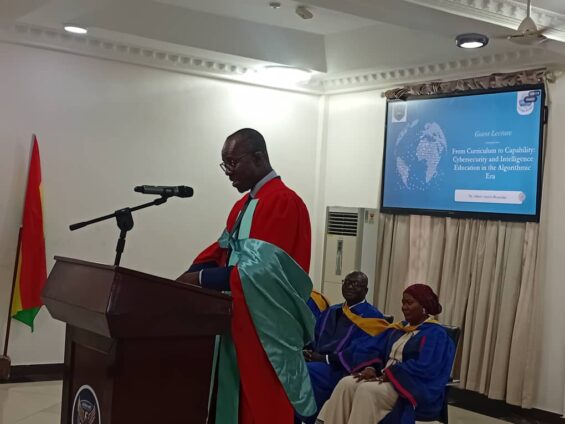
Delivering a public lecture on the theme ” From Curriculum to Capability: Cybersecurity and Intelligence Education in the Algorithmic Era,” at the launch of MSc programmes in Cybersecurity and Digital Forensics, as well as Security and Intelligence, at Accra Metropolitan University College on Wednesday, April 22, Dr Albert Antwi-Boasiako stressed that academic training must move beyond theory to practical capability.
“Bridging the gap between education and real-world capability requires structural change. Education should therefore be seen as a formation rather than an instruction,” he advised.
Dr Antwi-Boasiako argued that institutions must transition from content-driven teaching to a model that shapes well-rounded professionals grounded in discipline, resilience and ethical clarity. He emphasised the need for students to gain exposure to real-life operational environments before graduating.
“Students should graduate with practical experience, with exposure to live environments including participation in real investigations or simulations,” he noted. “Capability is built when knowledge meets reality.”
He underscored that professional competence is not static but evolves through continuous learning and adaptation.
“Capability is never a destination. It emerges through experimentation and repetition, it emerges through failures, and it emerges through reflections on what will positively contribute to the human condition,” he stated.
Addressing the global cybersecurity workforce shortage, Dr Antwi-Boasiako pointed to a mismatch between academic training and industry demands. Citing findings from Fortinet’s 2024 Skills Gap Report, he highlighted that the global shortfall in cybersecurity professionals stands at approximately four million.
Read also:
- Gov’t to Deploy 2,500 Transformers in Kumasi to Improve Power Supply Reliability
- Banks’ Earnings Rise As Costs Growth Moderates Sharply
- WHO Tests Global Pandemic Preparedness in Major Global Simulation Exercise
- GRIDCo Fire Outbreak: 2 Generation Units Have Been Restored – Energy Minister
- We Inherited Crisis And Confronted It Head-On, Honourable Jinapor
“The issue is not really about the quantity of education, but the relevance of the educational curriculum and approach,” he explained. “Graduates often understand concepts such as firewalls, encryption and threat models, but struggle to apply this knowledge in real-world scenarios.”
He added that over 70 per cent of organisations report a shortage of job-ready cybersecurity talent, reinforcing the urgency for reforms aimed at producing “capability-ready” graduates.
Dr Antwi-Boasiako, who is currently the Executive Chairman of E-Crime Bureau, also called for a reconfiguration of academic faculty structures, advocating the integration of industry practitioners into teaching roles to ensure that instruction reflects operational realities.
“In the Algorithmic Era, our academic faculties must embody both academic rigour and operational experience,” he said. “Teaching must be informed by practice, not abstraction.”
He urged institutions to rethink assessment models to prioritise critical thinking, judgement and analytical depth, particularly as artificial intelligence continues to reshape decision-making processes.
“In an age of intelligent machines, human value lies in judgment, ethics and responsibility. Machines can optimise decisions, but only humans can justify them,” he observed.
Positioning cybersecurity as a national priority, he called for deliberate state-led strategies to develop talent pipelines and strengthen intelligence capabilities.
“Our Republic must intentionally develop cybersecurity workforce strategies, intelligence capability pipelines and early talent identification systems,” he said, adding that the new programmes at Accra Metropolitan University College align with this broader national development agenda.