ELS: MBN360 NEWSOn that authority, the Court found nothing improper in the Attorney-General announcing his representation of the Chief Justice in this case.
The Discrimination Argument Rejected
The central plank of Oppong Nkrumah’s application was that assigning specific criminal cases to judges during the legal vacation violated the constitutional guarantee of equality and non-discrimination under Article 17.
The Court rejected that argument outright, holding that there was no evidence that the Chief Justice had directed that the law be applied differently to persons appearing before the courts.
The Court noted a further difficulty with the applicant’s own case. Oppong Nkrumah had himself acknowledged that the Chief Justice possessed discretion to issue warrants assigning judges to conduct cases, a concession the Court treated as working against his discrimination claim.
“I am unable to see how the directive assigning cases to be heard during the legal vacation can be said to be discriminatory,” the Court held. Justice Pwamang observed that the warrants were clear on their face, requiring only that the assigned judges conduct cases already pending before their respective courts.
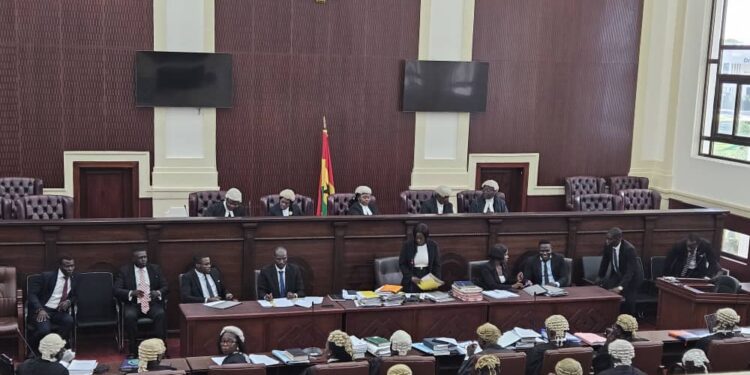
The Supreme Court has dismissed the interlocutory injunction application filed by Ofoase-Ayirebi MP Kojo Oppong Nkrumah, which sought to stay High Court criminal trials until the final determination of his case challenging the constitutionality of warrants the Chief Justice issued authorising judges to hear trials during the legal vacation.
Justice Gabriel Scott Pwamang, sitting as a single judge, ruled that Oppong Nkrumah had failed to establish a sufficiently strong case to justify an injunction against the Chief Justice’s exercise of his constitutional and administrative powers.
The decision means the trials that had been paused pending the outcome, including the Adu-Boahene case, can now resume, even as the underlying constitutional challenge to the warrants continues separately.
Before addressing the merits, the Court dealt with a procedural objection over who could appear for the Chief Justice. Justice Pwamang explained that the Supreme Court had previously held in Republic v Tsatsu Tsikata that the Chief Justice, as a public official, could be represented by the Attorney-General in proceedings brought against him.
Read also:
Critically, the Court noted that Oppong Nkrumah had not alleged that the Chief Justice’s selection of cases was influenced by the colour, gender, religion or any other constitutionally prohibited characteristic of the accused persons or witnesses involved, a gap the Court treated as fatal to an Article 17 claim built on selective treatment.

Advancing Justice, Not Undermining It
The Court framed the warrants as part of a broader administrative effort rather than a scheme targeting particular defendants. It held that the warrants formed part of efforts to create opportunities for more criminal cases to be heard and determined expeditiously, addressing the pressure of case backlogs within the court system.
Justice Pwamang stressed that the fact certain criminal cases are not ordinarily heard during the legal vacation does not mean the administration of justice cannot be advanced during that period.
The reasoning positions vacation sittings as an exercise of discretion aimed at efficiency rather than a departure from due process that requires special constitutional justification.
What the Ruling Does and Does Not Settle
Justice Pwamang, presiding as a solo judge, dismissed the application in full. The ruling resolves only the narrower question of whether trials should have paused while the larger dispute plays out.
It leaves undecided the substantive challenge Oppong Nkrumah filed on August 14, which argues that Order 79 of the High Court (Civil Procedure) Rules, 2004, and the Chief Justice’s warrants issued under it, are unconstitutional, that they breach the right to health of lawyers and judicial staff required to work through the recess, and that selective case assignment amounts to unequal treatment before the law.

That case will now proceed on its own timetable before the full Supreme Court, separate from the injunction bid Justice Pwamang has just rejected. The practical effect is immediate.
High Court trials that had been stayed pending the Supreme Court’s determination, including the prosecution of former National Signals Bureau Director-General Kwabena Adu-Boahene and his wife Angela Adjei-Boateng, are no longer blocked by the injunction question and can proceed under the Chief Justice’s existing warrants while the constitutional case against those same warrants continues to be argued.
The ruling leaves the Chief Justice’s authority to schedule vacation sittings intact for now, while the broader question of whether that authority was exercised constitutionally remains open before the Supreme Court.