
Els: MBN360 News
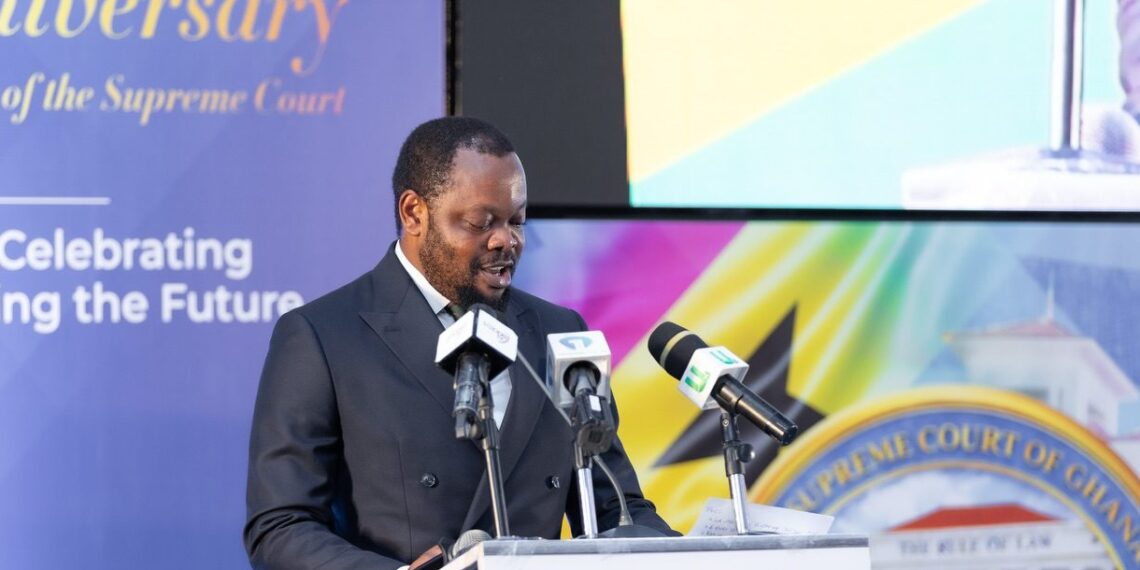
Deputy Attorney General and Minister of Justice, Dr. Justice Srem Sai, has stated that the challenges facing the Office of the Special Prosecutor can only be resolved through a constitutional amendment, rather than ordinary legislation.
He explained that while the importance of the Office of the Special Prosecutor is widely accepted, the current debate is centered on concerns about its legitimacy and constitutionality.
According to him, these concerns have existed since the inception of the office and are now being brought to the forefront through legal challenges.
Dr Srem Sai noted that many lawyers who understand constitutional law have long held the view that establishing an independent prosecutorial body requires changes to the Constitution.
“I don’t know any lawyer, even as of today, I don’t know any lawyer who honestly believes that to create an independent prosecutorial authority in Ghana, we just have to use ordinary legislation to do that”.Dr Justice Srem Sai, Deputy Attorney General and Minister for Justice
Legal Challenges Not a New Development
The Deputy Attorney General pointed out that the objections being raised in court against the authority of the Office of the Special Prosecutor are not unprecedented. He explained that individuals facing prosecution have, in the past, challenged the authority of prosecuting bodies and succeeded in court.

He referenced previous cases such as Republic versus Mohammed Shafik at Nijadi and ISSA versus the Republic, where courts upheld objections that ultimately halted prosecutions. These examples, he said, demonstrate that it is within the rights of accused persons to question the legality of the authority prosecuting them.
According to him, raising such objections does not amount to opposition to anti corruption efforts. Rather, it reflects the exercise of legal rights within the framework of due process.
Dr Srem Sai emphasized that the current situation should be viewed through the lens of the rule of law. He explained that when a court determines that a prosecuting authority has failed to demonstrate proper authorisation, the decision must be respected, even if it generates public concern.
He stated that disagreements with court rulings should be addressed through established legal channels, including appeals. He rejected claims that the issue represents a conflict between the Attorney General’s office and the Office of the Special Prosecutor, clarifying that his office was not involved in initiating the case that triggered the controversy.
According to him, the Attorney General’s office only became aware of the matter after the court had delivered its decision, making it inaccurate to portray the situation as an institutional dispute.
Constitutional Amendment as the Way Forward
Dr Srem Sai reiterated that the most effective and lasting solution is to amend the Constitution to properly establish an independent prosecutorial authority.
He explained that the Constitution clearly outlines how state powers are assigned and that any attempt to alter those arrangements must follow the formal amendment process.

He stressed that relying on ordinary legislation to create such an office exposes it to legal challenges, as courts may find inconsistencies between the law and the Constitution. This, he said, is the underlying issue in the current debate.
He added that this position is not new and has been consistently held by the Attorney General’s office as well as supported by legal precedents and opinions from experienced practitioners.
Read also:
- Rihanna makes history as first woman to hit 200 million RIAA certifications
- Black Panther star Aba Arthur champions authentic storytelling at Ohemaa Project masterclass
- Omane Boamah’s son selected for International Mathematics Olympiad
- Yeji Prison Outreach Sensitizes Students On Crime Prevention Strategies
- “Happy” Caicedo Commits Long-term Future to Chelsea
Debate Over Independence and Authorisation
A key aspect of the controversy, according to Dr Srem Sai, is whether the Office of the Special Prosecutor requires authorisation from the Attorney General to prosecute cases. He explained that this question goes to the heart of the office’s independence.
He noted that if the office is truly independent, it should not require authorisation from another institution. However, he pointed out that the existing legal framework raises questions about whether such authorisation is necessary.
He added that this position is not new and has been consistently held by the Attorney General’s office as well as supported by legal precedents and opinions from experienced practitioners.
Debate Over Independence and Authorisation
A key aspect of the controversy, according to Dr Srem Sai, is whether the Office of the Special Prosecutor requires authorisation from the Attorney General to prosecute cases. He explained that this question goes to the heart of the office’s independence.
He noted that if the office is truly independent, it should not require authorisation from another institution. However, he pointed out that the existing legal framework raises questions about whether such authorisation is necessary.
Dr Srem Sai clarified that the issue is not about the willingness of the Attorney General to grant authorisation. Instead, it is about determining whether the law requires the Office of the Special Prosecutor to obtain such approval before exercising prosecutorial powers.
The Deputy Attorney General explained that, under current practice, institutions that require prosecutorial authority must receive formal authorisation from the Attorney General. This is typically done through an executive instrument that specifies which individuals are permitted to prosecute on behalf of the state.
He cited examples such as the Economic and Organised Crime Office, where only designated lawyers are authorised to prosecute cases. He indicated that a similar process could apply to the Office of the Special Prosecutor if necessary.
However, he emphasized that the broader issue remains unresolved, as the debate is fundamentally about the constitutional basis of the office rather than administrative arrangements.
Concerns About Legal Precedent
Dr Srem Sai warned that allowing Parliament to assign constitutional powers through ordinary legislation could create a dangerous precedent. He explained that if such an approach is accepted, it could open the door for similar actions in other areas of governance.
He argued that the law must be applied consistently and that constitutional procedures should not be bypassed, even in pursuit of objectives that are widely supported. According to him, maintaining these safeguards is essential to preventing abuse of power.

He added that legal principles are designed to ensure that authority is exercised within clearly defined limits, protecting both institutions and individuals.
The Deputy Attorney General concluded by reaffirming the government’s commitment to resolving the matter in a way that upholds the Constitution and serves the public interest. He stated that any steps taken will be carefully considered to balance legal requirements, institutional integrity, and the fight against corruption.
He emphasized that the Office of the Special Prosecutor remains an important institution, but its long term effectiveness depends on a solid constitutional foundation. According to him, pursuing a constitutional amendment is the most appropriate path to achieving that goal while preserving the rule of law.