Els: MBN360 Africa
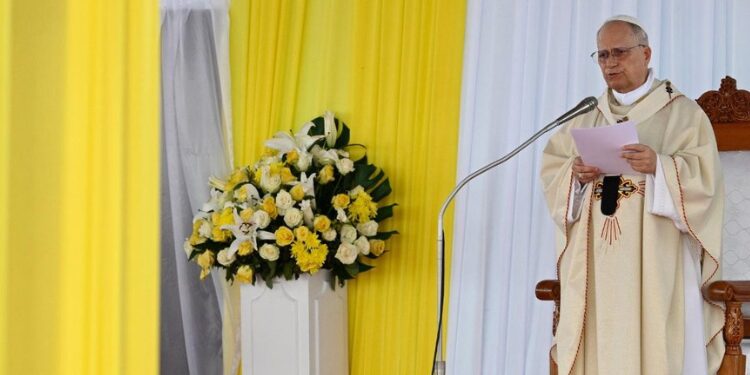
Pope Leo XIV has urged Africans to reject violence, corruption and discouragement during a major Mass at Japoma Stadium in Douala, Cameroon, where hundreds of thousands of worshippers gathered as part of his ongoing four-nation Africa tour.
The Holy Mass, attracted an estimated 120,000 faithful, according to Vatican figures cited by local authorities. The gathering formed a central moment in the Pope’s Africa itinerary, which has been marked by strong messages on inequality, governance, conflict and global injustice, drawing widespread attention across the continent and internationally.
Throughout the visit, Pope Leo XIV has consistently called for peace, accountability and social justice, warning against corruption while urging communities to defend human dignity. In his remarks in Cameroon, he also pointed to the stark contrast between the country’s natural resources and the widespread poverty experienced by many citizens.
Speaking during the Mass at Douala, the Holy Father called for resilience in the face of hardship and encouraged people to remain steadfast and hopeful despite difficult conditions.
“Do not give in to distrust and discouragement. Reject every form of abuse or violence, which deceives by promising easy gains but hardens the heart and makes it insensitive. Do not forget that your people are even richer than this land, for your treasure lies in your values: faith, family, hospitality, and work.”Pope Leo XIV
The Holy Father also reflected on the Gospel account of the multiplication of the loaves and fishes, delivered to a vast crowd. He noted that, just as in Jesus’ time, people continue to ask where God is in moments of widespread need and suffering.
Pope Leo XIV explained that Christ’s response to human hunger was demonstrated through sharing and collective generosity.
“A serious problem was solved by blessing the little food that was present and sharing it with all who were hungry,” he said. “The multiplication of the loaves and the fish happened while sharing: that is the miracle!”Pope Leo XIV
He warned against behaviours that deepen scarcity and inequality, stressing that food and resources must not be lost through conflict, hoarding or waste, arguing that such actions undermine collective wellbeing.
According to the Pontiff, as long as bread is not stolen in strife, hoarded through rationing, or wasted by those who gorged themselves, there is food for everyone.
Read also:
- Rihanna makes history as first woman to hit 200 million RIAA certifications
- Black Panther star Aba Arthur champions authentic storytelling at Ohemaa Project masterclass
- Omane Boamah’s son selected for International Mathematics Olympiad
- Yeji Prison Outreach Sensitizes Students On Crime Prevention Strategies
- “Happy” Caicedo Commits Long-term Future to Chelsea
Beyond physical needs, the Pontiff emphasised that societies also require moral, spiritual and social nourishment rooted in peace, justice and freedom, describing solidarity and forgiveness as vital contributions to human dignity.
Besides our material necessity, we also hunger for the bread of life in peace, freedom, and justice, and our every act of solidarity and forgiveness becomes “a morsel of bread for humanity in need of care. Yet this alone is not enough,” said Pope Leo XIV .
“The food that sustains the body must be accompanied, with equal charity, by nourishment for the soul a nourishment that sustains our conscience and steadies us in dark hours of fear and amid the shadows of suffering.”Pope Leo XIV
Kenyan Bishops Call for National Renewal and Social Justice

Kenya Conference of Catholic Bishops, on the other hand, has called for broad national renewal anchored in respect for human life, ethical leadership, and stronger social justice, in a pastoral message addressed to both Catholics and the wider public.
The Bishops reflected on Pope Leo XIV’s global appeal for dialogue and reconciliation, warning that ongoing international conflicts are having ripple effects that extend to countries such as Kenya, particularly in economic and social terms.
Their message centred on the sanctity of life. The bishops expressed concern over recent occurrences of inexplicable killings and deaths, warning that recurrent examples risk being normalized in public life.
They warned that indifference, particularly when victims are from vulnerable groups, has the potential to destroy the country’s moral and social fabric if accountability is not increased.
The bishops also criticised a decline in the tone and quality of public discourse, citing rising political intolerance, insults, and instances of violence linked to political activity. They also condemned the involvement of young people in disruptive actions and warned against the growing acceptance of “goonism,” urging leaders to demonstrate responsibility and dignity in public engagement.
According to the Bishops statement, “we cannot afford to descend into a culture of disrespect and fear,” instead advocating for political behaviour that prioritises the common good and defends the dignity of all citizens.
The bishops also expressed concern about unresolved abductions and threats against young people, emphasising the urgent need for justice, accountability, and the safeguarding of fundamental freedoms.-