
ELS: MBN360 Extractives/Energy
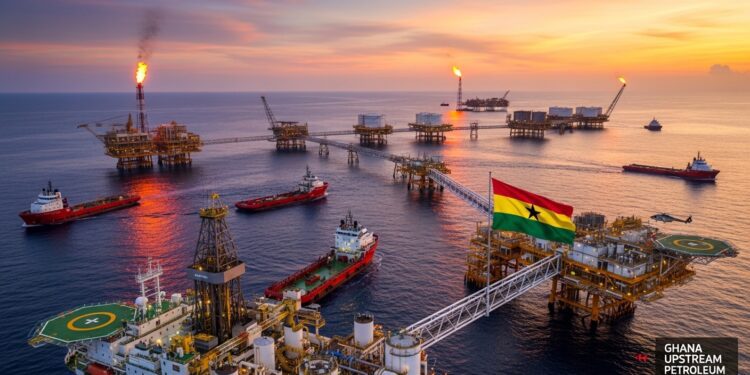
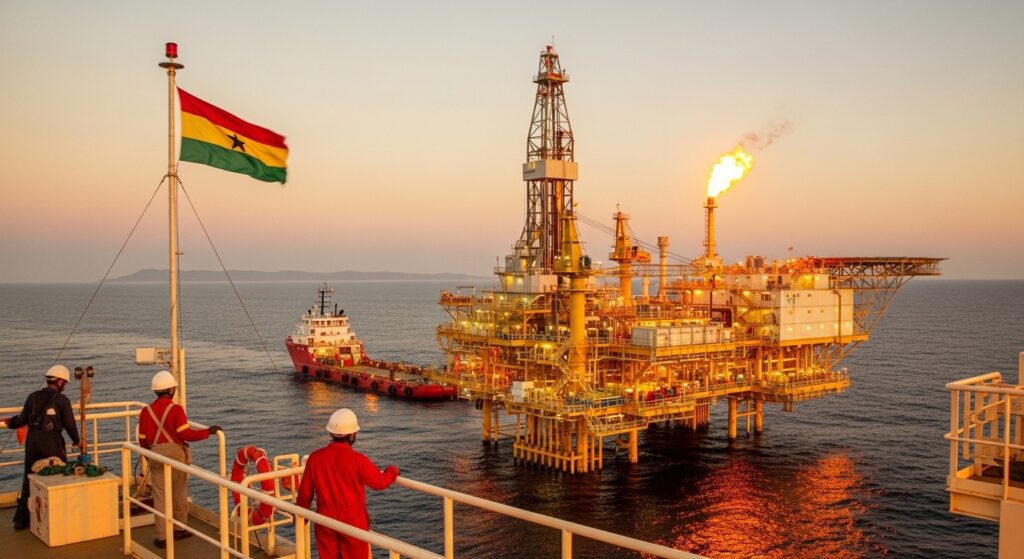
Ghana’s upstream petroleum industry is facing mounting pressure as crude oil production continues its prolonged decline, raising fresh concerns over the country’s fiscal resilience, energy security and long-term ability to maximise value from its hydrocarbon resources.
A new analysis indicates that the sustained fall in production is increasingly eroding petroleum revenues at a time when government finances remain under pressure and demand for foreign exchange remains high.
The latest assessment by the Institute for Energy Security (IES), cited by Norvan Reports, paints a troubling picture of an industry that has struggled to reverse falling output despite petroleum remaining one of Ghana’s most strategic economic sectors. The report suggests that without sustained upstream investment, continuous field development and renewed exploration, the country’s oil production could continue its downward trajectory into a seventh consecutive year.
The findings come even as operators at some of Ghana’s major offshore fields have recently reported encouraging drilling results, underscoring the growing importance of translating isolated production gains into a broader recovery strategy for the entire upstream sector.
Six years of falling output raise fresh concerns
According to the IES report, Ghana’s crude oil production declined from 71.44 million barrels in 2019 to 37.30 million barrels in 2025, representing a reduction of 47.79 percent over the six-year period.
The report further notes that projections by the Energy Commission indicate production could decline again in 2026 to 34.83 million barrels, extending what has become one of the country’s longest periods of sustained production decline since commercial oil production began in 2010.

The figures suggest Ghana is producing almost half the volume of crude oil it did six years ago, a trend that has significant implications for public finances given the sector’s contribution to export earnings, government revenue and foreign exchange inflows.
Ghana’s crude oil production fell from 71.44 million barrels in 2019 to 37.30 million barrels in 2025, representing a contraction of 47.79%.Institute for Energy Security (IES)
The report also highlights that continued production declines risk reducing the country’s ability to benefit fully from existing petroleum assets while the global energy industry undergoes a gradual transition towards lower-carbon energy systems.
Revenue losses extend beyond the oil sector
The decline in production has translated directly into lower petroleum revenues for the state.
According to the report, total petroleum receipts fell by 43.30 percent to US$770.30 million in 2025 from US$1.36 billion recorded the previous year, reflecting both weaker production volumes and softer international crude prices.
Total petroleum receipts dropped by 43.30% to US$770.30 million in 2025, compared with US$1.36 billion in 2024.Institute for Energy Security
For Ghana, the consequences extend well beyond the petroleum industry itself.
Oil revenues remain an important component of government income, supporting expenditure through royalties, corporate income taxes, carried and participating interests, as well as surface rentals. Reduced production therefore limits the fiscal resources available to government while simultaneously affecting the Ghana National Petroleum Corporation’s ability to finance future investments.
At a time when Ghana continues implementing fiscal consolidation measures and rebuilding macroeconomic stability, declining petroleum receipts further narrow the country’s fiscal space.
Lower export volumes also reduce foreign exchange earnings, placing additional pressure on the balance of payments and the cedi during periods of external shocks.
Investment needed to reverse production trend
The report argues that Ghana’s declining output is not solely the result of maturing oil fields but also reflects the absence of sufficient field redevelopment, continuous drilling programmes and new exploration activity capable of replacing depleted reserves.
Read also:
- World Gold Council commits initial US$250,000 to support Ghana’s responsible mining drive
- Vice President heads to U.S. for Sister Cities International 70th Anniversary Conference
- President Mahama receives Wisconsin Governor on Accra visit
- CID rescues nine trafficking victims, arrests ten in Afienya cybercrime operation
- FiFA Re-Activates the old adage of “Robbing Peter to Pay Paul”
According to the IES, the country may have forgone substantial petroleum value by failing to sustain production through ongoing upstream investment.

The IES estimates that Ghana forfeited more than US$16.50 billion in potential gross petroleum revenues between 2019 and 2025 under a scenario where production had been sustained through continuous field development, new exploration licences and improved reservoir management.Institute for Energy Security
The assessment reinforces concerns that declining investment across Africa’s upstream petroleum sector could reduce production even before global oil demand reaches its long-term peak.
For Ghana, the challenge is particularly significant because several of its producing fields have entered mature phases that require additional capital expenditure to sustain output.
Industry analysts have increasingly pointed to enhanced recovery techniques, infill drilling and accelerated exploration as critical measures needed to slow production decline.
Signs of recovery offer cautious optimism
Despite the broader industry downturn, recent operational developments suggest parts of Ghana’s upstream sector may be showing early signs of recovery.
As previously reported, ENI recently achieved record gas production of about 282 million standard cubic feet per day, supporting domestic power generation while maintaining operational reliability exceeding 99.9 percent.
Similarly, Kosmos Energy has reported improved production performance at the Jubilee Field following the successful drilling of new wells, with output expected to increase further as additional wells come on stream.
These developments demonstrate that targeted upstream investments can deliver measurable production gains even within mature petroleum assets.
However, analysts caution that isolated operational successes alone may not be sufficient to reverse Ghana’s overall production decline unless accompanied by broader exploration activity and sustained sector-wide investment.
Balancing today’s petroleum value with tomorrow’s transition
The report also arrives amid growing debate over how Ghana should position its petroleum sector as the global energy transition accelerates.

Recent discussions within the Public Interest and Accountability Committee (PIAC) have highlighted the importance of ensuring that international climate policies do not undermine Ghana’s ability to derive value from existing petroleum resources before alternative industries are fully developed.
That perspective has gained additional relevance as production declines continue to reduce petroleum revenues independently of the global transition.
For policymakers, the immediate challenge is therefore twofold: restoring confidence in upstream investment while ensuring petroleum revenues generated today support long-term economic diversification.
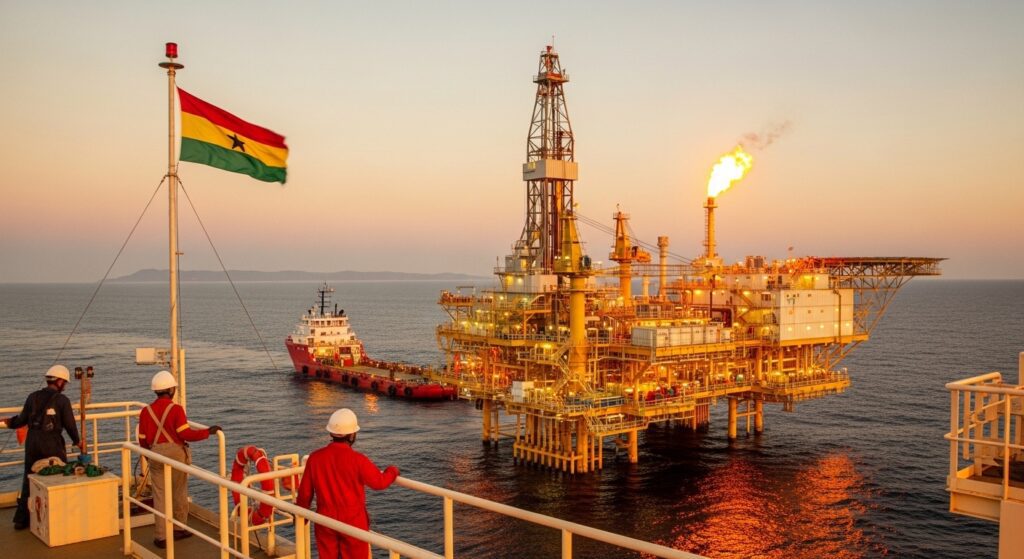
Maintaining production does not imply delaying the transition to cleaner energy. Rather, it reflects the reality that petroleum continues to finance public investment, support energy security and generate foreign exchange needed to strengthen other sectors of the economy.
The latest IES assessment therefore reinforces the urgency of developing a comprehensive upstream strategy that combines continuous field development, renewed exploration, regulatory certainty and investment promotion.
Without such measures, Ghana risks seeing declining production further weaken one of its most important revenue-generating sectors at a time when every additional barrel produced carries growing economic significance.