Els: MBN360 Features,
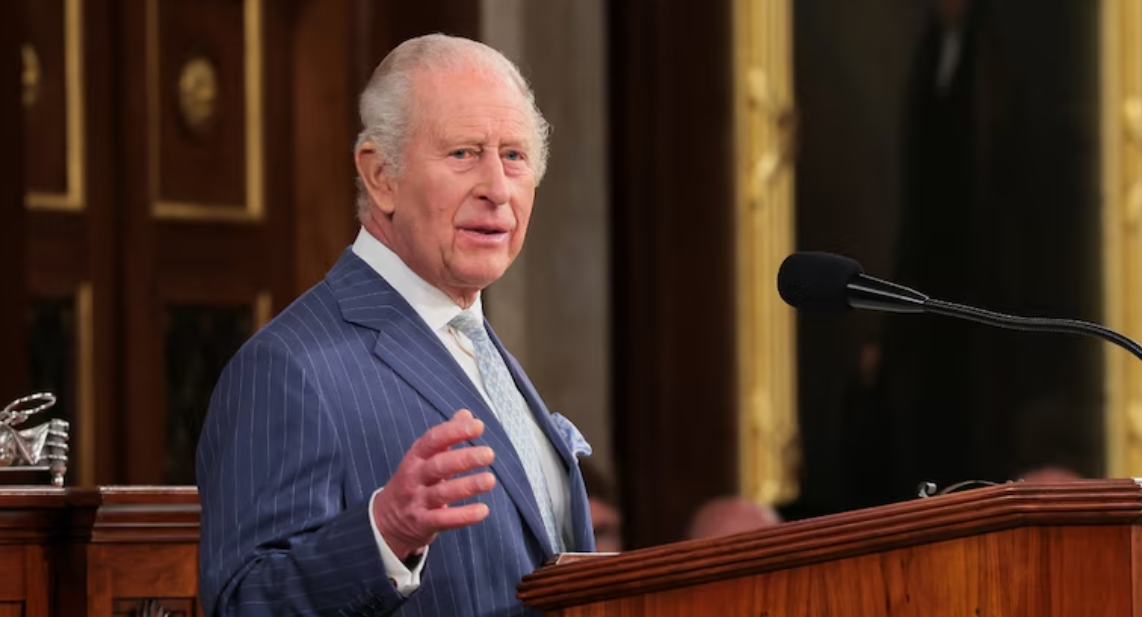
King Charles III reaffirmed the enduring bond between the United Kingdom and the United States on Tuesday during a historic address to a joint session of Congress. The monarch’s visit comes at a delicate diplomatic juncture, following the United Kingdom’s refusal to join the United States and Israel in initial military strikes against Iran—a decision that has strained ties between the White House and Downing Street. Marking the 250th anniversary of America’s independence from British rule, the King characterized the trans-Atlantic journey as a “story of reconciliation, renewal and remarkable partnership” born out of “bitter divisions of 250 years ago.”
Standing on the same dais where his mother, Queen Elizabeth II, spoke 35 years ago, the King reflected on the transformation of the two nations. “From the bitter divisions of 250 years ago, we forged a friendship that has grown into one of the most consequential alliances in human history,” he told the assembled lawmakers. The 28-minute speech was punctuated by several standing ovations from both sides of the aisle.
A Legacy of Shared Democratic Values
The King drew a direct line from ancient English law to the American judicial system. He noted that the Magna Carta is cited in at least 160 U.S. Supreme Court cases. He described the document as “the foundation of the principle that executive power is subject to checks and balances.”
This specific reference triggered some of the most enthusiastic applause of the afternoon from both Democrats and Republicans. The King emphasized that the two nations are anchored by “common democratic, legal and social traditions.” He argued that this shared framework allows the allies to find a way to “come together” despite modern challenges.
Navigating Global Conflict and Uncertainty
The royal visit comes amid significant international tension, including the conflict in Iran and ongoing wars from Europe to the Middle East. Charles acknowledged that the current global environment is “more volatile and more dangerous than the world to which my late mother spoke.” He urged the international community to resist “clarion calls to become ever more inward-looking.”
While the King did not mention specific policy disputes, he called for “unyielding resolve” in supporting Ukraine and reinforced the importance of the NATO alliance. “The story of the United Kingdom and the United States is, at its heart, a story of reconciliation, renewal and remarkable partnership,” Charles stated. He added that when the two nations agree, “And by Jove, Mr. Speaker, when we have found that way to agree, what great change is brought about — not just for the benefit of our peoples, but of all peoples,” Charles said. “This, I believe, is the special ingredient in our relationship.”
Addressing Political Violence and Personal Ties
Read also:
- Ice Prince opens up on quitting sex, alcohol and smoking
- Understanding hantavirus, illness suspected in cruise ship outbreak
- I quit smoking because I’m asthmatic – Reggie Rockstone
- Mahama rallies chiefs, security agencies against rising drug abuse among youth
- Zelenskyy Discusses PURL Initiative On European Political Community Summit Sidelines
At the opening of his remarks, the King addressed the recent assassination attempt at the White House Correspondents’ Association dinner. Having previously called President Donald Trump to express sympathy, the King told Congress, “Let me say with unshakeable resolve: Such acts of violence will never succeed.” House Majority Leader Steve Scalise, who survived a 2017 shooting, was among the first to applaud.
Despite the President’s public friction with British Prime Minister Keir Starmer—whom Trump disparaged as “no Winston Churchill” for not joining initial attacks on Iran—the relationship between the White House and the Palace remains cordial. Trump and First Lady Melania Trump hosted the King and Queen Camilla for a state dinner Tuesday night. The President, who previously hosted the royals at Windsor Castle, praised the King as a “fantastic person.” “American patriots today can sing, ’My country, ’tis of thee, sweet land of liberty,’ only because our colonial ancestors first sang, ‘God save the king,’” Trump remarked.
Confronting Societal Ills and the Epstein Fallout
The King’s visit was shadowed by the ongoing legal fallout surrounding Jeffrey Epstein and the February arrest of the King’s brother, Andrew Mountbatten-Windsor. While Charles declined requests to meet with survivors during his trip, he used his platform to acknowledge the “victims” of societal failures. He spoke of the “vibrant, diverse and free societies that gives us our collective strength, including to support victims of some of the ills that, so tragically, exist in both our societies today.”
Representative Ro Khanna, D-Calif., hosted a roundtable with survivors earlier that day and criticized the King’s absence. “I thought the king owed that to the survivors, given his brother’s serious allegations of abuse,” Khanna said. The King’s speech instead focused on the “deliberation of many, representing the living mosaic of the United States,” rather than the “will of one.”
Historical Echoes and Diplomatic Wit
The King delivered his remarks from the same chamber where President Franklin D. Roosevelt spoke after Pearl Harbor. He recalled how his mother spoke in 1991 following the Gulf War, when she noted, “Some people believe that power grows from the barrel of the gun. So it can, but history shows that it never grows well nor for very long.” Charles also nodded to his grandparents, King George VI and Queen Elizabeth, who in 1939 became the first reigning British monarchs to visit the U.S. Capitol.
Charles lightened the atmosphere by referencing the tradition of taking a Member of Parliament “hostage” at Buckingham Palace during royal speeches. “These days, we look after our ‘guest’ rather well — to the point that they often do not want to leave! I don’t know, Mr. Speaker, if there were any volunteers for that role here today?” He also quipped about his ancestor, George III, in what he called a “Tale of Two Georges.” “King George never set foot in America, and please rest assured, I am not here as part of some cunning rearguard action!”
A Shared Responsibility for the Future
The conclusion of the King’s 20th visit to the United States underscores a pivotal moment of environmental and diplomatic alignment. As the White House modifies climate regulations, the King pointedly encouraged those in power to “reflect on our shared responsibility to safeguard nature, our most precious and irreplaceable asset.” By invoking the sterile nature of force and the enduring strength of “mutual agreement, on contract and on consensus,” the visit serves as a calculated bridge between a storied past and a volatile future, ensuring that the “special ingredient” of the trans-Atlantic alliance remains intact regardless of the political climate.