Els: MBN360 Sports
The Confederation of African Football (CAF) and the Union of European Football Associations (UEFA) have formalized a wide-ranging strategic partnership aimed at accelerating football development across Africa and Europe.
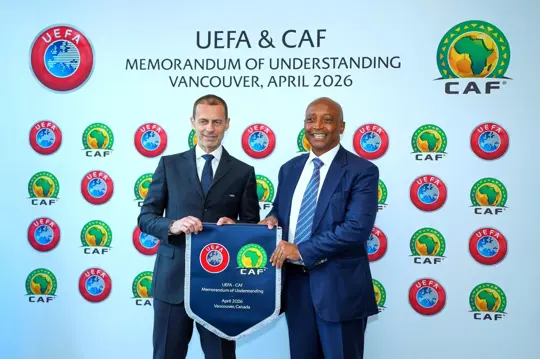
The agreement, signed in Vancouver, Canada, by CAF President Patrice Motsepe and UEFA President Aleksander Čeferin, takes the form of a Memorandum of Understanding (MoU) that will run until June 30, 2031.
At its core, the partnership seeks to deepen collaboration between the two confederations while leveraging football as a tool for inclusion, participation and social cohesion. Both governing bodies reaffirmed their commitment to integrity, solidarity and openness, principles they say will guide the implementation of the agreement over the next five years.
Dr. Motsepe stressed the significance of the deal in the context of Africa’s recent football growth. He pointed to steady progress across competitions and talent development, noting that the continent is positioning itself among the global elite.
“African football has experienced significant growth in recent years,” he said.
“We are building towards making it among the best in the world.”
He added that the agreement strengthens long-standing ties between Africa and Europe, particularly through the success of African players in European leagues.
“This MoU strengthens our historic relationship,” Motsepe explained.“It reflects a shared vision of unity through football.”
Čeferin echoed similar sentiments, highlighting the broader social and developmental impact of the sport across both continents.
“Europe and Africa are home to extraordinary football landscapes. The game plays a vital role both on the pitch and in society.”UEFA President Aleksander Čeferin
Focus on Youth, Women’s Football and Technical Development
A central pillar of the agreement is the expansion of opportunities in youth and women’s football. Under the arrangement, CAF member associations will gain access to selected UEFA youth competitions, while collaborative initiatives will include exchanges tied to programmes such as the African Schools Football Championship.
Čeferin emphasized the importance of investing in younger generations and promoting gender inclusivity. “We want to expand opportunities for boys and girls,” he noted. “We also aim to advance women’s football and support wellbeing.”
The MoU also outlines structured development programmes designed to foster long-term partnerships between African and European member associations. These initiatives are expected to focus on grassroots systems, talent identification and sustainable football ecosystems.
Coaching education is another major component. Both organisations plan to share technical expertise, align coaching methodologies and facilitate collaborative learning platforms.
Read also:
- Malaria should not kill a child” — expert on path to elimination
- Work is killing 840,000 people a year, and stress is mainly the cause – UN report finds
- Council of State member commends President Mahama for visit to tidal wave-affected communities
- ‘No drumming, noise-making, roadside preaching from May 4’ – AMA warns
- Gov’t sets up interim team to manage Adamus mine
Motsepe described this as critical to raising standards across the continent.
“This partnership includes education and training of coaches. It ensures we build strong technical foundations.”Dr. Patrice Motsepe, CAF President
Refereeing will also benefit from the agreement, with provisions for exchange programmes involving match officials and instructors. The aim is to improve officiating standards through knowledge-sharing and exposure to different competitive environments.
Governance, Knowledge Exchange and Long-Term Impact
Beyond on-field development, the partnership places significant emphasis on governance and institutional strengthening. Regular meetings and progress reviews will be conducted to ensure effective implementation and alignment on shared priorities.
The MoU includes provisions for observer programmes at major tournaments, allowing officials from both confederations to gain insight into organisational best practices. There will also be collaboration on conferences and professional events, further enhancing knowledge exchange.
Education and capacity building form another layer of the agreement. This includes access to specialised programmes and cooperation in football medicine, with the development of structured training frameworks aimed at improving player welfare and performance.
Dr. Motsepe highlighted the broader societal role of football within the partnership. “Football is a tool to unite people,” he said. “It brings hope, joy and opportunity.”
He added that combining resources and expertise would amplify the game’s impact globally.
Čeferin reinforced that perspective, focusing on long-term community benefits. “We aim to invest in people,” he said. “We want to strengthen football’s lasting impact on communities.”
The agreement also leaves room for future joint initiatives, signaling that CAF and UEFA intend to evolve the partnership beyond its current framework. With the MoU set to run through 2031, both organisations are positioning the collaboration as a cornerstone for sustained growth, not just in elite competitions, but across grassroots, governance and social development structures.
Ultimately, the deal reflects a shared conviction that football can serve as more than a sport, acting as a vehicle for education, unity and opportunity across two of the world’s most influential football regions.