
Els: MBN360 Education
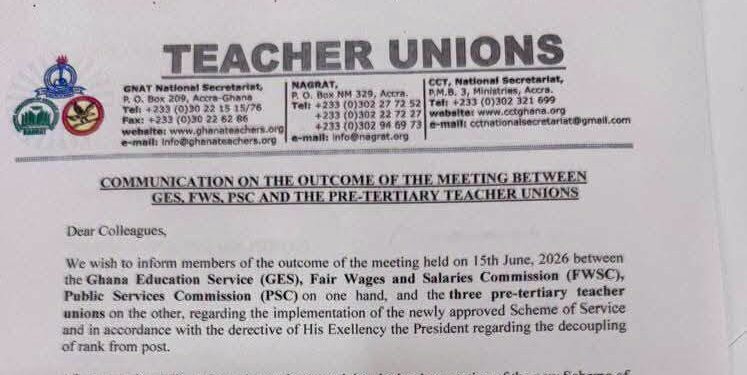
The Ghana National Association of Teachers (GNAT), the National Association of Graduate Teachers (NAGRAT), and the Coalition of Concerned Teachers Ghana (CCT-GH) have reached an agreement with the Ghana Education Service (GES), the Fair Wages and Salaries Commission (FWSC), and the Public Services Commission (PSC) to implement the newly approved Scheme of Service in phases.
The arrangement marks a major step in the government’s effort to decouple rank from post within the Ghana Education Service. The decision was contained in a joint communication issued by the three pre-tertiary teacher unions, following a meeting held on June 15, 2026, between the unions and the three state institutions.
The engagement focused on the operationalisation of the new Scheme of Service and the implementation of the President’s directive on separating rank from post in the Ghana Education Service.
According to the statement, all parties agreed that implementation of the Scheme of Service, migration to appropriate ranks, and corresponding salary placement would be carried out in phases to ensure an orderly, transparent, and accurate process.
Phased Implementation Structure
Under the agreed arrangement, the first phase will cover officers occupying the ranks of Director I, Director II, and Deputy Director. Subsequent phases will extend the exercise to all remaining ranks within the Ghana Education Service, in line with an agreed implementation schedule.

The unions indicated that the phased approach was adopted after extensive deliberations among all parties, aimed at ensuring smooth execution and reducing administrative errors during the migration and placement process.
The Scheme of Service is expected to bring long-awaited clarity to thousands of education professionals who have been awaiting its full operationalisation following government approval. It represents one of the most significant reforms in Ghana’s pre-tertiary education sector in recent years.
Migration and Data Verification Process
To support implementation, the parties agreed that all relevant information required for migration and salary placement would be drawn from teachers’ personal files. Data verification will be undertaken across three administrative levels of the Ghana Education Service: schools, district education offices, and regional education offices.
The unions further noted that this multi-level verification process is intended to ensure accuracy and consistency in the migration exercise.
Read also:
- Mahama Unveils High-Powered Global Panels to Drive Reparatory Justice
- World Bank Approves Ghana’s $300m STAR-J Project to End Double-Track System
- Parliament congratulates Black Stars after 1-0 win over Panama in 2026 World Cup opener
- 2026 World Cup: Late Yirenkyi strike gives Ghana victory over Panama in opener
- 2026 World Cup: ‘We battled like warriors’ and won ‘with our brains’ – Queiroz opens up on Ghana’s victory
Teachers have therefore been urged to cooperate fully with school heads and education authorities whenever information is requested for verification and processing.
Union Position and Stakeholder Engagement
In the joint communication signed by Thomas T. Musah, General Secretary of GNAT; Jacob Anaba, President of NAGRAT; and King Ali Awudu, President of CCT-GH, the unions reaffirmed their commitment to continued engagement with all stakeholders throughout the implementation process.

They stressed that the phased rollout is intended to promote transparency, fairness, and efficiency in the exercise, while ensuring that all affected staff are properly placed under the new structure.
“After extensive deliberations, the parties agreed that the implementation of the new Scheme of Service, the migration to the appropriate ranks, and the corresponding salary placement exercise should be undertaken in phases.”Thomas T. Musah, General Secretary of GNAT; Jacob Anaba, President of NAGRAT; and King Ali Awudu, President of CCT-GH
The Scheme of Service is designed to provide a structured career progression framework within the Ghana Education Service. It defines qualifications, responsibilities, promotional pathways, and corresponding ranks for both teaching and non-teaching personnel.
It also forms part of broader public sector reforms aimed at strengthening human resource management, improving fairness in promotions, and ensuring that salary placement aligns with approved ranks rather than posts held.
Education stakeholders have long advocated for the reform, describing it as critical to improving professionalism, career development, and motivation among teachers.
Next Steps
With the agreement reached, attention now shifts to the commencement of verification and migration processes through schools, district offices, and regional education offices.

The first phase—covering Deputy Directors, Director II, and Director I officers—will be implemented before subsequent expansion to all remaining ranks within the Ghana Education Service.
The unions have assured members that they will continue to engage government and relevant institutions to ensure the process remains transparent, equitable, and beneficial to all affected teachers under the new Scheme of Service.