Els: MBN360 News
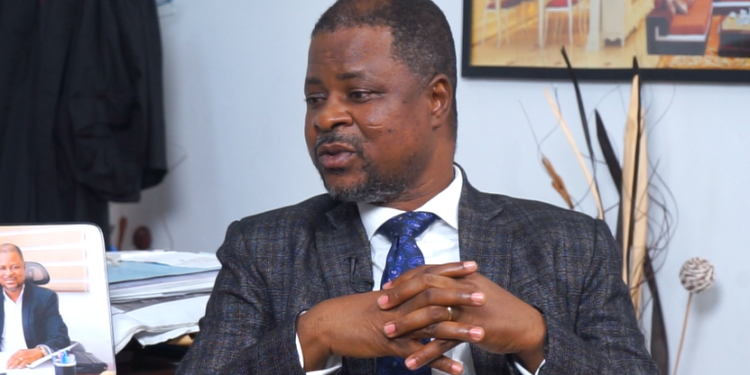
Former Deputy Attorney-General Joseph Kpemka has acknowledged, to some extent, that the Office of the Special Prosecutor (OSP) did not receive the necessary authorisation from the Attorney-General after its establishment, but argues that responsibility for activating the process also lay with the office itself.
His comments come amid renewed legal debate over the powers of the Office of the Special Prosecutor (OSP) under the Office of the Special Prosecutor Act, 2017 (Act 959), following a High Court ruling that questioned the basis of its prosecutorial authority.
The OSP, established in 2018 as Ghana’s flagship anti-corruption body, was designed to investigate and prosecute corruption-related offences. However, its mandate has recently come under scrutiny over the requirement for prior authorisation from the Attorney-Genera.
Kpemka, in an interview on Eyewitness News on Wednesday, April 15, said the early period after the passage of Act 959 created a political and institutional environment that discouraged efforts to seek formal approval.
“At the time, if you look at the euphoria that greeted the arrival of Act 959, it was as though anybody who triggered any process at that time [appeared] as if you were seeking to control or act in manners that will show that you were interfering with the work of Special prosecutor, you were likely to be an enemy of the state. So it looks like my boss [Gloria Akuffo] and all of us actually looked on and did not actually give this authorisation,” he said.
He explained that responsibility should also have rested with the OSP to actively pursue the Attorney-General for the necessary authorisation or seek legal enforcement where required.
Read also:
- Vice President Opoku Agyemang Addresses Ghanaian Diaspora In Spain
- Mahama says power outages are not “dumsor” but planned grid upgrades
- Pope Leo XIV Describes Angola as Beautiful Yet Wounded
- Ben Proudfoot calls for urgent digitisation of Ghana’s historic film archives
- Supreme Court must embrace technology to reduce delays – Nana Oye Bampoe Addo
“That is why I am saying that it was now incumbent on the implementors of that law namely the special prosecutor when the office came into existence to write to the AG to demand the authorisation which ought to be given in compliance with law otherwise you go for a court order to compel the AG give the authorisation to operationalise the law,” he added.
Kpemka further maintained that the recent High Court ruling was not an interpretation of the law, but rather a determination based on non-compliance with statutory requirements.
“Let me state clearly that the High Court from what I read did not interpret the Act. The high court did not interpret the act and to tell us the effect of Act 959 as far as the provision in section 42 is concerned. That is not what the High Court embarked upon,” he said.
He argued that only the Supreme Court has the authority to interpret the law in such constitutional matters.
“The interpretation to the law can only be done by the Supreme Court,” he stated.
The debate over the OSP’s prosecutorial independence continues to generate legal and policy discussions, particularly regarding the balance between institutional autonomy and oversight by the Attorney-General.