Els: MBN360 News
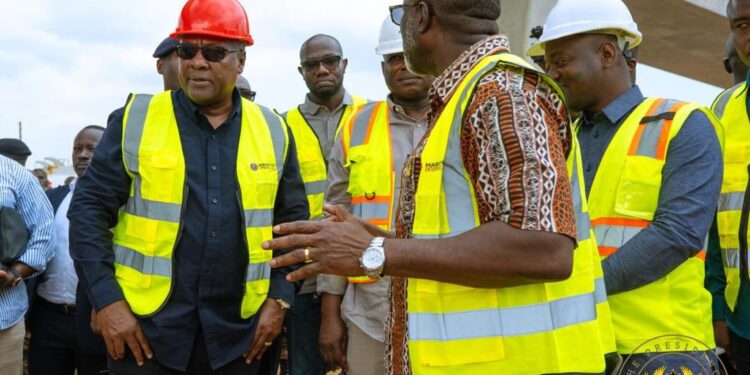
President John Dramani Mahama has undertaken a detailed inspection of the ongoing Kasoa to Winneba dualisation project, expressing confidence that the major highway will be opened to traffic by December 31, 2026, or shortly into the first quarter of 2027.
The visit forms part of the government’s Big Push infrastructure initiative aimed at addressing congestion and modernising key transport corridors across the country under Mahama’s administration.
Addressing concerns about delays and disruptions, the President acknowledged the frustrations of commuters but emphasized that temporary inconvenience is necessary to achieve long term gains.
He noted that the project is critical to easing traffic congestion along one of Ghana’s busiest highways and improving mobility between Accra and the Central Region.
“I can understand the frustration of commuters, but help is on the way,” he said, adding that the progress and quality of work observed during the inspection were encouraging.
Technical Design and Road Configuration
The project’s design reflects a deliberate effort to address both urban congestion and long distance traffic efficiency. According to the highway site engineer, the first 12 kilometre stretch from Kasoa to Akoti has been designed as an eight lane road.
This includes dedicated service lanes on both sides to handle local traffic and central lanes reserved for highway movement. Beyond this urban section, the road transitions into a dual carriageway through peri urban areas, with service lanes introduced only at key locations such as the Onion Market and Winneba.
This design ensures a balance between accessibility for communities and smooth highway travel. The full scope of the project includes seven grade separated interchanges positioned along the corridor to eliminate traffic conflicts and improve flow.
In addition, 15 pedestrian crossings have been constructed using a combination of overpasses and underpasses to enhance safety.
Construction Progress and Engineering Challenges
Work on the project has reached advanced stages, with physical structures between Akoti and Winneba, known as Lot 2A, approximately 88 percent complete. The main road works under Lot 2 are about 80 percent complete.
Read also:
- AMA Announces May 2 Sanitation Day with One-Day Trading Suspension
- Dr. Adutwum praises Ofori-Atta’s support for teacher recruitment
- Stakeholders urge stronger action as Ghana marks World Malaria Day
- Ofori-Atta’s US immigration case set for June 15 hearing
- Two perish in fatal crash on Cape-Coast-Accra Highway
The engineer explained that certain sections required extensive rock blasting, particularly around Budumburam, to create space for bridges and underpasses. These activities, while time consuming, were necessary to ensure the durability and safety of the infrastructure.
The project, executed by local contractor MM Delovely Company Limited, is fully funded by the Government of Ghana. With a contract duration of 36 months, engineers remain optimistic that the remaining works can be completed within six months if current progress is maintained.
Expanded Scope and Connectivity Improvements
Additional components have been integrated into the project to enhance its overall impact. The Winneba underpass, which was not part of the original plan, has been added and is now nearing completion at about 80 percent.
The project also includes the construction of inner roads connecting key areas such as the University Junction and Swedru Road. These additions are expected to improve local access and reduce congestion within surrounding communities.
Beyond Winneba, the government has extended dualisation works towards Mankessim, including an 11 kilometre bypass designed to divert traffic away from congested town centers. Further interchanges at Apam Junction and Otuam Junction are planned to support continuous traffic flow along the corridor.
Addressing Traffic Bottlenecks
President Mahama highlighted how previous interventions, such as the Kasoa overpass, had shifted congestion rather than eliminating it entirely. He explained that while earlier projects eased traffic in Kasoa, they created new bottlenecks further along the route.
“The overpass freed traffic but created another bottleneck at Budumburam,” he noted, adding that the current project is designed to resolve such challenges by providing a continuous and high capacity road network.
He indicated that parts of the central lanes could soon be opened to allow through traffic, reducing pressure on side roads and enabling faster completion of remaining works.
Confidence in Local Contractors
The President commended the contractor for the quality of work, describing it as evidence of the capability of Ghanaian firms to deliver complex infrastructure projects.
He emphasized that the government’s commitment to prompt payment under the Big Push initiative has played a key role in maintaining steady progress. “We do not owe any contractor even one cedi,” he stated, noting that timely payments encourage efficiency and accelerate project completion.
With significant progress already achieved, the government remains optimistic about meeting its target timeline. The President expressed hope that the full stretch from Kasoa to Winneba will be opened by the end of the year, marking a major milestone in Ghana’s road infrastructure development.