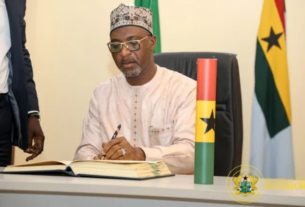

El Samuels: MBN360 News
The Minister of State for Climate Change and Sustainability, Baba Seidu Salifu, says, climate change is no longer just an environmental concern, but a pressing national development challenge, which is impacting the country’s infrastructure, its energy future and Ghana’s economy as a whole.
At the Government Accountability Series on May 6, 2026 , the Minister stressed that the effects of climate change are being felt across critical sectors, including water security, food systems, and energy transitions. He warned that without urgent and coordinated action, these impacts could undermine Ghana’s long-term development goals.
Salifu highlighted the government’s commitment to addressing these challenges through strengthened collaboration among state institutions, development partners, international institutions and the private sector.
According to the Minister, his office was established to align national efforts, foster strategic partnerships, and scale up climate finance to drive Ghana’s economic transformation. Central to this effort is the mobilisation of sustainable financing to support climate initiatives. He noted that beyond securing funding, the office is focused on building robust institutional systems to ensure the effective attraction, management, and deployment of climate finance.
Read also:
- NPP has the edge to win 2028 polls – Afoko
- Over 70km cleared for Kumasi Expressway project — Mahama
- Nothing Celebratory for Us Over Ofori-Atta’s Residency Ruling — Ahiagbah
- Petroleum Commission Urges Strategic Regional Investment for West African Gas
- Minority Demands Appearance of Gold Board CEO Amid Procurement Questions and Financial Scrutiny
Key interventions include, supporting the development of project preparation pipelines, advancing readiness for carbon markets, and promoting blended finance models to attract both public and private investments and strengthening accreditation processes.
The Minister also revealed that the office has facilitated structured engagements between the Climate Vulnerable Forum and key national institutions. These engagements aim to identify priority climate investment opportunities and enhance Ghana’s pipeline of bankable climate projects. He added that, efforts are underway to strategically position Ghana’s national priorities within global climate finance frameworks while improving the country’s capacity to attract long-term investments.
On energy, Salifu said the office has supported initiatives to advance Ghana’s transition to renewable energy while ensuring that climate action contributes to economic growth and industrial development. These initiatives include expanding solar rooftop deployment, promoting distributed renewable energy systems, and integrating climate considerations into major government programmes such as the 24-hour economy policy and the “Big Push” infrastructure agenda.
Additionally, the office is promoting the development of green industrial zones and climate-aligned infrastructure, while strengthening partnerships to accelerate renewable energy adoption, support electric mobility, and facilitate technology transfer.
Salifu emphasized that, climate action must be aligned with Ghana’s broader economic reset agenda, and create new opportunities for growth while enhancing long-term energy security.