
Els: MBN360 Politics
xecutive Director of Global InfoAnalytics, Mussa Dankwa, has indicated that emerging data from recent polling suggests delegates of the National Democratic Congress are increasingly prioritising national interest and leadership performance over strict party loyalty when considering future leadership choices.
According to Mr Dankwa, the latest findings reveal that NDC delegates are paying closer attention to competence, vision, and governance performance as key criteria in selecting a leader ahead of the party’s future political direction.
“Interesting data continue to point to the fact that NDC delegates prioritise the country over their party when it comes to selecting a leader, at least for now”.Executive Director of Global InfoAnalytics, Mussa Dankwa
The analysis forms part of ongoing assessments of political attitudes within the governing party as attention gradually shifts toward the party’s long term leadership outlook and the eventual 2028 elections.
Performance Becoming Key Leadership Factor
Mr Dankwa explained that the data shows increasing importance attached to how potential leaders perform in government and national administration.

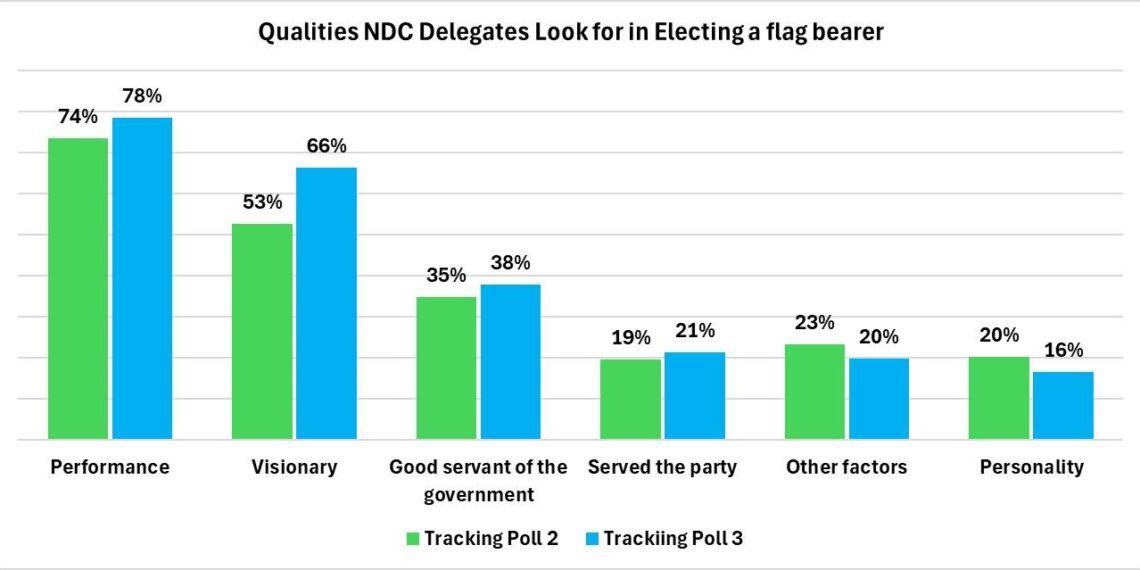
According to the latest poll, attention to a candidate’s performance has increased from 74 percent to 78 percent, making it one of the strongest considerations among delegates.
The findings suggest that delegates are likely to place significant weight on measurable governance outcomes and leadership effectiveness rather than relying solely on internal party considerations.
Political analysts believe this trend could influence the type of candidates likely to emerge strongly within the NDC ahead of future internal contests.
Demand for Visionary Leadership Rising
One of the most notable findings highlighted by Mr Dankwa was the sharp increase in the importance delegates attach to visionary leadership. According to him, the percentage of delegates prioritising visionary qualities in a leader rose significantly from 53 percent to 66 percent over the polling period.
“Visionary saw astronomical rise over the period, increasing from 53 percent to 66 percent,” he stated. The increase reflects what analysts describe as growing expectations among party delegates for leaders capable of presenting long-term national solutions and inspiring broader public confidence.
Analysts note that visionary leadership has become increasingly important in Ghana’s political environment as voters and party members seek leaders with clear economic and developmental direction.
The poll findings suggest that delegates may now be placing greater value on national transformation and strategic leadership capacity than traditional political considerations alone.
Governance Service Also Gains Attention
Mr Dankwa also noted that delegates are paying increasing attention to how well individuals serve within government positions. “Good servant of the government, too, increased from 35 percent to 38 percent,” he revealed.
Read also:
- Malaria should not kill a child” — expert on path to elimination
- Work is killing 840,000 people a year, and stress is mainly the cause – UN report finds
- Council of State member commends President Mahama for visit to tidal wave-affected communities
- ‘No drumming, noise-making, roadside preaching from May 4’ – AMA warns
- Gov’t sets up interim team to manage Adamus mine
The data indicates that delegates are increasingly evaluating leadership contenders based on their public service records and contributions to governance.

This could favour candidates with strong ministerial, parliamentary, or administrative experience within the current government.
Party Loyalty Not Dominating Delegate Priorities
Despite the growing emphasis on performance and governance, Mr Dankwa acknowledged that party service remains relevant within the NDC’s internal political calculations.
However, he noted that party loyalty does not currently appear to dominate delegates’ priorities compared to broader national leadership qualities. “The top criteria don’t suggest putting the party at the top of what they look out for,” he observed.
According to the poll, “party servant” ranked fourth among the criteria considered by delegates, although it still recorded a slight increase from 19 percent to 21 percent. “In fourth place, however, is party servant, which also saw a marginal increase from 19 percent to 21 percent,” Mr Dankwa stated.
The findings suggest that while party commitment remains important, delegates may be placing greater emphasis on electability, competence, and national appeal.
Implications for NDC’s Future Leadership
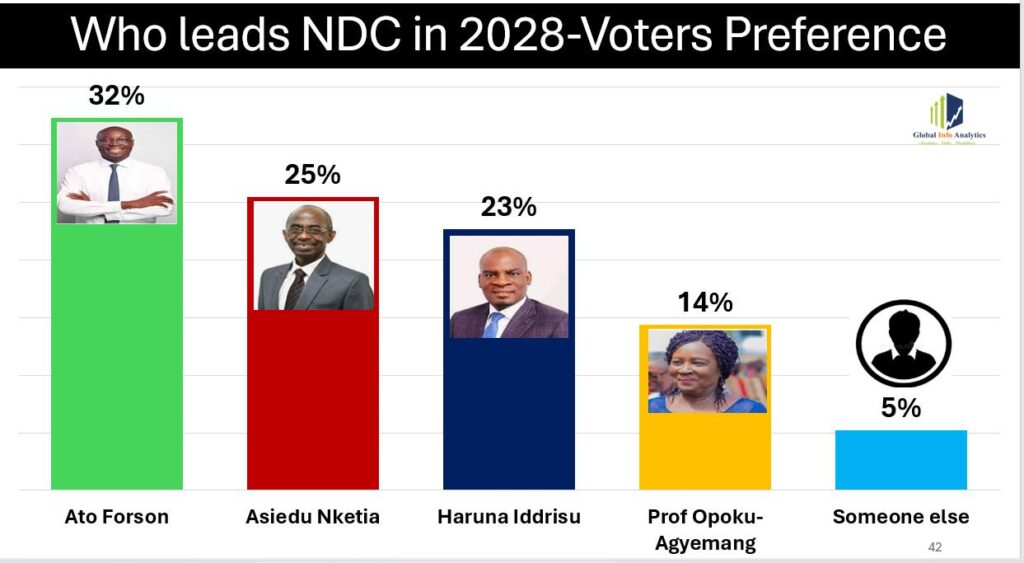
Mr Dankwa indicated that the evolving attitudes reflected in the poll could have significant implications for the future leadership direction of the NDC. “How this data unfolds going forward could determine who leads the NDC in 2028,” he stated.
Political analysts say the findings may shape internal strategies among potential contenders seeking future leadership positions within the party.
The increasing importance attached to governance performance and visionary leadership could push aspirants to focus more on public administration, policy achievements, and national development messaging.
Analysts also believe the trend reflects broader changes within Ghana’s political landscape, where party supporters are increasingly demanding accountability and results from political leaders.
Delegates Seeking Broader National Appeal
The findings may also indicate that delegates are conscious of the need for the party to maintain broad national appeal beyond its traditional support base.
Analysts suggest that prioritising candidates viewed as competent, visionary, and effective in governance could improve the party’s competitiveness in future national elections.
The poll comes at a time when political discussions within both major parties are gradually shifting toward long term succession planning and leadership positioning ahead of the next electoral cycle.
While internal party dynamics remain fluid, the latest data suggests that NDC delegates may increasingly favour leaders perceived as capable of balancing party interests with national development priorities.
For now, the Global InfoAnalytics analysis points to a growing preference for leadership qualities tied to governance, vision, and national performance rather than party loyalty alone.