Els: MBN360 News
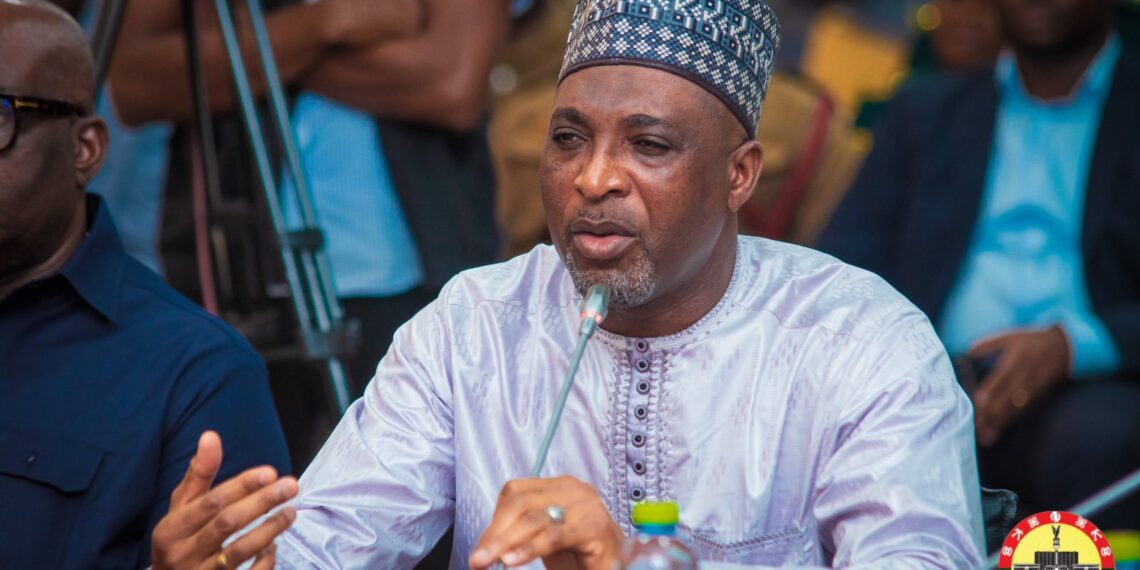
Ghana’s Minister for the Interior, Hon. Muntaka Mubarak Mohammed, has revealed that government can recruit only 5,000 personnel into the country’s internal security services despite receiving more than half a million applications from young Ghanaians seeking employment.
According to the Minister, the limited recruitment capacity reflects the current fiscal constraints facing the country under an ongoing International Monetary Fund programme and the broader economic conditions inherited by the government.
Speaking on the recruitment exercise, the Interior Minister explained that the government had carefully assessed its financial capacity before determining how many new personnel could be absorbed into the security services.
“As you know, we are under an IMF programme and considering the economic challenges we inherited, the economy can only accommodate a limited number of recruits at this stage”.Minister for the Interior, Hon. Muntaka Mubarak Mohammed
He explained that the recruitment plan allows for 2,500 new police officers, 2,500 additional personnel across other ranks, and 500 cadets, bringing the total number of available positions to roughly 5,000 in the first phase of the process.
Massive Interest in Security Services
The Minister disclosed that the level of interest in the recruitment exercise has been unprecedented, highlighting the scale of youth unemployment pressures across the country.

According to him, the Ghana Police Service alone attracted about 130,000 applicants hoping to join the force. However, the Ghana Immigration Service recorded an even higher number of applications, with more than 180,000 young people seeking to join an institution whose current workforce stands at about 18,300 officers.
“That means you have 180,000 people seeking to join an institution that has fewer than 20,000 officers,” the Minister observed. Despite the large number of applicants, the fiscal space available to the government allows for the recruitment of only 1,000 personnel into the Ghana Immigration Service during this phase.
The Ghana National Fire Service also received 124,000 applications even though its current workforce stands at slightly above 17,000 personnel nationwide.
Similarly, the Ghana Prisons Service recorded 71,000 applicants despite having a workforce of just over 14,000 officers. In this case, the recruitment exercise will accommodate only 500 new officers.
Altogether, the four major security institutions received well over half a million applications for a combined recruitment intake of 5,000.
Screening Process and Selection Challenges
Hon. Muntaka Mubarak Mohammed explained that the selection process is designed to ensure fairness while maintaining professional standards within the security services.
He noted that initial stages such as body selection and documentation screening did not require applicants to pay additional fees beyond the purchase of the recruitment voucher.
Following those stages, fewer than 30,000 applicants were disqualified, leaving more than 400,000 candidates eligible to proceed to the aptitude test phase.
The Minister said authorities were careful to design a selection mechanism that reduces the number of candidates gradually before the medical screening stage, which requires payment from applicants.
Read also:
- Thomas Partey, Former Arsenal Player to deny rape charges, court hears
- GoldBod to Establish Gold Buying Centres Across Mining Districts
- US Strikes Military Sites On Iran’s Kharg Island
- Missile strike hits US Embassy in Baghdad as Iran warns of retaliation over oil hub
- Education Must Deliver Practical Solutions – Veep Opoku-Agyemang honoured as UCC’s first distinguished fellow
According to him, allowing hundreds of thousands of candidates to proceed to medical examinations would impose unnecessary financial burdens on applicants.
“Aptitude tests did not require payment, but medical examinations will require payment. It would not be fair to allow more than 400,000 people to pay for medicals when we know the system can only absorb 5,000”.Ghana’s Minister for the Interior, Hon. Muntaka Mubarak Mohammed
For that reason, the minimum pass mark for the aptitude test was set at 65 percent to reduce the number of qualified candidates before the medical stage. Even with this threshold, the Minister said about 105,000 applicants have qualified to proceed to medical screening.

Plans for Future Recruitment
The Interior Minister acknowledged the disappointment many young people may feel after participating in the process but urged them to remain patient.
He explained that the current recruitment exercise forms part of the 2025 intake and should be seen as the first phase of a broader recruitment strategy.
According to him, President John Dramani Mahama has directed that data on candidates who successfully pass the medical examinations should be retained for future recruitment exercises.
If additional recruitment opportunities arise later in the year or in 2026, the government may draw from the existing database instead of reopening the entire application process.
“Those who qualify and pass the medical examinations will have their data kept so that when new recruitment opportunities open, we can consider them without restarting the process”.Ghana’s Minister for the Interior, Hon. Muntaka Mubarak Mohammed
Balancing Security Needs and Fiscal Responsibility
Hon. Muntaka Mubarak Mohammed emphasised that the government must balance the need to strengthen national security institutions with the realities of the public wage bill.
He noted that the combined workforce of the major internal security agencies currently stands at fewer than 100,000 personnel nationwide.
The Ghana Police Service has about 49,000 officers, the Ghana Immigration Service about 18,000, the Ghana National Fire Service approximately 17,000, and the Ghana Prisons Service around 14,000.
Despite these numbers, the government already spends roughly 13 billion Ghana cedis annually on the wage bill for security personnel. “If the resources were available, we would be happy to recruit many more people, but the economy must be able to sustain the cost,” the Minister explained.

The Interior Minister also highlighted earlier government initiatives designed to create employment opportunities for young people within the security sector.
These include programmes under the youth employment model that recruited 15,000 police assistants, 5,000 personnel to support the fire service in markets, and another 5,000 to assist the prisons service. Together, those initiatives created temporary employment opportunities for about 25,000 young people.
The Minister said these programmes also serve as a training ground that allows participants to gain experience and familiarity with the operations of the security services, potentially improving their chances in future recruitment exercises.
He assured young applicants that the government remains committed to expanding employment opportunities as the national economy improves. “This will not be the first and last recruitment exercise. As the economy grows stronger, we will continue to open more opportunities for young people,” he said.