Els: MBN360 News
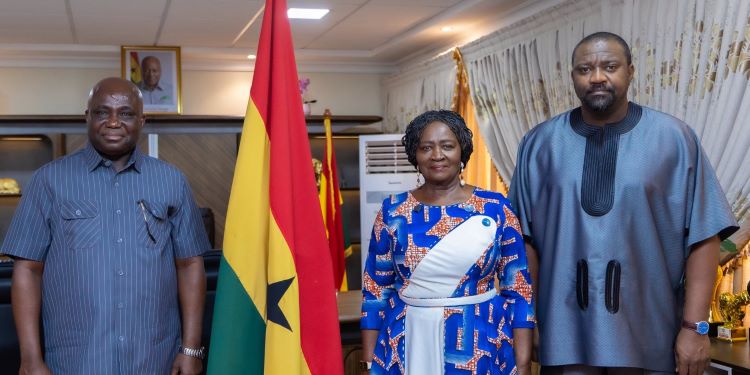
The Ministry of Food and Agriculture (MoFA) became the center of national strategic coordination recently, as the Vice President, H.E. Professor Jane Naana Opoku-Agyemang, conducted a high-stakes working visit to audit the progress of the Agriculture for Economic Transformation Agenda (AETA).
Received by the Minister for Food and Agriculture, Hon. Eric Opoku, the Vice President moved beyond diplomatic pleasantries to engage in a rigorous performance review of the state’s primary interventions against food inflation and import dependency.
According to the Minister, the visit served as a definitive “stewardship check,” confirming that the Ministry has successfully transitioned from policy design into an aggressive execution phase aimed at total food self-sufficiency.
“I had the privilege of presenting a summary account of the strategic initiatives and transformative efforts undertaken under my leadership to reshape the nation’s agricultural landscape, focused on the pragmatic measures implemented by the Ministry, which constitute key interventions designed to vigorously combat persistent challenges such as substantial food import bills and pervasive inflationary pressures”Hon. Eric Opoku, Minister for Food and Agriculture
Hon. Opoku’s report during the briefing focused on the measures against persistent challenges, specifically the multi-billion-dollar food import bill that has historically pressured the national currency. With the Feed Ghana Programme as the engine of growth, MoFA has established a resilient framework for boosting domestic production and stabilizing the prices of essential commodities.
“The National Food Buffer Stock has achieved significant progress fiscally and storage wise and is now exceptionally well-positioned to actualize the President’s vision for robust food security. Through these concerted efforts, we are collectively building a more resilient, productive, and self-sufficient agricultural sector”Hon. Eric Opoku, Minister for Food and Agriculture

Another pivotal highlight of the Minister’s briefing was the revitalization of the National Food Buffer Stock, where he reported that the system is now “exceptionally well-positioned,” both fiscally and logistically to handle the projected surplus from the 2026 harvest.
This stabilization of the buffer stock is a critical component of the national strategy to decouple Ghana’s food security from global supply chain shocks, and by expanding irrigation infrastructure and vegetable production, the Ministry has ensured that the “Feed Ghana” mandate is not a seasonal aspiration but a year-round industrial reality.
The infrastructure reset also includes the rapid deployment of Farmer Service Centers (FSCs) across the districts, with the first center soon to be built. These centers are designed to act as the technical backbone of rural modernization, providing smallholder farmers with access to state-of-the-art machinery and expert technical support.
Hon. Opoku emphasized that these centers are equipped to empower farmers, moving them from subsistence methods to high-yield, mechanized agribusiness, as this ground-level empowerment is essential for reducing post-harvest losses and ensuring that every acre of Ghanaian soil contributes to the national industrialization drive.
Poultry Revitalization and Social Inclusivity
The Vice President’s visit also brought a renewed focus on the poultry sector, which the Minister identified as a “crucial area” for both economic growth and national nutrition. The revitalization of this sector was directly linked to the government’s commitment to providing high-quality protein for basic and secondary school children.
He noted that with support for local poultry farmers through targeted interventions, the Ministry is creating a domestic supply chain that replaces expensive imported frozen chicken, thereby retaining wealth within the local economy and creating thousands of jobs for young Ghanaians.
Read also:
- Mahama Declares Overhaul of Ghana’s Pension System to Protect Workers
- Even our own people are involved — Mahama on challenges in galamsey fight
- Every Ghanaian worker must retire with dignity – Mahama
- CAF strips Senegal of AFCON 2025 title, crowns Morocco champions
- 23 killed, 108 wounded in suspected suicide bombings in northeast Nigeria.

In addition to industrial scaling, the MoFA has prioritized Inclusive Economic Development, with Hon. Eric Opoku highlighting targeted initiatives designed to support vulnerable women, providing them with the resources and training necessary to establish sustainable livelihoods.
According to the Sector Minister, this focus on “ameliorating poverty,” through agriculture ensures that the dividends of the 2026 economic transformation are felt by those at the base of the pyramid.
The Vice President praised the Ministry’s focus on “empowering women and vulnerable groups, and encouraged stronger collaboration with research institutions such as the CSIR,” to harness innovation and local expertise, noting that food security cannot be achieved without the active participation and empowerment of the entire workforce.
Vice President’s Directive
In her remarks to the Ministry’s leadership, Professor Jane Naana Opoku-Agyemang issued a stern directive regarding the sustainability of agricultural technology, stressing that Ghana must move beyond the mere purchase of foreign equipment.
She mandated MoFA to ensure that Ghanaians are actively involved in the assembly and maintenance of agricultural machinery. This “local content” requirement is to build a domestic pool of technicians and engineers, ensuring that the Farmer Service Centers remain operational long into the future without a reliance on foreign expertise.
In encouraging a “stronger collaboration,” with research institutions such as the Council for Scientific and Industrial Research (CSIR), she emphasized that innovation must be harvested locally to address the specific challenges of Ghana’s soil and climate.
For the government, integrating soil and crop testing into the core of the Ministry’s support services, ensures that farmers are not just working harder, but working smarter. This research-led approach is the only way to achieve the “self-sufficiency” that the Vice President identified as a core pillar of national development.

As the working visit concluded, the message from both the Vice President and the Minister was one of collective resolve.
“The Government remains strongly committed to supporting the Ministry’s efforts and to strengthening coordination to drive agricultural transformation. The meeting reinforced our collective resolve to build a resilient, productive, and self-sufficient agricultural sector for Ghana”Vice President Professor Jane Naana Opoku-Agyemang
The Ministry of Food and Agriculture has successfully aligned its district-level operations with the President’s high-level vision for a productive, self-sufficient nation.
The combination of fiscal discipline at the Buffer Stock, the industrialization of the poultry sector, and the nationwide rollout of Farmer Service Centers has created a resilient agricultural engine that is now ready to power the rest of the economy.
The 2026 Agriculture for Economic Transformation Agenda is no longer a set of policy papers; it is a visible, grounded reality. Under the stewardship of Hon. Eric Opoku and the oversight of Vice President Opoku-Agyemang, the Ministry has proven that it has the capacity to translate political will into tangible results for the Ghanaian farmer.
As the nation moves toward the next phase of the Accelerated Export Development strategy, the success at MoFA provides the foundation upon which all other industrial goals will be built.