Read also:
- Finance Ministry Relocates to Kanda to Boost Efficiency
- 2026 World Cup: GFA appoints Black Queens head coach Kim Lars Björkegren as Black Stars assistant coach
- 2026 World Cup: Black Stars expand technical team with five key appointments
- Yeji: Mathias Catholic Hospital gets new maternity beds
- TrumpRx Website Launched, Offering 43 Popular Drugs at Discounted Prices
Els MBN360 News
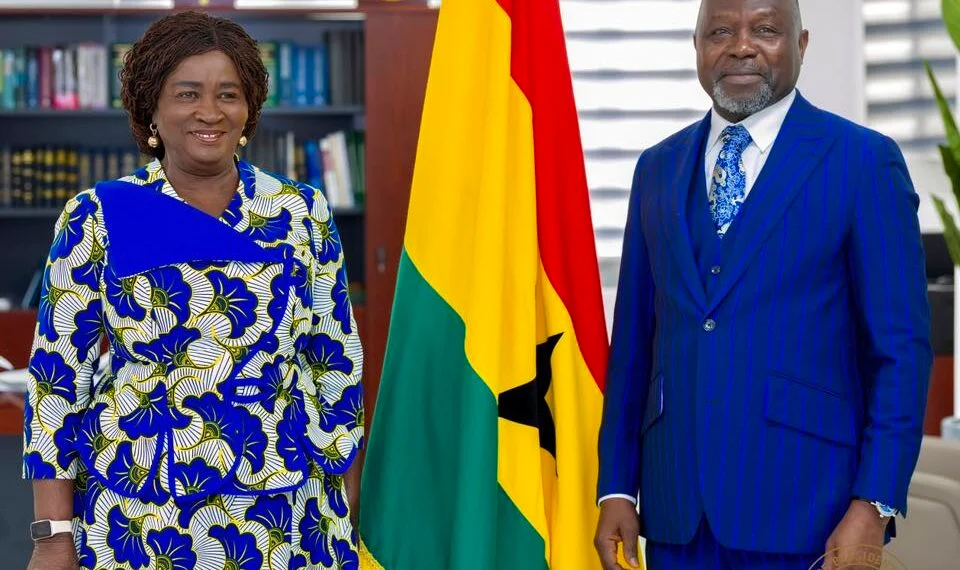
ice President Professor Jane Naana Opoku Agyemang has reaffirmed government’s commitment to strengthening Ghana’s justice delivery system following an official visit to the Ministry of Justice, where she engaged the Attorney General and Minister for Justice, Dr Dominic Akuritinga Ayine, and senior officials on pressing institutional and legal challenges confronting the ministry.
The visit formed part of the Vice President’s ongoing series of engagements with key state institutions aimed at assessing operational constraints and aligning government support with national reform priorities.
Discussions at the Ministry of Justice focused on the growing complexity of the government’s legal obligations, including pending international arbitration cases, rising land compensation claims, and capacity gaps within critical departments.
Officials briefed the Vice President on the financial and legal risks posed by international arbitration matters currently facing the state. These cases, they noted, carry potentially significant fiscal implications and require careful handling to protect the national interest.

Another major concern raised was the steady increase in land compensation claims, many of which have accumulated over years and now represent a substantial burden on public finances.
“The Attorney-General confirmed that all prosecutorial processes, including matters relating to ORAL, are being handled with integrity. Sixteen dockets are currently under review, with no plea negotiations or compromised cases.”Vice President Professor Jane Naana Opoku Agyemang
Ministry’s Operational Challenges
Operational challenges within the ministry also featured prominently during the engagement. The Attorney General highlighted the ministry’s limited regional presence, noting that several regions lack fully functional justice offices.
He explained that plans are underway to establish offices in newly created regions and to renovate existing facilities, although progress remains dependent on the availability of funding.
In addition, Dr Ayine disclosed that work is ongoing on a Criminal Proceeds Recovery Bill, which is intended to enhance the state’s ability to trace, freeze, and confiscate assets acquired through criminal activity.

The proposed legislation, he said, would strengthen Ghana’s legal framework for combating corruption and economic crime while improving accountability in public life.
Veep Pledges Full Government Support
In her remarks to the leadership and staff of the ministry, Vice President Opoku Agyemang expressed government’s full support for their work and encouraged them to remain resolute despite the challenges they face.
Read also:
- Trade Minister Pledges Infrastructure Support for Beverage Giants
- MIIF Unveils Strategic Investment Agenda for Critical Minerals
- Starmer’s Chief of Staff Morgan McSweeney Resigns
- Ghana Scores 72% in World Bank Financial Index
- Mahama Recalls Baba Jamal as Ghana High Commissioner to Nigeria
She underscored the importance of the justice sector to democratic governance and national development, noting that the credibility of state institutions depends heavily on fairness, efficiency, and respect for the rule of law.
“Our responsibility as a government is representative,” the Vice President said, adding that public officials must remain conscious of the long term consequences of their decisions.
She stressed that policies and legal settlements entered into today should not become unsustainable burdens for future generations, particularly in areas such as land compensation and contractual obligations.

The Vice President called for sustainable and transparent solutions to the growing land compensation problem, advocating structured and fair mechanisms that balance the rights of affected citizens with the need to protect public resources.
She noted that unresolved compensation claims often escalate into protracted legal disputes that drain state finances and undermine public confidence. Professor Opoku Agyemang also highlighted the urgent need to strengthen the Legislative Drafting Department, which she described as a backbone of effective governance.
She pointed to challenges related to funding, staffing, and specialised training, and urged targeted investment to build the department’s capacity. According to her, strong legislative drafting is essential for producing clear, enforceable laws that respond to Ghana’s evolving social and economic realities.
She further proposed exploring the establishment of a dedicated legal training institute that could serve not only Ghana but neighbouring countries. Such an institution, she said, would promote specialisation, deepen professional expertise, and help develop home grown solutions to legal and institutional challenges across the sub region.
Adopting Innovative Ways towards Decentralization
Addressing the ministry’s limited regional footprint, the Vice President encouraged innovative approaches to decentralising justice services, noting that access to legal institutions should not be determined by geography.
She acknowledged that budgetary constraints remain a challenge but argued that sustained economic growth and expansion of the national resource base would ultimately enable more effective allocations to critical sectors such as justice.

The Vice President concluded by reaffirming her personal commitment to working closely with the Ministry of Justice to ensure it carries out its mandate effectively in the service of the nation. She described the ministry’s role as central to protecting democratic values, safeguarding public trust, and upholding the rule of law.
The engagement with the Ministry of Justice adds to a series of high level consultations by the Vice President aimed at reinforcing institutional performance and accountability across government.
It also signals a renewed focus on legal reforms as part of broader efforts to strengthen governance, manage public resources responsibly, and secure a just legacy for future generations.