Els: MBN360 Agribusiness
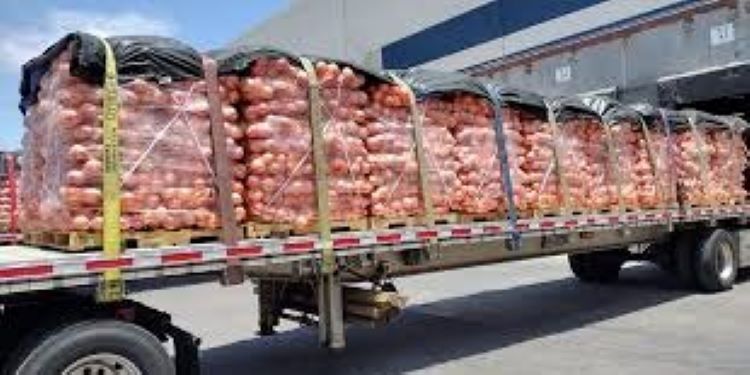
A complex geopolitical and trade dispute in the Nigerian border town of Samia, Kebbi State, has triggered an immediate threat to Ghana’s vegetable supply chain, as dozens of Ghanaian trucks transporting onions from the Republic of Niger remain detained by suspected armed groups.
This marks a sharp escalation from a localized market disagreement in Accra to a cross-border crisis. According to Mustapha Sulemana Talimu, spokesperson for the Onion Sellers Association, the logistical delay of the standoff is a precursor to a sharp inflationary spike in the cost of essential foodstuffs, exposing the fragility of the ECOWAS Protocol on the Free Movement of Goods.
“Two, three days ago, a small group among the onion traders had an issue with Nigerian traders and stopped their cars from offloading goods at the market. Because of that, all the trucks coming to Ghana have now been seized… What we are talking about is the business of onions in Ghana, but the politics has come into it”Mustapha Sulemana Talimu, Spokesperson for the Onion Sellers Association
With the crisis rooted in a distributive rift within the Accra onion market, where a delicate balance between Ghanaian, Kusasi, Hausa, and Nigerian trader associations has collapsed, the detention of trucks is a direct retaliation by Nigerians that could escalate further.
For now, this “tit-for-tat” protectionism has now spilled across three borders, turning a commercial dispute into a blockade that threatens the livelihoods of thousands of transporters and traders.
Mr. Talimu noted that the logistical route for these goods is a grueling multi-country transit, where drivers typically procure their stock from the farming community of Galimi in the Republic of Niger, and traverse through Nigeria, Benin, and Togo before reaching the Ghanaian border.

Under normal conditions, this corridor is a lifeline for the Ghanaian vegetable market. However, with trucks now stationary for over 72 hours in the sweltering heat of Kebbi State, the perishability factor has become the primary source of economic loss – especially as onions are highly susceptible to spoilage when confined in stationary, unventilated trucks for extended periods.
For the drivers stranded in Samia, the situation is increasingly desperate. Each day of detention represents a total loss of inventory value, as the vegetables succumb to rot.
This is not just a loss for the traders; it is a direct hit to Ghana’s agribusiness value chain, as the capital tied up in these shipments is effectively liquidated by the delay. The appeal for government intervention is no longer a request for policy clarity – it is a plea for the salvage of millions of Cedis in rotting assets.
A Conflict of Associations
At the heart of the standoff is a dispute over the distribution model of trucks from Nigeria to Ghana in Accra. Industry insiders like Alhaji Fuseini Atiiga noted that the tensions stem from a perceived imbalance in how 52 onion trucks that are brought to the capital are distributed among the various trader associations.
Read also:
- Ghana’s Economy to Defy Middle East Turmoil- Fitch Solutions
- Mahama: Savannah Region Set for SHS Upgrade, 24-Hour Markets, Stadium
He explained that the majority go to a particular association, which the Nigerian traders and farmers oppose, who play a pivotal role in the cross-border logistics of the Galimi-Accra route, have voiced opposition to, alleging that it favors a single association over the collective.
This internal friction highlights the lack of a formalized, transparent regulatory framework for vegetable distribution in Ghana’s major markets. While the country focuses heavily on industrializing, the “informal” but critical vegetable trade remains governed by associative agreements that are prone to breakdown.

The Samia blockade demonstrates how, when these informal agreements fail, the resulting “market politics,” can paralyze an entire international trade corridor. The detention of Ghanaian trucks by armed men in Nigeria represents a significant failure of the ECOWAS trade protocols.
While the African Continental Free Trade Area (AfCFTA) is being championed as the future of the continent, the Samia crisis shows that basic transit security remains a primary barrier to intra-Africa trade. The fact that armed groups in a third-country are being used to settle a commercial dispute in Accra suggests a breakdown in both regional security and trade diplomacy.
The affected traders are now bypassing their respective associations and appealing directly to the Ministry of Foreign Affairs, as the crisis has moved beyond the capacity of market queens and trader unions to resolve.
For the Onion Sellers Association, it requires a high-level diplomatic engagement between Accra and Abuja to ensure the safe passage of Ghanaian goods through Nigerian territory. Without a sovereign-backed guarantee of transit security, the Galimi-Accra corridor remains at the mercy of localized market skirmishes.
The crisis is being framed as a wake-up call for the nation. As Ghana moves toward a self-sustaining economy, it must also secure its essential import corridors.
The Samia standoff proves that food security is about what is grown within the borders, just as much as it is about the security of the routes that bring in the shortfall, and the current model, where 52 trucks are distributed via informal associations, is clearly insufficient for a modern economy.

Mr. Talimu added that to prevent a recurrence, the government must consider formalizing the vegetable distribution model to ensure equity among all stakeholders – local and international.
Furthermore, the Ministry of Foreign Affairs must work within the ECOWAS framework to establish appropriate lanes for perishable goods, ensuring that trade disputes do not translate into armed blockades.