
Els: MBN360 USA
The US Supreme Court has struck down President Donald Trump’s far-reaching global tariffs.
The 6-3 decision centers on tariffs imposed under an emergency powers law, the 1977 International Emergency Economic Powers Act, or IEEPA, including the sweeping “reciprocal” tariffs he levied on nearly every other country.
The US Supreme Court has struck down President Donald Trump’s far-reaching global tariffs.
The 6-3 decision centers on tariffs imposed under an emergency powers law, the 1977 International Emergency Economic Powers Act, or IEEPA, including the sweeping “reciprocal” tariffs he levied on nearly every other country.
The Constitution gives Congress the power to levy tariffs but the Trump administration argued that a 1977 law allowing the President to regulate importation during emergencies also allows him to set tariffs.
Other Presidents have used the law dozens of times, often to impose sanctions, but Trump was the first President to invoke it for import taxes. “And the fact that no President has ever found such power in IEEPA is strong evidence that it does not exist,” Roberts wrote, using an acronym for the law called the International Emergency Economic Powers Act.
Trump set what he called “reciprocal” tariffs on most countries in April 2025 to address trade deficits that he declared a national emergency. Those came after he imposed duties on Canada, China and Mexico, ostensibly to address a drug trafficking emergency.
Justices Samuel Alito, Clarence Thomas and Brett Kavanaugh dissented. “The tariffs at issue here may or may not be wise policy. But as a matter of text, history, and precedent, they are clearly lawful,” Kavanaugh wrote.
The majority did not address whether companies could get refunded for the billions they have collectively paid in tariffs. Many companies, including the big-box warehouse chain Costco, have already lined up to demand refunds in lower courts. Kavanaugh noted the process could be complicated.
Read also:
- ‘Emergency ward saved my life, it must work for every Ghanaian’ – Mahama Ayariga demands accountability over hit-and-run case
- Ahafo Police arrest 3 with firearms, ammunition and drone, foil suspected robbery
- EPA says $35m needed to fully restore the polluted Birim River.
- Minority slams gov’t over delay in briefing Parliament on Burkina Faso attack
- Airport renaming doesn’t require parliamentary approval—Transport Minister
“The Court says nothing today about whether, and if so how, the Government should go about returning the billions of dollars that it has collected from importers. But that process is likely to be a ‘mess,’ as was acknowledged at oral argument.”Brett Kavanaugh
The Treasury had collected more than $133 billion from the import taxes the president has imposed under the emergency powers law as of December, federal data shows. The impact over the next decade was estimated at some $3 trillion.
Supreme Court Ruling Hailed
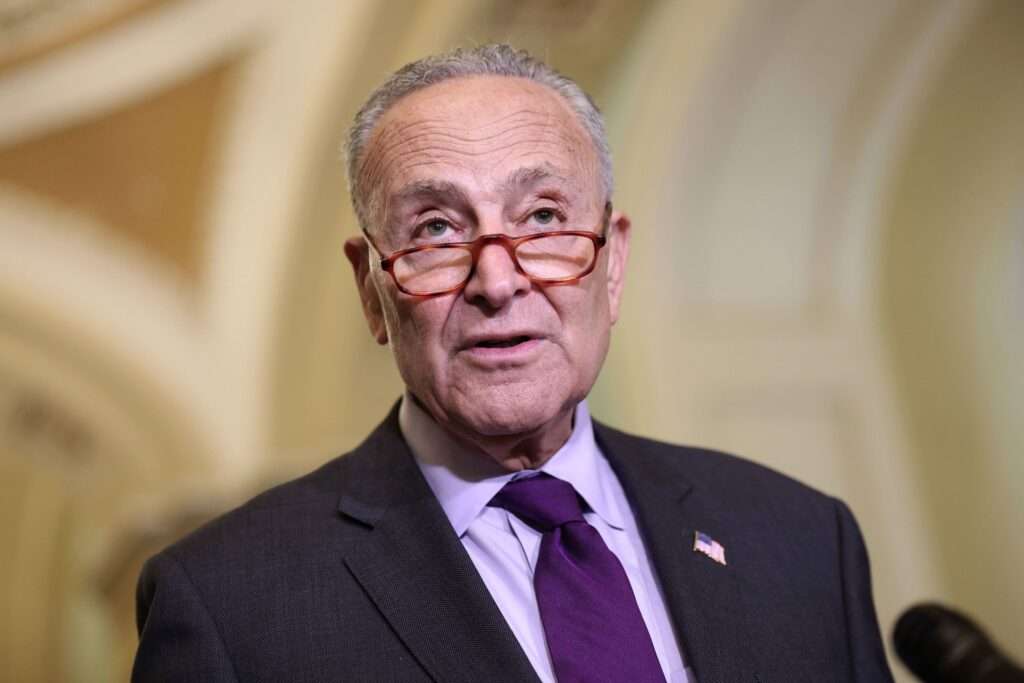
Senate Democratic Leader Chuck Schumer said in a statement that the Supreme Court’s ruling striking down President Donald Trump’s tariffs will “finally give families and small businesses the relief they deserve” and that Trump should end “this reckless trade war for good.”
He said the President’s “overreach failed,” adding, “We’ve said from day one: a President cannot ignore Congress and unilaterally slap tariffs on Americans.”
Some of the top Democratic lawmakers in the House also celebrated the Supreme Court’s decision striking down President Donald Trump’s global tariffs.
Rep. Richard Neal, the ranking Democratic lawmaker on the House Ways and Means Committee, called the decision “a victory for the American people, the rule of law, and our standing in the global economy.”
Neal stated that the tariffs drove up grocery and energy prices and destabilized small businesses. He also said that the administration must make consumers and businesses whole.
Rep. Brendan Boyle, the ranking Democrat on the House Budget Committee, said that the tariffs weakened the economy and made it harder for families to make ends meet. “Today’s decision is an important step toward protecting families and restoring basic economic fairness,” Boyle said.
Despite the ruling, other sweeping levies remain in place. Trump used another law, Section 232 of the 1962 Trade Expansion Act, to slap impose sectoral tariffs on steel and aluminum, cars, copper, lumber and products like kitchen cabinets worldwide. The US President also has plenty of other options to keep taxing imports aggressively.