Els: MBN360 Business
In the landscape of Ghana’s industrial transformation, the “Free Zone” model is often discussed in terms of tax holidays and initial capital entry. However, the true measure of the policy’s success lies in the durability and scaling of its enterprises.
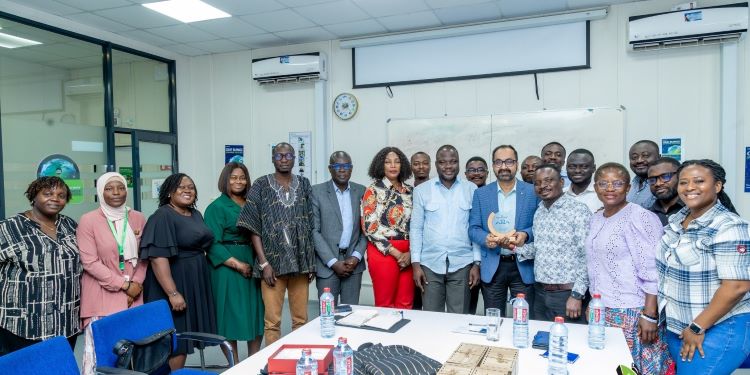
Recently, the Ghana Free Zones Authority (GFZA) marked a significant milestone in this trajectory, leading a high-powered delegation to the Tema facilities of Bunge Loders Croklaan (BLC) for a ceremonial 10th-anniversary courtesy call, which also doubled as a strategic audit of one of Ghana’s most successful 24-hour industrial anchors.
The visit to Bunge Loders Croklaan, a global leader in the shea nut processing sector, was led by the GFZA’s Deputy CEO in charge of Finance and Administration, Mr. Musah Sibiri Hamidu, to celebrate a company that has spent the last decade evolving from a specialized processor into a significant part of Ghana’s “Aftercare” success story.
“The engagement celebrated a decade of strong partnership, operational excellence and Bunge Loders Croklaan’s significant contributions to Ghana’s industrial growth.
“The visit also formed part of GFZA’s ongoing efforts to strengthen institutional relationships and reaffirm collaboration with Free Zone enterprises, as discussions focused on industry development, sustainable practices and future investment prospects”Ghana Free Zones Authority
For the GFZA technical team – including Dr. Patience Agbleze Acorlor (Director of Corporate Affairs) and Mr. Adu Ntiamoah (Director of the Tema Export Processing Zone) – BLC represents the gold standard of what the 24H+ Accelerated Export Development Programme aims to achieve nationwide: high-standard, food-safety-compliant manufacturing that operates around the clock to meet global demand.

While much of the national conversation around the 24-Hour Economy focuses on new legislation and MoUs, Bunge Loders Croklaan has quietly operated on a 24-hour cycle for years. This operational baseline is critical for a business-inclined audience to observe.
The GFZA noted that the BLC’s ability to maintain a continuous production flow suggests that the Tema Export Processing Zone (TEPZ) infrastructure, despite broader regional challenges, is capable of supporting world-class industrial output when managed with the right technical expertise.
The engagement between the GFZA and BLC’s leadership – led by General Manager Mr. Santana Kumar Bhuyan and Industrial Controller Mr. Peter Omari Asiamah – highlighted a key technical reality: 24-hour operations require more than just a night shift; they require a sophisticated “quality and food safety” framework.
Under the guidance of Ms. Nelly E. Kurd Marckay, BLC has integrated West African quality standards with global export requirements, ensuring that every ton of shea processed in Tema is ready for the most demanding international markets.
Read also:
- Government to Commence Recruitment of 7,000 Teachers from April 10
- Ghana Launches National Shock Responsive Social Protection Strategy
- 3,000 Tonnes: Maphlix Leads Ghana’s Tomato Recovery
- Apologise over galamsey claims or face lawsuit — Dame to Kwakye Ofosu
This “regulatory maturity” is the selling point that the GFZA is now using to pitch for future investment prospects within the sector.
Vertical Integration and the ESG Mandate
A significant portion of the anniversary dialogue centered on BLC’s impact on the “upstream” shea value chain, noting that the economic significance of BLC lies in its vertical integration.

Through training and equipping rural women in shea processing, the company is not just buying raw materials but securing its supply chain through human capital development. Environmental, Social, and Governance (ESG) strategy was highlighted as essential for any Free Zone enterprise looking to maintain its social license to operate over a multi-decade horizon.
Furthermore, BLC’s focus on the circular economy – specifically the youth-led initiative to transform waste plastic into fabric and school bags – demonstrates an industrial sophistication that goes beyond simple nut crushing. It reflects a shift toward sustainable industrialization, where waste management is treated as a secondary value stream.
For the GFZA’s Aftercare Team, led by Mr. Bilal Muazu Sulemana, these initiatives are benchmarks – they provide the evidence needed to convince skeptical investors that Ghana’s industrial enclaves can support complex, socially responsible, and environmentally conscious business models.
As the GFZA delegation toured the facility, the discussion inevitably turned toward the next decade, with the “future investment prospects,” mentioned in the official briefing, suggesting that BLC may be looking at capacity expansion or further diversification into high-value shea derivatives.
The contributions of the Director of the Tema Export Processing Zone signalled the GFZA’s readiness to facilitate this expansion. Whether through increased land allocation, enhanced utility support, or streamlined customs protocols, the Authority is positioning itself as a partner in BLC’s growth.
“The visit reaffirmed the GFZA’s commitment to providing the necessary support for Free Zone enterprises to thrive, ensuring that Ghana remains a competitive destination for industrial value addition”Ghana Free Zones Authority

The 10th-anniversary celebration of Bunge Loders Croklaan demonstrated that the Free Zone model, when coupled with a 24-hour operational mandate and a commitment to local value addition, can produce global champions.
For the GFZA, BLC’s contribution to Ghana’s industrial growth is measured not just in export volumes, but in the thousands of rural livelihoods it supports and the standards of operational excellence it sets for the rest of the TEPZ.