Els: MBN360 News
inority Caucus in Parliament has rejected the newly presented 12-page lithium lease agreement between Government of Ghana and Barari DV Ghana Limited over what they described as lack of value addition clause.
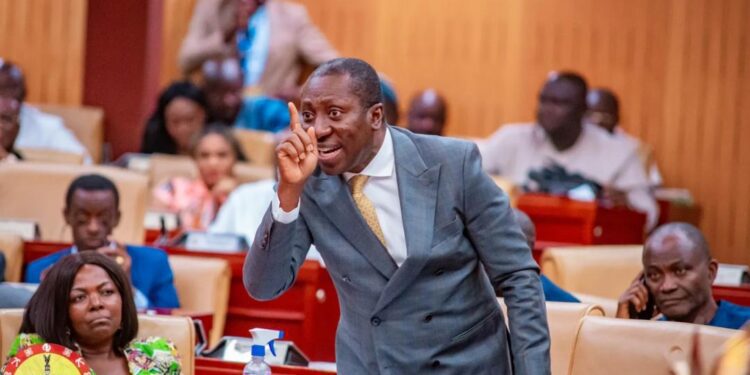
The caucus through Hon. Samuel Abu Jinapor, the former Minister of Lands and Natural Resources argued that the document fails to protect Ghana’s economic sovereignty by omitting a non-negotiable requirement for local processing, effectively reverting the nation to a “take and ship” model of mineral exploitation.
“The agreement I wrote before this, that agreement insisted clearly, not with discretion, it insisted in black and white that the lithium resources of our country cannot be exported in their raw form and that they will have to be processed to the level of condensates before they can be exported. And therefore, the company was obligated to set up a refinery here in Ghana to refine the lithium they mine into condensates before they can export the mineral. I have looked at this 12-page report, that is missing, Mr. Speaker.”Hon. Samuel Abu Jinapor
According to the Minority, the absence of a “value addition clause” in the current report undermines the collective consensus reached by previous administrations to ensure that the country’s critical minerals are not exported in their raw, unrefined state.
The former Lands Minster led the charge against the report during a high-stakes parliamentary session.
He cautioned that the current framework ignores the groundwork laid in previous agreements which mandated that the lithium resource be processed into condensates within Ghana.
“And indeed, they even presented a scoping report. They did research and did the modelling, the project modelling, in setting up a refinery in Ghana which will ensure that we add value to the lithium result. I have looked at this 12-page report, that is missing, Mr. Speaker. That is troubling. “Hon. Samuel Abu Jinapor
Read also:
- Mahama Administration Tightens Grip on Inefficient State Enterprises
- Tamale Hospital reports surge in stroke cases, urges regular checks
- Denounce ‘abject’ Afcon decision – senior CAF member.
- Police nab 12 over highway attacks in Ashanti Region, recover weapons
- Eid-ul-Fitr: Chief Imam urges Ghanaians to protect environment
The lack of value addition is widely viewed by mining experts and civil society as a mechanism that will “shortchange” the country.
Historically, Ghana’s gold and bauxite sectors have suffered from a lack of downstream integration, a trend the Minority insists must not be repeated with lithium.
Civil Society Organizations (CSOs) have long advocated for a ban on raw ore exports, arguing that the true wealth of green minerals lies in the refining process where lithium is converted into battery-grade chemicals.
Without a refinery, Ghana loses out on the premium pricing of processed condensates and the secondary industries such as electric vehicle battery manufacturing that could have been built around a local supply chain.
CSOs have even suggested that if the state lacks the immediate funds to ensure value addition, it “should wait” rather than rush into an agreement that drains the resource for minimal gain.
The Minority pointed to regional peers like Zimbabwe, where the government has “outrightly banned the export of lithium in its raw form” to force industrialization. This bold move serves as a benchmark for what many believe Ghana should be aspiring toward.
The former Minister noted that the private sector should not be allowed to dictate terms that bypass national interest, recalling arguments that “the state itself should exploit these minerals” if private entities refuse to commit to local refining.
By omitting the requirement for a refinery, the new committee report ignores the “scoping report” and “project modelling” previously conducted, which proved that establishing a lithium refinery in Ghana was a technically and economically viable venture for adding value to the lithium result.