Els: MBN360 News
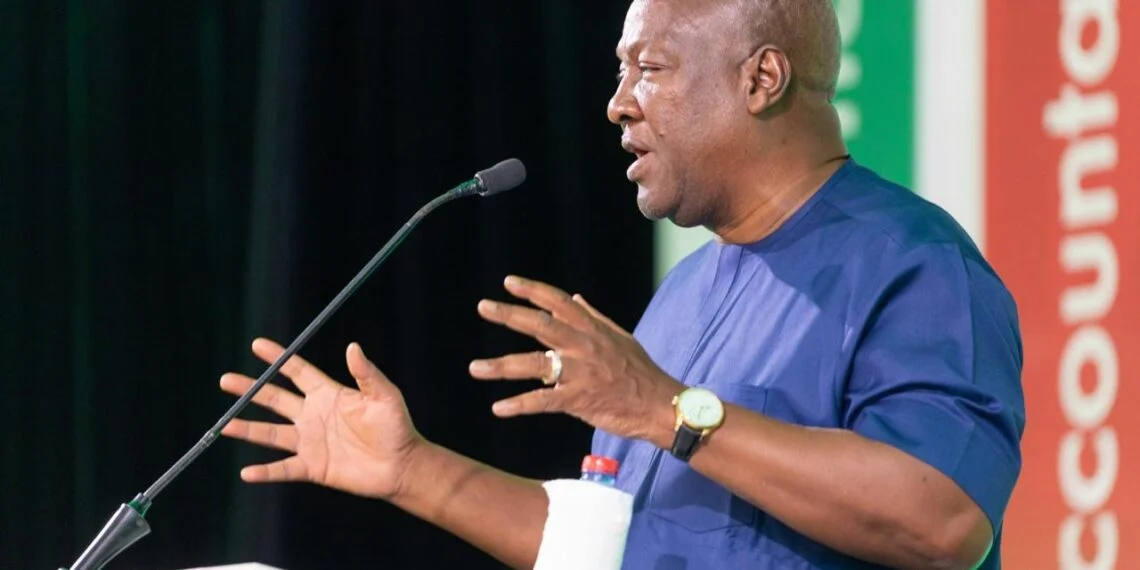
President John Dramani Mahama has announced the launch of a Regional Accountability Series aimed at deepening transparency, strengthening citizen engagement, and aligning government action more closely with local development priorities across Ghana’s sixteen regions.
The initiative was unveiled at the Jubilee House during a courtesy call by the Upper East Regional House of Chiefs, where the President outlined a structured programme of regional visits and dialogue sessions involving ministers, traditional authorities, and key stakeholders.
According to President Mahama, the Regional Accountability Series represents an expansion of the government’s broader accountability framework, bringing governance closer to communities and ensuring that national policies respond directly to regional needs.
He explained that the series would see him and his ministers travel to every region to engage with chiefs and stakeholders, review ongoing projects, and openly discuss development plans and challenges.
“I will be coming around with all the ministers to all the sixteen regions. We will call the Regional House of Chiefs and all the stakeholders. If there are any things you think the government should do, you can draw our attention to it. And we will also tell you what our policy for the region is and what we are doing in the region.”President John Dramani Mahama
A Two-Day Format for Each Regional Engagement
President Mahama outlined a two day format for each regional engagement. The first day will be devoted to field inspections of ongoing government projects, allowing ministers and regional leaders to directly assess progress, identify bottlenecks, and interact with project beneficiaries.

The second day will focus on dialogue sessions, where government officials will sit with chiefs and stakeholders to discuss the development trajectory of the region, review policy implementation, and receive feedback.
The President stressed that the initiative is designed to be inclusive and consultative, recognising the critical role of traditional authorities in governance at the local level.
By engaging Regional Houses of Chiefs, the government aims to tap into their influence and local knowledge to improve policy outcomes and conflict resolution, while also reinforcing trust between the state and communities.
Accountability Series at the District Level
Once the regional phase is completed, President Mahama said the accountability exercise will cascade to the district level , with Members of Parliament and District Chief Executives tasked to replicate the model in their respective districts.
According to the President, the engagement at the local level will convene chiefs and stakeholders to review district-level development, explain government actions, and listen to local concerns.
This, President Mahama said, will ensure that accountability does not remain confined to the national or regional levels but becomes embedded in everyday local governance.
The Regional Accountability Series builds on the Mahama-led government’s Government Accountability Series, which was launched in July 2025 as a strategic communication initiative to enhance transparency and public understanding of government performance.
Read also:

That national series features sector ministers delivering live updates on policy implementation and project delivery directly from the Presidency at Jubilee House.
Running three times a week on Mondays, Wednesdays, and Fridays, the Government Accountability Series allows ministers to provide mid year and ongoing performance briefings without intermediaries.
It is broadcast live and covered by the Information Services Department and the Ghana Broadcasting Corporation, making the sessions accessible to a broad national audience.
Since its launch, several key ministers have participated in the series, offering detailed updates on their respective sectors. The Minister for the Interior, Muntaka Mohammed Mubarak, opened the series with briefings on internal security, police reforms, and efforts to combat illegal mining.
In January 2026, the Minister for Trade, Agribusiness, and Industry, Hon. Elizabeth Ofosu Agyare, outlined progress in industrial growth and value addition, while the Minister for Works and Housing, Kenneth Gilbert Adjei, highlighted developments in water supply, housing delivery, and coastal protection projects.
The Minister of State in charge of Government Communications, Hon. Felix Kwakye Ofosu, has also used the platform to explain cabinet cost-cutting measures and other reforms.
Bridging Gap between National Policymaking and Local Realities.
President Mahama’s decision to take the accountability initiative directly to the regions reflects a deliberate effort to bridge the gap between national policymaking and local realities.

By combining project inspections with structured dialogue, the Regional Accountability Series is expected to improve coordination, accelerate project delivery, and enhance public confidence in government.
The President told the chiefs that the series would begin soon, noting that his farewell at the courtesy call was temporary. “I will say goodbye to you because I will be seeing you very soon as soon as we start the series,” he said, signalling the imminence of the regional engagements.
For many observers, the initiative represents a practical expression of the government’s reset agenda, which emphasises openness, performance tracking, and citizen participation.
By institutionalising regular engagement and reporting at regional and district levels, the government hopes to entrench accountability as a routine feature of governance rather than an occasional exercise.
As preparations begin for the nationwide rollout, expectations are high that the Regional Accountability Series will not only improve information flow but also translate dialogue into action.
For chiefs, stakeholders, and citizens across the country, the coming visits will offer an opportunity to directly shape development priorities and hold leaders accountable for promises made.