Els: MBN360 New
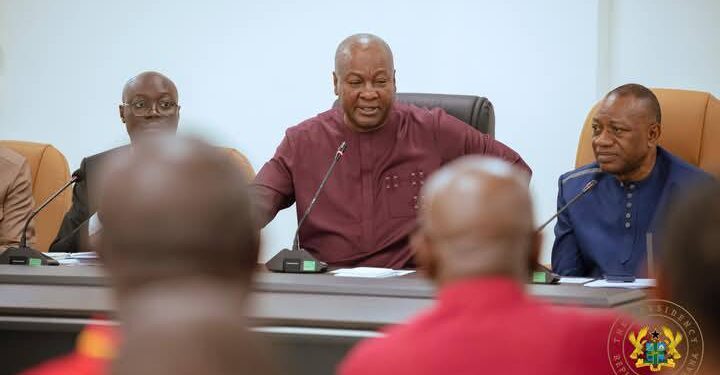
President John Dramani Mahama has nominated members to Ghana’s newly constituted Fiscal Council, a move aimed at reinforcing financial discipline and strengthening oversight of public finances as the country prepares to exit its International Monetary Fund programme.
The nominations, announced in a statement signed by Felix Kwakye Ofosu, spokesperson to the President and Minister for Government Communications, were made pursuant to Section 11D of the Public Financial Management Act, as amended in 2025.
The council is expected to serve as an independent oversight body to ensure that the government adheres to fiscal rules and maintains prudent economic management.
The nominees include Dr Emmanuel Oteng Kumah as Chairperson, Prof Patrick Opoku Asuming representing academia, Leslie Dwight Mensah from a research think-tank, J Kweku Bedu Addo as a former public policy expert from the Ministry of Finance, and Dr Henry Akpenamawu Kofi Wampah, a former official of the Bank of Ghana.
Strengthening oversight in a critical economic phase
The establishment of the Fiscal Council comes at a pivotal moment for Ghana’s economy. With the country expected to exit its current IMF support programme in August 2026, policymakers are seeking to institutionalise fiscal discipline to prevent a return to unsustainable borrowing and macroeconomic instability.

The council is designed to act as an independent watchdog, providing oversight of fiscal policy and ensuring that government decisions align with established financial rules. Its creation reflects broader efforts to build credibility in economic governance and reassure both domestic and international stakeholders.
According to the Presidency, the council will play a key role in shaping sound decision making in public financial management, particularly as Ghana transitions from programme based support to independent economic management.
Broad support from policy institutions
The establishment of the Fiscal Council has received support from policy and research institutions, including IMANI Centre for Policy and Education and the International Institute for Sustainable Development.
Both organisations have described the council as a critical tool for enhancing transparency, accountability, and long term debt sustainability.

At a high level policy roundtable held in Accra, stakeholders emphasised that the effectiveness of the council will depend on how it is implemented. Discussions focused on operational independence, staffing, and the need for clear frameworks to guide its work.
Fernando Mora of the International Institute for Sustainable Development noted that the focus should now shift from legislative design to practical implementation, ensuring that the council can function effectively within Ghana’s institutional landscape.
Key responsibilities and fiscal targets
The Fiscal Council will be tasked with monitoring Ghana’s fiscal performance and advising government on policy direction. It will also enforce newly established fiscal rules, including a debt to GDP ceiling of 45 percent by 2034 and a requirement to maintain an annual primary surplus of at least 1.5 percent of GDP.
Read also:
- Politics of Tolerance: Promoting Good Governance and Development in Ghana
- Major brands exit UK music festival as Keir Starmer slams Kanye West booking
- Mohammed Raii gifts Stonebwoy brand-new land cruiser in grand show of support
- BoG Governor reaffirms Cedi stability at Kwahu Business Forum.
- Dodowa–Afienya–Dawhenya road project hits 35% completion, ahead of schedule
In addition, the council will provide independent assessments of budget forecasts, contributing to greater transparency in fiscal planning. These responsibilities are intended to strengthen accountability and reduce the likelihood of fiscal slippages.
The legal foundation for the council is anchored in recent amendments to the Public Financial Management Act, which consolidated existing fiscal management laws and replaced the earlier Fiscal Responsibility Act of 2018.
Ghana previously established a Fiscal Council in 2018 under former President Nana Addo Dankwa Akufo-Addo. That body, chaired by former Bank of Ghana Governor Paul Acquah, served primarily in an advisory capacity.

However, the earlier council was eventually dissolved to make way for the current structure, which is intended to have greater independence and stronger enforcement capabilities. The transition reflects lessons learned from past efforts to strengthen fiscal governance.
Supporting economic stability and investor confidence
The operationalisation of the new council aligns with broader efforts by the Ministry of Finance, led by Cassiel Ato Forson, to restore macroeconomic stability following periods of high inflation and debt distress.
Recent data indicates improvements in key economic indicators, including a reported decline in inflation to 3.2 percent as of March 2026. Authorities are seeking to build on these gains by embedding discipline within the institutional framework.
The Fiscal Council is expected to play a central role in maintaining these improvements by ensuring that fiscal policy remains consistent with long term sustainability goals.
Balancing independence and accountability
While the council’s creation has been widely welcomed, analysts caution that its success will depend on its ability to operate independently of political influence. Ensuring transparency in its operations and clarity in its mandate will be critical to building trust among stakeholders.
There is also a need to balance oversight with collaboration, as the council will work alongside government institutions to shape fiscal policy. Its recommendations and assessments are expected to influence decision making at the highest levels.

For the business community and investors, the council represents a potential stabilising force in Ghana’s economic landscape. By providing credible and independent oversight, it could help reduce uncertainty and improve confidence in the country’s fiscal management.
A step toward long term discipline
The nomination of members to the Fiscal Council marks a significant step in Ghana’s efforts to strengthen its economic governance framework. As the country prepares to exit its IMF programme, the council is expected to serve as a cornerstone of fiscal discipline and accountability.
Its success will depend on effective implementation, sustained political commitment, and active engagement from stakeholders. If these conditions are met, the council could play a transformative role in shaping Ghana’s economic future.