
Els: MBN360 News Asia
ranian missiles struck several Gulf Arab states on Saturday, dramatically widening the regional conflict after Tehran vowed retaliation for joint U.S. and Israeli strikes on its territory.
The missile barrage targeted countries hosting American military facilities, shaking a region that has long prided itself on relative stability despite ongoing tensions elsewhere in the Middle East.
The attacks marked a significant expansion of hostilities beyond Israel and Iran, drawing Gulf capitals directly into the confrontation.
State media in the United Arab Emirates reported that one person was killed in Abu Dhabi, though no further details were immediately provided.
Interceptions Across the Gulf
Governments in Kuwait, Qatar, the United Arab Emirates and Jordan confirmed that their air defence systems had intercepted incoming Iranian missiles. All four countries host U.S. military personnel or facilities, making them potential targets in Tehran’s response.
Iran’s Islamic Revolutionary Guard Corps issued a defiant statement claiming broad strikes across the region.
“All occupied territories and the criminal U.S. bases in the region have been struck by the powerful blows of Iranian missiles.
“This operation will continue relentlessly until the enemy is decisively defeated.”Iran’s Islamic Revolutionary Guard Corps
The claim suggested a coordinated and sustained retaliation campaign, rather than a single wave of strikes.
In Bahrain, authorities confirmed that an attack occurred inside the kingdom’s territory. Officials said a service centre linked to the United States Fifth Fleet had been struck.
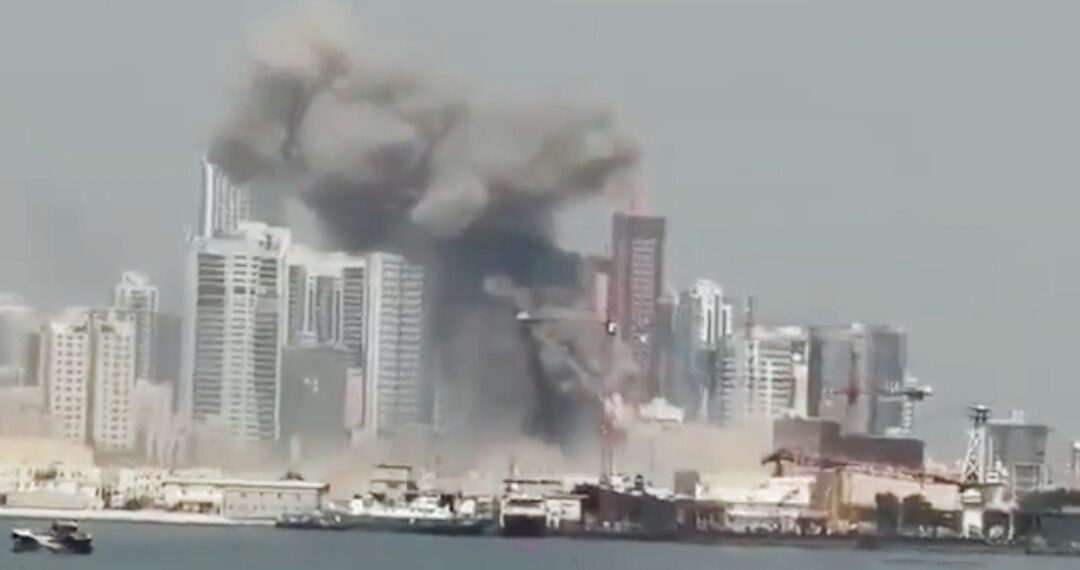
Video footage captured by a Reuters witness showed a plume of grey smoke rising near Bahrain’s coastline as warning sirens echoed across the small island nation. The U.S. Fifth Fleet, headquartered in Bahrain, plays a critical role in American naval operations across the Gulf and surrounding waters.
The incident underscored the strategic significance of Gulf states in the broader confrontation between Tehran and Washington.

Residents in Abu Dhabi described tense scenes as explosions reverberated across the city. Five witnesses, including two Reuters correspondents, reported hearing loud booms in rapid succession.
Read also:
- Police undertake ‘show of force’ ahead of Ayawaso East by-election
- Ghana marks 78th anniversary of 1948 crossroad shooting
- NDC gov’t refusing to take responsibility for anything that affects Ghanaians – Miracles Aboagye
- Fuel prices to increase marginally from March 1, driven by crude price surge.
- Big Push Sees 73 Roads, 1,717Km Construction Nationwide – President Mahama
One witness said she counted five explosions that caused windows in a house near the Corniche waterfront to vibrate. Others in the Al Dhafra and Al Bateen areas recounted similar experiences as air defences responded to incoming threats.
Authorities issued mobile phone alerts urging residents to shelter in secure buildings and remain away from windows because of missile threats. Fighter jets were seen flying over Yas Island, adding to the atmosphere of heightened alert.
The attack marked a rare instance of direct military action reaching the heart of the Emirati capital.
In Qatar, officials said incoming missiles were intercepted before reaching Qatari territory following what they described as “joint coordination” with allied forces. Several successive waves of blasts were heard in the capital, Doha, as air defence systems engaged.
After the U.S. Embassy issued a warning advising residents to take shelter, daily life initially appeared to continue. Shoppers remained in supermarkets, beachgoers headed toward the coastline and tourists boarded buses through the West Bay district.
However, once the Qatari government issued a shelter-in-place alert to mobile phones nationwide, streets quickly thinned and traffic eased as residents retreated indoors.
Regional Airspace Disrupted

The escalation also disrupted regional air travel. Global airlines suspended flights across large swathes of the Middle East, with flight tracking maps showing Iranian airspace virtually empty.
The Kuwaiti army confirmed that it dealt with missiles entering Kuwaiti airspace, while Jordanian authorities said they had downed two Iranian ballistic missiles.
The widening geographic scope of the conflict has heightened fears of further retaliation and prolonged instability. By striking Gulf states that host U.S. forces, Iran signalled its willingness to expand the battlefield beyond direct exchanges with Israel.
The missile attacks bring the conflict into a part of the Arab world that has invested heavily in projecting security and economic stability.
Gulf capitals are home to major financial hubs, global airlines and multinational corporations, making the escalation particularly concerning for international markets.
With U.S. military installations across the Gulf now openly targeted and civilian areas shaken by explosions, the risk of a broader regional war appears to be rising.
The coming days will determine whether diplomatic efforts can de-escalate tensions or whether the confrontation will deepen further across the Middle East.