
Read also:
- GSA Aligns 2026 Roadmap with MoTAI’s Strategic Planning
- Minority presses Mahama to appoint substantive Defence and Environment ministers
- Gospel Music Icon Ron Kenoly Passes Away at 81.
- Mahama orders probe into alleged paid overseas scholarships
- “NDC will beat Bawumia anytime in the day” — Ayariga
Els MBN360 News
Institute of Economic Affairs (IEA) has declared its resolute support for President John Dramani Mahama’s vision of resource sovereignty, urging a radical departure from the proposed Minerals and Mining Royalty Regulations 2025.
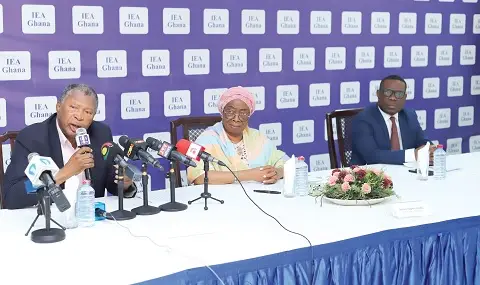
During press briefing in Accra, Her Ladyship Justice Sophia Akuffo, a fellow at IEA and former chief justice of Ghana expressed deep concern over the draft regulations currently before Parliament, which the institute argued merely perpetuate a colonial-era royalty system.
While the government’s new framework seeks to introduce a sliding scale of 5% to 12% for gold and lithium, the IEA contends that these incremental fiscal adjustments fail to address the fundamental issue of ownership, keeping Ghana in a “trap” where it captures almost none of the true value of its natural endowments.
The institute’s critique highlights a “profound contradiction” between the Ministry of Lands and Natural Resources’ push for a 9% to 12% sliding royalty and the President’s more progressive international stance.
In various global forums, including his keynote at the 2025 National Economic Dialogue and the 80th UN General Assembly, President Mahama has advocated for “increased indigenous participation” and an end to the “fastening out of vast concession areas to foreign interests.”
The IEA warned that while the President appears “way ahead of his ministers,” the current draft bill under consideration by the Minerals Commission still clings to the old paradigm, effectively ignoring the presidential call to exercise full sovereignty over the nation’s critical minerals to ensure the well-being of its citizens.
“Ghana must have full ownership of its natural and mineral resources at all points in time. It must exercise this ownership right by engaging private sector, local and foreign expertise strictly through service contracts that preserve national control and maximise the benefits of the country’s industrial transformation.
“We are tired of the continued image of poverty-stricken, disease-ridden rural communities living at the periphery of huge foreign-controlled natural resource concession areas.Her Ladyship Justice Sophia Akuffo
The Economic Drain of the Royalty Paradigm

From an extractive expert’s perspective, Ghana’s continued reliance on a royalty-based regime is a significant contributor to its fiscal fragility.
Under the current “Guggisberg era” agreements, the state primarily receives a small percentage of gross revenue, leaving the lion’s share of profits, value-added processing, and technical data in the hands of multinational corporations.
Estimates suggest that by not owning the minerals outright, Ghana loses billions in potential “resource rent” the surplus value beyond production costs and a fair return on capital.
This lack of sovereignty means that during commodity price booms, such as the recent gold price surges, the state only sees a marginal increase in revenue through royalties, while the real wealth is exported to foreign shareholders, leaving host communities to grapple with the environmental and social “periphery of poverty.”
Service Contracts: A Path to Genuine Sovereignty

To break this cycle, the IEA proposes a transition to “service contracts,” a model successfully utilized by various oil-producing and mineral-rich nations to retain 100% ownership of their resources.
Unlike the current concession system, where a company “owns” the ore in the ground once a lease is signed, service contracts treat foreign firms as hired experts paid a fee for their drilling, blasting, and processing services.
This shift would empower Ghana to control the entire value chain from assaying and smelting to marketing ensuring that “sovereignty is not a trap” but a functional tool for wealth creation.
By maintaining title to the minerals, the state can leverage its resources as collateral for industrialization, effectively ending the era of being “poverty-stricken” amid vast mineral wealth.
Realigning Policy with National Vision

The IEA’s intervention serves as a critical call for the Ministry of Lands and Natural Resources to realign its legislative agenda with the “Resetting Ghana” agenda championed at Davos and the UN.
The institute argues that the draft 2025 regulations represent a “failure of imagination” that refuses to move beyond colonial fiscal structures.
By adopting a service-led ownership model, Ghana can finally bridge the gap between its status as a top global producer and its domestic economic reality.
The “Days of offering the very least by way of respect and dignity” must end, replaced by a regime where the state dictates the terms of extraction, ensuring that every ounce of gold and lithium extracted serves the primary goal of creating “wealth and prosperity” for the Ghanaian people.