
Els: MBN360 Business
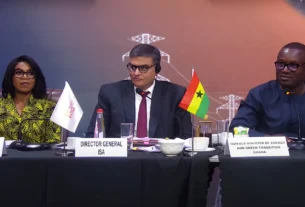
The Ghana Investment Promotion Centre (GIPC) is pivoting toward a more aggressive reform agenda following the official launch of the World Bank Group’s Business Ready (B-READY) report in Accra.
Addressing a high-level assembly of policymakers and private-sector titans, GIPC Chief Executive Officer Mr. Simon Madjie emphasized that while Ghana has built a “World Cup level” regulatory framework, the nation must now close the “delivery gap,” to remain competitive.
According to GIPC, the B-READY initiative, which replaces the former Doing Business rankings, provides a rigorous, evidence-based assessment of how effectively economies support private-sector growth and institutional resilience.
“The report highlighted a significant divergence in Ghana’s performance across three core pillars: Regulatory Framework (69/100), Public Services (50/100), and Operational Efficiency (52/100). While the legal structures are robust, the real-world experience of businesses remains hampered by bureaucratic lag”GIPC

A standout revelation of the report is Ghana’s leadership in labour-market regulation. Scoring 71 out of 100, Ghana ranks within the elite top 20% of economies globally. This performance is largely attributed to the country’s sophisticated dispute-resolution mechanisms and institutional improvements in utility provision.
However, the World Bank’s findings warned that these regulatory wins are being undermined by operational bottlenecks that increase the cost of doing business. The gap between strong rules and slower delivery shapes how investors assess risk, cost, and predictability. “This gap matters because the real win is jobs, and jobs at scale come from investment.”
Currently, Ghana’s gross capital formation stands at approximately 10% of GDP, significantly trailing industrializing peers like Morocco, which maintains levels near 30%. The GIPC noted that it is now targeting these “operational frictions,” – such as the 23-day average for import clearance – as the primary frontier for reform.
Read also:
24-Hour Economy
The B-READY findings are being directly integrated into the government’s 24-Hour Economy (24H+) strategy, which the Centre recently pitched to a South Korean business delegation at the Ghana-Korea Business Forum.
Policymakers argue that the 24-hour initiative is not merely about extending working hours, but about ensuring “system readiness.” For a three-shift system to be viable, the public services supporting the private sector – such as ports, electricity, and digital regulators – must operate with the same 24/7 reliability.

“The 24-Hour Economy is not just about working longer hours. It is about creating an enabling framework for productivity – supported by infrastructure, financing, and strong institutional collaboration.
“To facilitate this, the GIPC has already introduced an expedited 24-hour premium service to fast-track investment registrations and approvals, ensuring that the administrative entry point for investors matches the speed of modern global trade”GIPC
Despite the progress in financial services and labor, the B-READY report identified Market Competition as a critical weak spot, with Ghana scoring just 34%. This reflects a need for stronger enforcement of competition laws and more transparent licensing procedures to prevent market concentration and encourage new entrants.
“The launch offered stakeholders an evidence-based platform to evaluate Ghana’s progress toward a more enabling business climate and to identify reforms needed to accelerate investment-led growth”GIPC
By addressing these structural constraints, the GIPC’s aim is to transform the report’s diagnosis into a roadmap for rapid industrialization.

With a clear baseline established by the World Bank, the focus now shifts to execution, ensuring that Ghana’s “ready” status on paper translates into a frictionless experience for every investor on the ground.