Read also:
- Stonebwoy uses global platform to champion African unity at African Prosperity Dialogue
- Police mandates strict uniforms for private security operators
- COCOBOD begins paying LBCs to clear cocoa farmers’ arrears
- Newmont Ghana Supports Korle Bu’s Critical Care with Equipment Donation
- Empower Women, Youth, and SMEs for Mining Prosperity – Abu Jinapor
Els MBN360 News
hana and Zambia have taken a major step toward deepening bilateral relations with the signing of ten agreements covering key areas of cooperation, including the introduction of visa free travel between the two countries.
The agreements were announced by President John Dramani Mahama during his historic address to the Zambian Parliament as part of his three-day state visit to Lusaka, a visit aimed at strengthening political, economic, and social ties between the two African nations.
Addressing lawmakers, President Mahama praised Zambia’s recent macroeconomic recovery efforts, describing the stabilisation of the Zambian economy and the performance of the kwacha as positive signals to investors and regional partners.
He said Ghana looks forward to expanding trade, investment and financial cooperation with Zambia, noting that economic stability creates confidence and provides a strong foundation for long term development partnerships.
President Mahama also expressed Ghana’s confidence in Zambia’s democratic credentials, saying his government follows Zambia’s democratic journey with keen interest.
He commended the strength of Zambia’s institutions and the commitment of its people to free and fair elections, adding that democratic governance remains essential for peace, stability and sustainable growth across the continent.

Revitalisation of the Permanent Joint Commission for Cooperation
Central to the renewed engagement between the two countries is the revitalisation of the Permanent Joint Commission for Cooperation. President Mahama explained that the commission provides a structured and resource focused framework to guide collaboration across priority sectors.
These include trade, investment, energy, tourism, mining, agriculture, education, science and technology, youth development and defence cooperation. He said the framework would help both countries move beyond declarations of intent to concrete actions that deliver measurable benefits to their citizens.
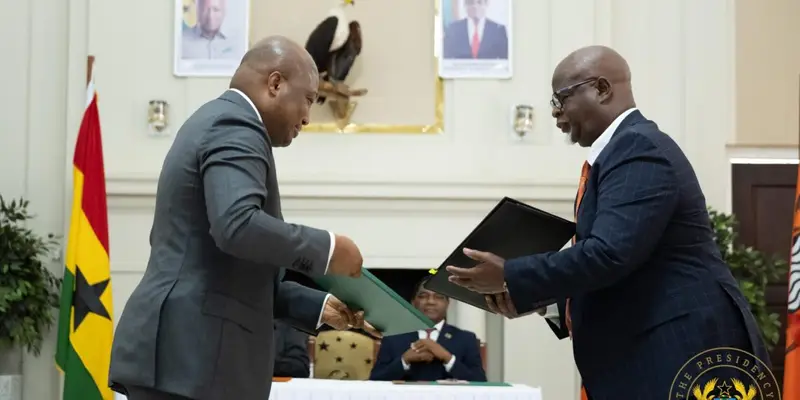
The highlight of the visit was the signing of ten agreements earlier in the day, which President Mahama described as the backbone of the new phase of Ghana Zambia relations.
“Prominent among these is the Memorandum of Understanding to allow visa-free travel for all categories of passport holders between Ghana and Zambia. And so it means as of this …, when signatures were appended, Zambians don’t need a visa to go to Ghana, and vice versa”.HE John Dramani Mahama, President of Ghana
President Mahama said the removal of visa requirements reflects a shared commitment to African integration and the belief that the free movement of people is essential for economic growth and cultural exchange.
He noted that easier travel would encourage private sector partnerships, enhance trade flows and allow citizens to explore opportunities across borders with fewer barriers.

Cooperation in Peace and Security
Beyond mobility, the agreements also reinforce cooperation in peace and security, which President Mahama described as indispensable foundations for development. He said Ghana values its long standing cooperation with Zambia in defence training, intelligence sharing and peacekeeping operations.
According to him, strengthening collective security arrangements remains critical for safeguarding stability not only in both countries but across the wider African region.
In his address, President Mahama also spoke extensively on the issue of justice and restoration, aligning his remarks with the African Union’s 2025 theme of justice for Africans and people of African descent through reparations.
He described the quest for reparations as a moral responsibility and a forward looking agenda aimed at addressing historical injustices while building a fairer global order.
In his role as the African Union champion for reparations, he announced that Ghana would soon sponsor a United Nations resolution seeking to declare slavery as the greatest crime against humanity. He expressed hope that Zambia would support the initiative as a co-sponsor.
The Ghanaian leader further addressed Parliament in his capacity as the African Union champion for gender and development. He said Ghana has moved decisively from symbolism to action by electing its first female vice president and operationalising the Affirmative Action Gender Equity Act.

The law mandates a minimum of 30 percent female representation in all public appointments, a measure he said is already reshaping governance and decision-making in the country.
President Mahama revealed that Ghana is also working to establish a women’s development bank to expand access to financing for female led enterprises, adding that plans are far ahead for its rollout.
He stressed that investing in women yields broad economic and social dividends, noting that when women are empowered, families, communities and national economies benefit. He described gender equality as a shared continental struggle that requires cooperation and collective resolve.
Trade and Economic Integration
Turning to trade and economic integration, President Mahama highlighted the opportunities presented by the African Continental Free Trade Area. He said the framework offers Africa an unprecedented chance to boost intra African trade, promote value addition and accelerate industrialisation.
Ghana, he noted, remains committed to working closely with Zambia to reduce trade barriers, harmonise standards and stimulate private sector collaboration that can drive job creation and inclusive growth.
He also emphasised the human dimension of Ghana Zambia relations, pointing to the presence of Ghanaians living and working in Zambia and Zambians doing the same in Ghana.
According to him, these communities are the true custodians of bilateral relations, enriching both societies and strengthening mutual understanding through everyday interaction, family ties and shared experiences.
President Mahama concluded by reflecting on Africa’s demographic future, noting projections that the continent will account for about a quarter of the world’s population by 2050.

He said this demographic dividend presents both an opportunity and a responsibility, requiring sustained investment in skills development, innovation and fair representation in global governance. Without such investments, he warned, Africa risks remaining on the margins of global decision making.
Expressing gratitude for the invitation to address the Zambian Parliament, President Mahama reaffirmed Ghana’s commitment to deepening cooperation with Zambia based on mutual respect and a shared African destiny.
He described the signing of the ten agreements as a clear signal that both countries are determined to translate historical solidarity into practical cooperation that delivers real benefits for their people and contributes to Africa’s broader development and integration goals.