
Els: MBN360 News
The Ghana Centre for Democratic Development has offered a mixed assessment of the Mahama administration’s anti-corruption record after one-year in office, commending key reforms while warning that unresolved gaps pose serious risks.
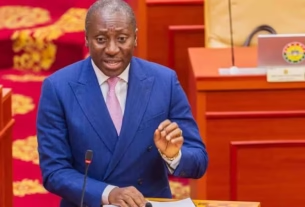
The evaluation was presented as part of CDD-Ghana’s one year governance review, led by Dr. Kojo Pumpuni Asante, Director of Policy Engagement and Partnerships. His presentation focused on institutional reforms, ethical frameworks, and enforcement challenges shaping the government’s anti-corruption agenda.
Dr. Asante noted that the administration has taken deliberate steps to signal its commitment to integrity and accountability. Among the headline initiatives is the adoption of a code of conduct for public officials, designed to clarify ethical standards and guide behaviour across government.
He also referenced the launch of Operation Recover All Loot, an initiative aimed at tracing and reclaiming public funds lost through corruption and mismanagement.
Another major development highlighted was the initiation of the second phase of the National Anti-Corruption Action Plan, now rebranded as NECAP.
According to Dr. Asante, this revised framework places stronger emphasis on ethics and prevention, marking a shift toward reducing corruption risks before they materialise rather than relying solely on prosecutions.
Institutional Collaboration and Fiscal Discipline
CDD-Ghana further acknowledged efforts by the President to strengthen coordination among key accountability institutions. Dr. Asante pointed to engagements involving the Auditor General, Attorney General, and the Chief Justice, which were intended to ensure stricter enforcement of fiscal rules and compliance with public financial regulations.
In addition, the assessment recognised reforms driven by the Minister for Finance to improve public financial management. Amendments to the Public Financial Management Act now require commencement authorisation before contracts can be approved, a measure aimed at curbing unauthorised commitments.

The establishment of a compliance desk to monitor adherence to these rules, according to Dr. Kojo Pumpuni Asante, Director of Policy Engagement and Partnerships, is a practical step toward strengthening fiscal discipline.
Despite these positive actions, CDD-Ghana identified significant weaknesses that could undermine credibility. One major concern is the presidential gift policy, which sets a threshold of 20,000 cedis for gifts to public officials.
Dr. Asante noted that the policy attracted widespread criticism from citizens who argued that the threshold was too high and susceptible to abuse through repeated gifting.
Read also:
- ‘Emergency ward saved my life, it must work for every Ghanaian’ – Mahama Ayariga demands accountability over hit-and-run case
- Ahafo Police arrest 3 with firearms, ammunition and drone, foil suspected robbery
- EPA says $35m needed to fully restore the polluted Birim River.
- Minority slams gov’t over delay in briefing Parliament on Burkina Faso attack
- Airport renaming doesn’t require parliamentary approval—Transport Minister
He observed that public concerns raised when the policy was introduced have not been addressed, creating what he described as an ethical loophole. In his view, the absence of revisions weakens confidence in the administration’s stated commitment to closing gaps in public sector ethics.
Asset Declaration and Procurement Risks
Asset declaration was cited as another area with mixed outcomes. While compliance with filing requirements has improved, Dr. Asante stressed that verification remains a major challenge. Without independent and effective verification mechanisms, he warned that asset declaration risks becoming procedural rather than substantive.
The assessment also raised concerns about sole sourcing in public procurement. Dr. Asante referenced comments by the International Monetary Fund Country Director indicating that sole sourcing accounted for a significant proportion of contracts.
CDD-Ghana expressed concern that clear measures to control or reduce the practice have not yet been demonstrated. Questions were also raised about Operation Recover All Loot itself.

While acknowledging its intent, Dr. Asante noted that stakeholders had expressed concerns about overlaps between ORAL and existing anti-corruption institutions. He said clarity is still needed to ensure the initiative complements, rather than duplicates, established mandates.
CDD-Ghana further highlighted the continued absence of the Conduct of Public Officers Bill, which was expected to provide a comprehensive legal framework for regulating ethical conduct in public office. Dr. Asante described its non-implementation as a missed opportunity to consolidate integrity measures into enforceable law.
Selective Justice and Institutional Tensions
The assessment also drew attention to perceptions of selective justice, particularly regarding the Attorney General’s use of nolle prosequi to discontinue cases involving members of the governing party that were already before the courts.
Dr. Asante said these actions by the Attorney General and Minister for Justice have generated legitimacy concerns and reinforced public perceptions of unequal application of the law.
Beyond individual cases, CDD-Ghana warned of growing tension among anti-corruption institutions, especially involving the Attorney General’s office and bodies such as the Office of the Special Prosecutor. Dr. Asante cautioned that institutional rivalry and lack of coordination weaken enforcement and dilute public trust.

CDD-Ghana concluded that while the Mahama administration has laid important foundations in its first year, unresolved loopholes and governance risks could erode progress if not addressed.
Dr. Asante stressed that effective anti-corruption work depends not only on strong policies but also on coherence, fairness, and collaboration among institutions.
As the administration enters its next phase, CDD-Ghana indicated it will continue to monitor both reforms and implementation. The think-tank maintained that Ghana’s anti-corruption drive stands at a critical point, where early momentum must be matched with credible enforcement and institutional unity.