
Els: MBN360 Extractives/Energy
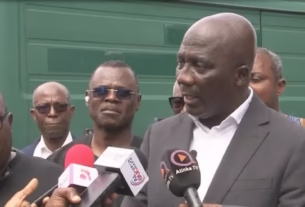
Benjamin Boakye, the Executive Director of the Africa Centre for Energy Policy (ACEP), has raised a red flag regarding the potential risks of abolishing the GHS1 fuel levy, cautioning that such a move could jeopardize the hard-won stability of Ghana’s power sector.
While acknowledging the intense pressure on businesses and the general public due to crude oil prices surging from $60 to over $100, Ben Boakye argued that the levy serves as a critical financial lifeline for the energy value chain.
He maintains that while the intervention from transport unions and other bodies for price relief is understandable, the government must meticulously analyze the risks of removing a revenue stream that has historically addressed under-recoveries and ensured the prompt settlement of debts to gas producers.
“The pressure on consumers at this point, I mean, seeing crude oil price increase from about $60 to now above $100, certainly there’s pressure on businesses and the general public. And it’s not surprising that you have such intervention from critical groups like the transport unions. It’s a good call, but there are risks that need to be analysed. The one cedi was imposed for contributing to the revenues that were being used to address the under-recoveries in the power sector.”Benjamin Boakye

Expanding on this fiscal necessity, Ben Boakye highlighted that the GHS1 levy has provided “significant liquidity” required to settle monthly gas bills which currently exceed $70 million.
He reminded stakeholders of the recent $500 million payment made to replenish guarantees drawn down by partners like E&I, a move that stabilized fuel supply for power generation.
Without this dedicated revenue, the Ministry of Finance would be forced to “bridge the gap” from other unspecified sources, potentially returning the country to a cycle of energy debt.
Ben Boakye posits that the fundamental choice facing the nation is whether to “trade stability of the power sector for some cushioning of the consumer” or to seek more sustainable relief by eliminating systemic inefficiencies within the petroleum pricing formula itself.
“So the fundamental question to answer is whether we want to trade stability of the power sector for some cushioning of the consumer. As industry watchers, what we see possible is for us to analyse the sector broadly to see where some relief could be generated. We need to create some savings that will cushion consumers in these tough times without compromising the interventions that are actually supporting the stability of the power sector.”Benjamin Boakye
The Peril of Defunding Energy Security

According to ACEP Boss, the immediate abolishment of this levy, without a verified alternative revenue source, could trigger a domino effect of “under–recoveries” and technical failures.
If the $70 million monthly gas bill remains unpaid, international producers may reduce supply, leading to a resurgence of erratic power supply, or “dumsor,” which would arguably hurt businesses more than the current fuel prices.
Read also:
- Delays in Mineral Royalties Disbursement Undermine Resource Management – Patrick Stephenson
- Kwahu Easter paragliding festival opens at Odweanoma
- Van Dijk apologizes as Liverpool “Give Up” FA Cup dream
- GPL: Hearts of Oak end winless run, move third after 1-0 win Over Young Apostles
- Deliver value for money or face sanctions – GETFund warns contractors.
The repercussion of such a move is not merely fiscal; it threatens the operational integrity of the power plants that rely on the prompt settlement of debts to maintain a steady flow of natural gas.
Consequently, any hasty political decision to scrap the levy to satisfy short-term public outcry could inadvertently collapse the very infrastructure that keeps the lights on.
Optimizing Margins Over Levy Scrapping

Rather than removing the GHS1 levy, Boakye points toward the “unbelievable” costs associated with internal distribution and administrative margins as a more viable area for reform.
He noted that it “really doesn’t make sense” for the Unified Petroleum Pricing Fund (UPPF) to cost nearly one cedi per litre just to transport fuel from Tema to local pumps.
By unpacking these margins, Boakye suggests that the government could uncover a “lot of settlements and business people being paid at the expense of the taxpayer.”
He argues that optimizing this space would create genuine savings for the average consumer without defunding the essential security of the energy sector.
Eliminating Waste and Redundant Interventions

Further relief could be found by scrutinizing interventions like “fuel marking,” which Ben Boakye asserts provides “no value” despite costing the state over 40 million cedis every month in payments to private entities.
He contends that these “trapped” interventions, designed to protect tax revenue and fuel quality, have instead become sources of waste.
By redirecting the 40 million cedis currently “paid to private people” and streamlining the UPPF, the government could “pass on optimization” to the pump.
This strategic shift would allow the state to maintain the GHS1 levy for power stability while simultaneously lowering the overall financial burden on the Ghanaian consumer through the elimination of parasitic industry costs.