
Els: MBN360 News
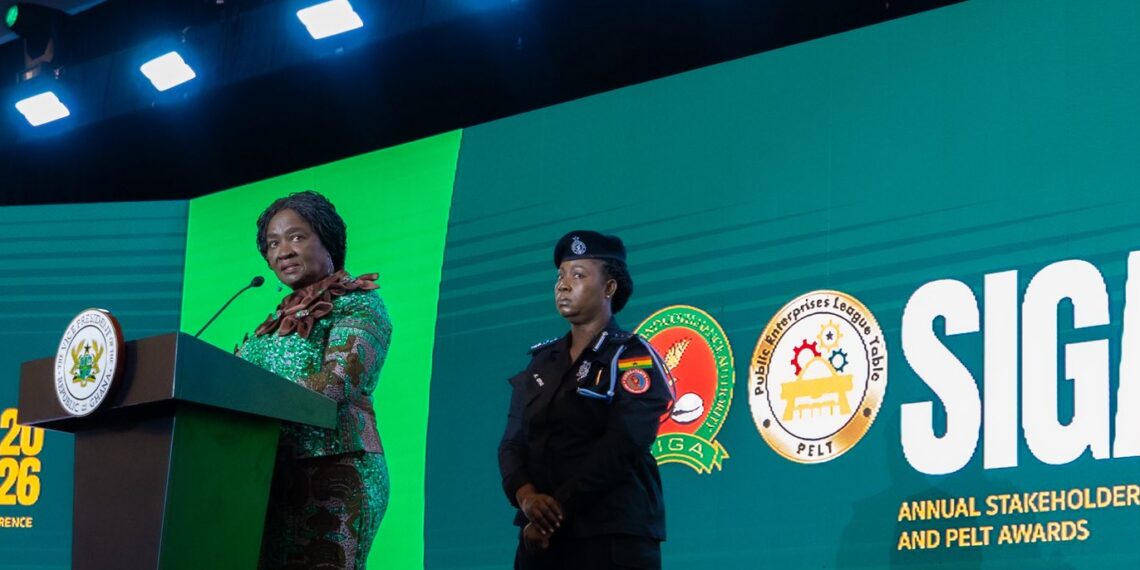
Vice-President Professor Jane Naana Opoku-Agyemang has intensified calls for far-reaching reforms in Ghana’s State-Owned Enterprises, warning that persistent inefficiencies continue to impose a heavy burden on the national economy.
Speaking at the 2026 Stakeholder Conference organised by State Interests and Governance Authority, she underscored the need for decisive action to reposition the sector under the government’s broader economic reset agenda.
The conference convened policymakers, regulators, and industry leaders to evaluate the performance of public enterprises and identify practical steps toward improving efficiency and accountability.
The Vice-President acknowledged the critical role State-Owned Enterprises play in Ghana’s economic architecture. These institutions manage key national assets, generate revenue, and provide employment across strategic sectors. However, she noted that many of them are falling short of expectations.
She pointed to recurring operational inefficiencies, weak governance systems, and financial underperformance as major obstacles limiting their impact. These structural weaknesses, she explained, continue to erode value and undermine the ability of SOEs to contribute meaningfully to national development.
The situation has raised broader concerns about the sustainability of public enterprises and their alignment with Ghana’s long-term economic priorities.
Mounting Fiscal Burden on the State
The Vice-President highlighted the growing fiscal implications of underperforming SOEs, noting that several entities remain dependent on government bailouts to stay afloat. This reliance diverts critical public resources away from essential development projects and social interventions.

She stressed that the continued support for loss-making enterprises is not sustainable, particularly at a time when the government is pursuing fiscal consolidation and economic recovery.
Her remarks reflect increasing scrutiny of how public funds are allocated and the need to ensure that State-Owned Enterprises deliver value for money.
In response to these challenges, the government is advancing a comprehensive reform programme led by the Ministry of Finance in collaboration with State Interests and Governance Authority, led by its leader Professor Michael Kpessa-Whyte.
The Vice-President explained that the reforms are designed to strengthen corporate governance, enforce performance standards, and enhance transparency across the sector.
Read also:
- NPP’s poll decline ‘startling’ – Prof Nortey calls for introspection
- 2026 World Cup: ‘We fear no foe’ – Kurt Okraku on Black Stars campaign
- Drone strikes turn Sudan hospitals into targets with 64 dead and 89 wounded, WHO warns of medical collapse
- Ghana Music Society launched to promote cultural identity through arts
- Ghana School of Law student dies after medical emergency during lectures.
Central to this effort is the introduction of stricter performance contracts, which will hold boards and management teams accountable for delivering measurable results. These contracts are expected to align enterprise operations with clearly defined national objectives.
She also disclosed that a review of the State’s equity holdings is currently underway. This exercise aims to assess the viability of existing investments and guide future strategic decisions to optimise returns.
Performance Measurement Takes Centre Stage
A key component of the reform process is the Public Enterprises League Table, an initiative that ranks State-Owned Enterprises based on performance indicators. The Vice-President described this tool as essential for driving accountability and fostering a culture of competition within the sector.

By publicly tracking performance, the league table provides transparency and encourages underperforming entities to improve. It also offers recognition to enterprises that demonstrate strong governance and operational excellence.
The upcoming Public Enterprises League Table Awards are expected to spotlight both high achievers and institutions that require urgent attention, reinforcing the government’s commitment to results-driven management.
Reaffirming the government’s long-term vision, the Vice-President stated that State-Owned Enterprises must transition from being fiscal liabilities into engines of economic growth. She noted that well-managed SOEs have the capacity to generate revenue, create employment, and support industrial development.
Achieving this transformation, she cautioned, will require consistent implementation of reforms and a strong commitment to discipline across all levels of management. The success of the initiative will depend on the ability of institutions to adapt to new governance standards and deliver on performance expectations.
She emphasised that the reform agenda is not merely about correcting inefficiencies but about unlocking the full potential of public enterprises to drive national progress.
Accountability as the Cornerstone of Reform
The Vice-President concluded her address with a strong call for accountability among all stakeholders involved in the management of State-Owned Enterprises. She urged boards, executives, and regulators to uphold the highest standards of professionalism and integrity in their operations.

She warned that without a firm commitment to transparency and responsible leadership, reform efforts could fall short of their intended outcomes. Accountability, she stressed, must become the foundation upon which the new SOE framework is built.
As Ghana continues its economic reset journey, the performance of State-Owned Enterprises is expected to remain a critical benchmark for assessing progress. The government’s ability to implement meaningful reforms in this sector will play a decisive role in shaping the country’s fiscal stability and long-term growth trajectory.