
Els: MBN360 News
Afellow of the Center for Democratic Development, Ghana (CDD-Ghana) and renowned legal scholar, Professor Stephen Kwaku Asare, has called for a fundamental shift in how Ghana approaches the Office of the Special Prosecutor, arguing that the institution must be treated as a permanent pillar of the justice system rather than a continuing experiment.
According to Professor Asare, the Office of the Special Prosecutor was established to confront a problem that conventional enforcement institutions struggled to resolve for decades.
“The Office was created to confront a specific and persistent problem, high-level corruption that ordinary enforcement mechanisms had struggled to address for decades.”CDD-Ghana Fellow and legal scholar, Professor Stephen Kwaku Asare
He stressed that the OSP operates within a justice system characterised by slow-moving criminal trials, frequent procedural objections, extended court recesses, and weak case-management structures. In such an environment, Professor Asare argued that accountability is not dramatic or swift. It is gradual, methodical, and often quiet.
A Mandate That Invites Controversy
Professor Asare explained that controversy is built into the very mandate of the Office. Because the OSP is required to investigate individuals with political power and influence, its actions are inevitably interpreted through partisan lenses.
When the Office appears inactive, critics accuse it of losing direction. When it acts, it is accused of targeting opponents. This paradox, he said, exposes the vulnerability of any institution tasked with scrutinising entrenched power within a polarised political climate.

Yet he argued that suspicion should not be mistaken for failure. Rather, it reflects the discomfort that accountability naturally generates among those accustomed to operating without scrutiny.
He cautioned against measuring the Office’s effectiveness by noise or public spectacle. Anti-corruption work, he emphasised, is rarely instant or theatrical. Its true impact often becomes visible only over time.
Contrary to claims that the OSP has been ineffective, Professor Asare pointed to concrete outcomes that demonstrate institutional progress. He noted that the Office has secured convictions, recovered significant sums through negotiated settlements and kept multiple criminal trials active before the courts.
“Corruption networks within key public institutions have been disrupted. Matters have been referred for further recovery and enforcement. Some suspects, faced with scrutiny, have fled rather than account.”CDD-Ghana Fellow and legal scholar, Professor Stephen Kwaku Asare
These developments, he argued, are not signs of an institution drifting without purpose. They reflect an office engaged in the difficult, often unglamorous work it was created to perform.
Existential Challenges and Legal Resistance
Despite these efforts, Professor Asare observed that the OSP has faced persistent challenges to its legitimacy since its inception. Legal debates have questioned its constitutional design and its placement within Ghana’s governance framework.
Read also:
- Energy Commission Advances Ghana EV Charging Infrastructure Regulation
- Ghana can supply steel to entire West Africa if domestic steel industry thrives – Mahama
- GHS condemns attacks on staff, pledges enhanced security measures
- Majority Leader fires back at Sefwi protesters
More significantly, he noted that the current Special Prosecutor, Kissi Agyebeng has been subjected to repeated attempts at removal. Six petitions have been filed against the officeholder, all of which failed at the prima facie stage.
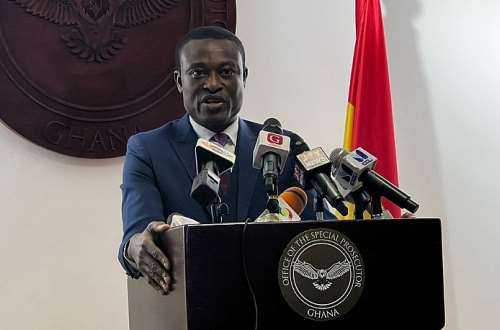
In his view, this record does not suggest misconduct. Instead, it highlights the resistance that inevitably confronts institutions mandated to hold powerful interests accountable.
“No accountability institution matures under constant existential contest. Institutions gain authority through continuity, predictability, and the public confidence that comes when they are allowed to function without perpetual disruption.”CDD-Ghana Fellow and legal scholar, Professor Stephen Kwaku Asare
Professor Asare urged the public and political actors to move beyond treating the OSP as a political instrument. He criticised the tendency to applaud the Office when it acts against perceived opponents and to doubt its credibility when its investigations appear slow or discreet.
The true measure of the Office, he said, lies not in public applause or outrage but in persistence. Investigations take time. Prosecutions take time. Deterrence, he added, takes even longer.
If Ghana genuinely intended to establish an independent mechanism to confront corruption at the highest levels, he argued, then the country must commit to creating conditions that allow the institution to succeed.
Reforming the Environment Around Accountability
Central to Professor Asare’s argument is the need to improve the broader environment in which the OSP operates. He called for reforms to criminal trial procedures, stronger asset recovery systems and clearer timelines for handling corruption cases.
He also highlighted the problem of interlocutory appeals and procedural delays that frequently stall trials. Addressing these issues, he said, is not about weakening due process or making prosecutions easier. Rather, it is about ensuring fair, timely and efficient justice, even when the accused are powerful figures.

He maintained that institutional strength is not built through constant challenges to legitimacy. Instead, it is reinforced when institutions are allowed to perform their lawful mandates in the public interest.
Professor Asare concluded that the future of the OSP represents a broader test of Ghana’s commitment to accountability. The Office, he said, was not created to generate political drama but to patiently confront corruption that undermines public trust and economic progress.
Allowing the institution to function without perpetual contestation, he argued, is essential if Ghana is to demonstrate seriousness in its fight against corruption. In his view, the question is no longer whether the OSP should exist, but whether the country is prepared to support the institutional conditions necessary for it to succeed.