Els: MBN360 AFRICA
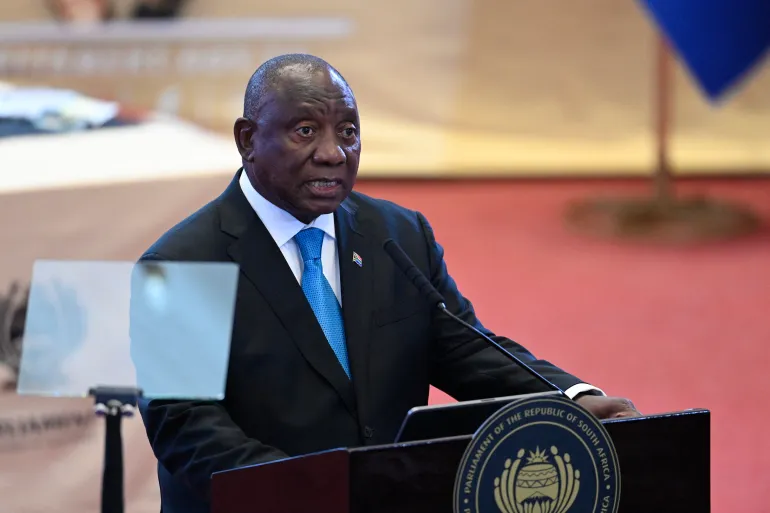
South African President, Cyril Ramaphosa has announced that he will deploy the army to work alongside the police in an intensified effort to confront rising levels of gang violence and other serious crimes across parts of the country.
The decision, outlined during his annual State of the Nation Address, signals a heightened security response to what he described as an urgent and immediate threat to South Africa’s stability and democratic order.
In his address, Ramaphosa said that he had directed the leadership of both the police and the army to urgently develop a coordinated deployment plan.

The plan, he noted, would determine where “our security forces should be deployed within the next few days in the Western Cape and in Gauteng to deal with gang violence and illegal mining.”
By identifying both gang violence and illegal mining as priority areas, Ramaphosa signaled a broad approach to combating organized criminal networks
“Organised crime is now the most immediate threat to our democracy, our society and our economic development.
“Children here in the Western Cape are caught in the crossfire of gang wars. People are chased out of their homes by illegal miners in Gauteng.”Cyril Ramaphosa
Ramaphosa clarified that the army would support, rather than replace, the police in maintaining order. “I will be deploying the South African National Defence Force to support the police,” he said, emphasizing that the initiative is intended to reinforce existing law enforcement capacity.
South Africa has one of the highest homicide rates in the world, with approximately 60 deaths each day involving killings in wars between drug gangs in areas of Cape Town and mass shootings linked to illegal mining in Johannesburg’s Gauteng province.
Authorities in South Africa have also long struggled to prevent gangs of miners from entering some of the 6,000 closed or abandoned mines in the gold-rich nation to search for remaining reserves.
Read also:
The government claims that the miners, referred to as “zama zamas”, or “hustlers” in Zulu, are typically armed, undocumented foreign nationals who are involved in crime syndicates.
The South African leader said other measures to fight crime include recruiting 5,500 police officers and boosting intelligence while identifying priority crime syndicates.
The cost of crime is measured in lives that are lost and futures that are cut short. It is felt also in the sense of fear that permeates our society and in the reluctance of businesses to invest,” Ramaphosa said.
Guns are the most commonly used weapon in South Africa, according to authorities, and illegal firearms are used in many crimes, despite the stringent rules governing gun ownership in the country.
Authorities To Hold Officials To Account In Water Supply
Ramaphosa also said authorities would pursue criminal charges against municipal officials who fail to deliver water to communities where shortages are among the main issues that anger most voters. “Water outages are a symptom of a local government system that is not working,” the President said of the worsening water crisis resulting from a drying climate and consistent failures to maintain water pipes. “We will hold to account those who neglect their responsibility to supply water to our people,” he said.
Residents of the country’s biggest city, Johannesburg, held scattered protests this week after taps had been dry in some neighbourhoods for more than 20 days
Ramaphosa also called out “powerful nations” who exert their “dominance and influence over less powerful states” and said South Africans could not consider themselves “free” as “long as the people of Palestine, Cuba, Sudan, Western Sahara and elsewhere suffer occupation, oppression and war.”
As the government prepares to implement the deployment, attention will likely turn to the effectiveness of joint operations between the SANDF and the police.
The coming days are expected to clarify how the plan will be executed in the Western Cape and Gauteng, and whether similar measures could be extended to other regions facing comparable challenges.
For now, Ramaphosa’s announcement marks a clear escalation in the state’s response to gang violence and illegal mining.
By mobilizing the army in support of law enforcement, the president has signaled that addressing organized crime has become a top national priority, with implications for South Africa’s security, governance, and long-term development.