Read also:
- Government Seals Joint Venture to Complete Saglemi Housing Project
- Government to Generate 27000 Jobs via New Major Factories
- Supreme Court Quashes Kpandai Election Rerun Ruling6
- Ghana hosts Regional talks to strengthen global nuclear weapons ban
- OSP’s bid to join suit challenging constitutionality the office dismissed
Els MBN360 News
The government has approved a new set of national sanitation enforcement directives scheduled to take effect in the first quarter of 2026, marking a significant shift in Ghana’s approach to environmental cleanliness and public health.
The new regime moves decisively away from years of sanitation advocacy toward a stricter enforcement model, with Metropolitan, Municipal and District Chief Executives now placed at the center of accountability for sanitation outcomes within their jurisdictions.
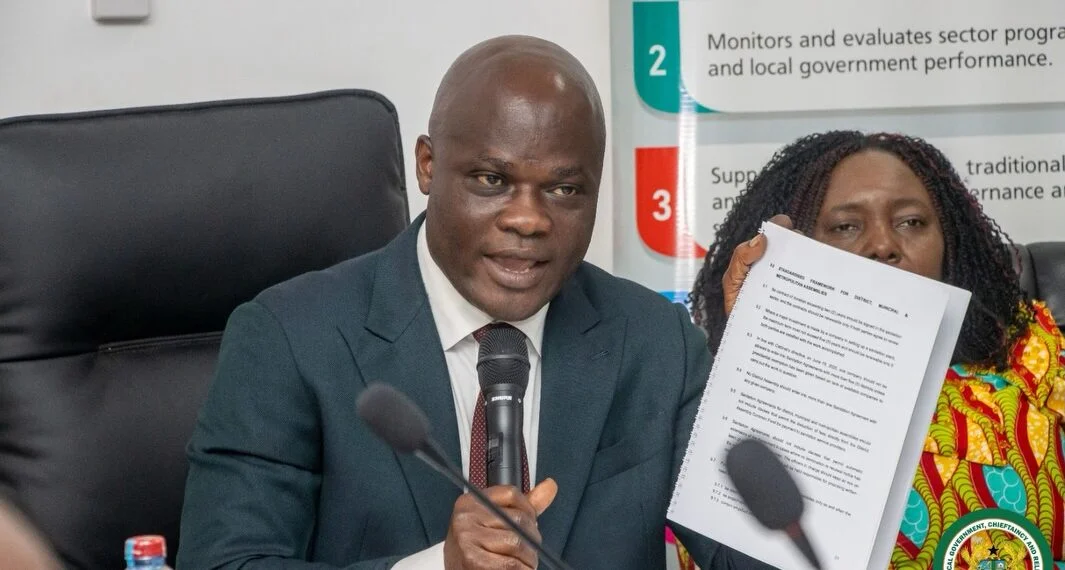
The Minister for Local Government, Chieftaincy and Religious Affairs, Hon. Ahmed Ibrahim, announced the measures while outlining government’s renewed resolve to address persistent sanitation challenges across the country.
According to him, sanitation can no longer be treated as a peripheral issue or a matter of public education alone, but as a core governance responsibility with clear consequences for failure.
He warned that MMDCEs who fail to ensure acceptable sanitation standards would face administrative sanctions, stressing that performance on sanitation would be closely monitored at the highest level of government.
Hon. Ibrahim explained that the new directives represent a deliberate policy shift, informed by years of weak enforcement and fragmented responsibility at the local level.

He noted that while public awareness campaigns have improved general understanding of sanitation, they have not translated into sustained behavioural change or cleaner communities. Under the new framework, enforcement mechanisms will be strengthened, institutions retooled, and local authorities given clearer mandates to act decisively.
A central feature of the new sanitation regime is the recruitment of dedicated sanitation guards by all Metropolitan, Municipal and District Assemblies. These guards will be responsible for monitoring public spaces, enforcing sanitation by-laws, and ensuring compliance with waste management regulations.
The minister said the presence of uniformed enforcement officers at the community level would serve as both a deterrent and a practical tool for improving cleanliness in markets, transport terminals, and residential areas.
Complementing this measure is the establishment of specialised sanitation courts to expedite the prosecution of sanitation offenders. These courts are expected to handle sanitation-related cases swiftly, reducing the delays that often undermine enforcement efforts.
Government officials believe that faster adjudication will reinforce the seriousness of sanitation offences and restore public confidence in the enforcement process.

The directives also introduce a daily clearance mandate, requiring assemblies to ensure that all markets, ceremonial streets, and major bus terminals are cleared of visible filth by 8:00 a.m. each day.
This requirement reflects concerns about the public health risks associated with early-morning congestion in poorly maintained public spaces, especially in urban centers. Assemblies will be expected to deploy sanitation personnel and logistics early enough to meet this daily benchmark.
In addition, the long-dormant National Sanitation Day is set to be relaunched as a legally backed monthly exercise. The cleanup will take place on the first Saturday of every month and will now carry statutory force rather than relying solely on voluntary participation.
The minister said the relaunch is intended to restore discipline to communal sanitation activities and reinforce the shared responsibility between citizens and local authorities.
Under the new rules, citizens and shop owners will also bear direct legal responsibility for cleaning the gutters and immediate surroundings in front of their properties.
Failure to maintain these frontages will attract sanctions, a measure aimed at addressing the widespread practice of shifting responsibility entirely onto local authorities. Hon. Ibrahim stressed that sanitation is a shared obligation and that personal responsibility must complement state enforcement.

Perhaps the most consequential aspect of the new regime is the introduction of sanitation performance benchmarking for MMDCEs. Cleanliness levels within districts will now serve as a key performance indicator, influencing assessments of administrative effectiveness.
Persistent failure to meet sanitation standards could lead to sanctions or removal from office, a development that underscores the political weight now attached to sanitation outcomes.
Beyond enforcement, the government is also implementing structural reforms to strengthen sanitation institutions. Environmental Health and Sanitation Units within assemblies are being upgraded into full departments, a move designed to improve their operational capacity, staffing, and authority.
This change is expected to enhance coordination and elevate sanitation within local government decision-making structures. Plans are also underway to decentralize the national sanitation budget, giving districts more direct control over waste management resources.
According to the minister, this will reduce bureaucratic delays and allow assemblies to respond more effectively to local sanitation needs. In addition, a new sanitation league table will be introduced to rank districts based on cleanliness.
High-performing districts will be recognised and rewarded, while underperforming ones will face public scrutiny and corrective action. The new enforcement regime builds on a broader reset of the sanitation sector initiated by President John Dramani Mahama in June 2025.
At the time, the president announced that government would not renew the long-standing sanitation contract between the Youth Employment Agency and Zoomlion Ghana Limited. The contract, which had run for 19 years, reached its natural conclusion and was discontinued rather than terminated prematurely.
That decision followed a formal petition by investigative journalist Manasseh Azure Awuni, who raised concerns about mismanagement and corruption associated with the arrangement.
In response, President Mahama ordered a comprehensive audit of all payments made to Zoomlion after the original contract expiry, with instructions to recover any unauthorised disbursements.
The government also announced a new policy direction under which future sanitation contracts would be awarded through competitive regional or district-based bidding, replacing the single national contract model.

Officials say the savings from this restructuring will be used to improve conditions for sanitation workers, particularly street sweepers. The government has indicated plans to increase the fees paid to sweepers to levels that reflect a more liveable income, addressing long-standing concerns about low remuneration in the sector.
Taken together, the new sanitation enforcement directives and the restructuring of sanitation contracts signal a more assertive role for the state in safeguarding environmental health. Hon. Ahmed Ibrahim described the reforms as necessary to protect public health, strengthen local governance, and restore discipline in waste management.
As the rollout approaches in early 2026, attention will turn to how effectively assemblies implement the directives and whether the promised enforcement translates into cleaner communities nationwide.