
Read also:
- EU Launches Probe into Grok AI Chatbot Over Explicit Imagery Concerns
- $214m GoldBod-BoG Loss Amounts to Financial Loss to State – Minority
- IMF Crowns Ghana Cedi Africa’s Best
- John Dumelo pledges improved pedestrian safety after UniMAC student’s death on N1
- DVLA plans specialized healthcare facility for drivers amid public debate
Els MBN360 News
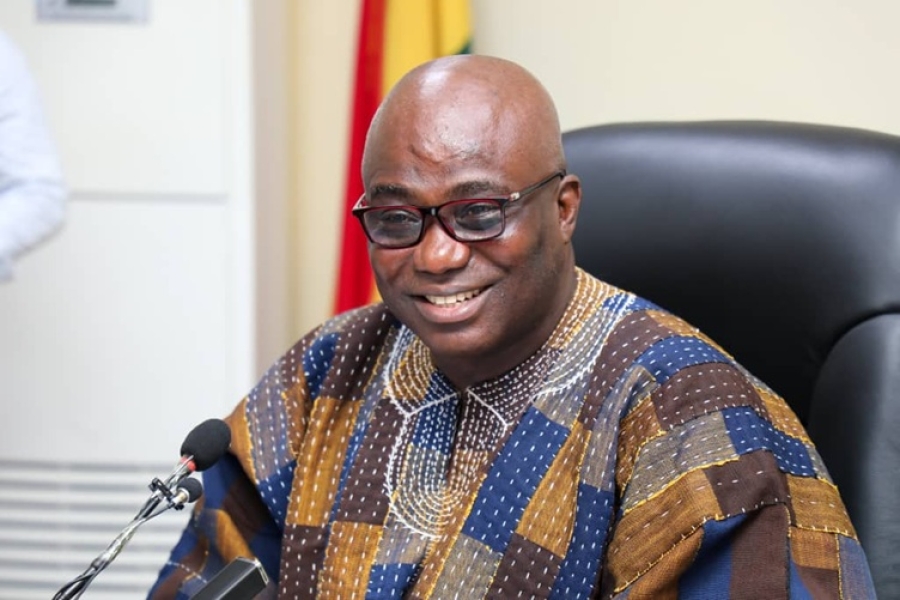
he Minister of Food and Agriculture, Hon. Eric Opoku, has delivered a firm assurance to the farming communities of Asutsuare that the “modernization” of Ghana’s premier irrigation scheme is back on the priority list, during a high-stakes working visit to the Kpong Irrigation Scheme (KIS).
The Minister confronted the reality of a project that is 75 per cent complete but currently dormant due to financial bottlenecks. The $22.5 million World Bank-funded project is the crown jewel of the “Feed Ghana” agenda, and Hon. Opoku noted that the government is moving with urgency to bridge the final 25 per cent gap.
“I have received about four certificates asking for payments and I have forwarded them to the Ministry of Finance for immediate action within the shortest possible time. Payment will be effected, and the work will resume on site.
“Kpong happens to be the biggest irrigation infrastructure in Ghana, and equally worthy of our attention. Government will do everything possible to ensure the timely completion of the project to transition Ghana from rain-fed to all year-round irrigation agriculture”Hon. Eric Opoku, Minister of Food and Agriculture

Hon. Opoku confirmed that his direct intervention for payments is designed to revitalize a scheme that covers 4,040 hectares and serves as the lifeblood for thousands of rice and banana farmers in the Greater Accra and Eastern Regions. He also noted that the rehabilitation is being implemented under the West Africa Food System Resilience Project (FSRP).
The technical scope of the project, was explained by Ghana Irrigation Development Authority’s Technical Supervising Consultant, Mr. Kofi Modzaka, as a masterpiece of modern agricultural engineering.
According to Mr. Modzaka, the “rehabilitation” is actually a radical modernization, involving the conversion of 62 kilometers of open, wasteful earth canals into high-efficiency closed pipe systems.
While the civil works on these pipelines are nearly complete at 96 per cent, the critical “automation and instrumentation,” phase – which will allow for precision water management – is currently lagging at 30 per cent due to the global logistics of specialized equipment.
Beyond the pipes, the Hon. Opoku announced the approval of two new Farmer Service Centres for the Left and Right Banks of the Kpong scheme. These hubs are designed to be one-stop shops where smallholders can access precision agriculture tools, heavy machinery, and technical training.
Breaking the Rice Glut
However, the most pressing concern came from the farmers themselves.
Charles Tetteh Hombey, President of the Kpong Irrigation Scheme Water Users Association, painted a sobering picture of “unsold produce,” and mounting loan defaults. For the farmers at Asutsuare, the ability to grow rice is no longer the issue – it is the ability to sell it, as the current glut has left many producers stranded with high-quality paddy but no off-takers.
Minister Opoku responded with a major policy directive involving the National Food Buffer Stock Company (NAFCO). He revealed that resources have been released to NAFCO to partner with local millers and aggregators to mop up the excess rice.
This intervention is intended to restore farmer confidence and ensure that the increased yields from the $22.5 million irrigation investment do not go to waste. To further ease the movement of produce, the Minister pledged an excavator to support the scheme’s daily operations.
“We acknowledge that lack of reliable markets has discouraged production despite increased output.
“We are also including the Kpong road network in our plan to rehabilitate 1,000 kilometres of agricultural roads nationwide. Functional irrigation systems and reliable road networks are critical to national food security, especially in the face of climate variability”Hon. Eric Opoku, Minister of Food and Agriculture

This holistic approach – combining water, machinery, roads, and markets – is what the Ministry believes will finally secure Ghana’s food sovereignty.