Els: MBN360 Business
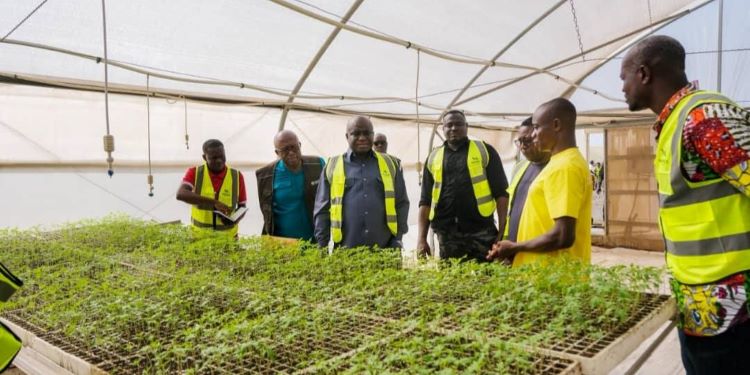
The Ministry of Food and Agriculture (MoFA) has initiated a direct field-level intervention to address the ongoing volatility in the domestic vegetable market, with the Sector Minister, Hon. Eric Opoku, leading a delegation of technical experts to the production facilities of Maphlix – a prominent local agribusiness specializing in both greenhouse and open-field tomato cultivation.
This “instituted field interaction,” signifies a move away from high-level policy discussions toward a practical assessment of Ghana’s internal production capacity, as the nation grapples with an impasse in the local tomato supply chain with Burkina Faso.
The Minister noted he is vetting high-performing private enterprises to determine if their models can be scaled to achieve national self-sufficiency.
“I led a team of technical experts to engage with the leadership of Maphlix tomato production. Maphlix is a local greenhouse tomato producer that also operates various open-field production sites in Accra. Their leadership team provided a briefing on their current production, which exceeds 3000 tonnes, supplemented by their open-field operations”Hon. Eric Opoku, Minister for Food and Agriculture
Hon. Opoku noted that this volume is significant in the context of the current market deficit, which has seen prices fluctuate due to over-reliance on cross-border imports. By auditing the Maphlix facility, the Minister signaled that the government is prioritizing robust and sustainable cultivation methods to stabilize the agricultural sector.
The audit focused heavily on the viability of the specific tomato species cultivated at the facility, noting how one of the primary challenges in the Ghanaian tomato sector has been the short shelf-life and low pest resistance of traditional varieties.

According to the Minister, the species utilized by Maphlix are positioned favorably for both human consumption and long-distance transport – a critical factor for a crop that often rots before reaching urban retail centers.
Hon. Opoku noted that the Ministry’s interest in these varieties is geared toward standardized seed distribution and technical support for farmers who adopt these high-yielding strains. Furthermore, he hinted at the synergy between greenhouse and open-field operations providing a roadmap for year-round production.
While open-field farming remains vulnerable to the erratic rainfall patterns of 2026, the greenhouse component at Maphlix ensures a “base load,” of supply that remains unaffected by climatic shifts.
The Minister’s engagement with this hybrid model was indicative of heavier investment in irrigation and controlled-environment infrastructure to decouple food security from weather dependency in the very near future.
Resolving the Impasse
For much of early 2026, in light of the Burkina Faso ban, the local tomato market has been caught between rising production costs and the high price of imported substitutes.
Read also:
- Apologise over galamsey claims or face lawsuit — Dame to Kwakye Ofosu
- Mahama Signs 5 Key Bills Into Law, Reforms Security, Education, and Finance
- Kejetia Market on Fire: Traders Cry Foul Over Safety Concerns
- PAC: GH¢21m spent on Black Star Square for 67th Independence Day despite venue change
- Sports Ministry rejects feeding contracts for 2026 World Cup
Following the Agriculture Minister’s pledge to salvage the situation, this field interaction was purely about gathering the data necessary to finalize a sustainable plan that addresses these structural challenges – to move from reactive crisis management to a proactive strategy that supports local “Agri-Champions,” like Maphlix.

For MoFA, addressing the supply gap requires more than just increased tonnage; it requires a reorganization of the value chain. The Ministry’s technical experts are reportedly looking into how the Maphlix production model can be integrated into the national distribution network to reduce “middleman friction.”
If the government can facilitate direct off-take agreements between high-capacity local producers and major retail hubs, the resulting price stability would provide immediate relief to households across the country.
“I wish to reiterate with confidence that sustainable plans are well underway to address current challenges, and the impasse in local tomato supply will be resolved in the near future”Hon. Eric Opoku, Minister for Food and Agriculture
Minister Opoku’s confidence is rooted in the technical expertise that accompanied him during the audit. This data-driven approach is a departure from previous years where agricultural interventions were often politically motivated rather than scientifically sound.
The focus on “environmental sustainability” also aligns with the broader ECOWAS and AfCFTA goals of promoting green agriculture. Through ensuring that local production is not only high-volume but also resource-efficient, Ghana is positioning its agribusiness sector for long-term resilience.
As the Ministry prepares to roll out the next phase of its agricultural stabilization plan, the Maphlix interaction serves as a proof of concept, demonstrating that with the right combination of technology, scientific oversight, and private-sector leadership, the domestic supply gap can be closed.

The visit to Maphlix is a clear indicator that the Ministry of Food and Agriculture is taking a hands-on approach to the 2026 food security crisis – identifying and supporting local producers who can deliver high-quality, scientifically vetted crops.
The success of these interventions will ultimately be measured by the price and availability of tomatoes in the local markets.
However, the technical audit of Maphlix provides a strong signal that the government is no longer content with stop-gap measures, with a renewed focus on scale, science, and sustainability.